Coral rescue work gathers pace on Weizhou Island









As a strong gust of wind hit the Beibu Gulf in the South China Sea, Huang Wen and other "coral sitters" waited anxiously for the sea to calm.
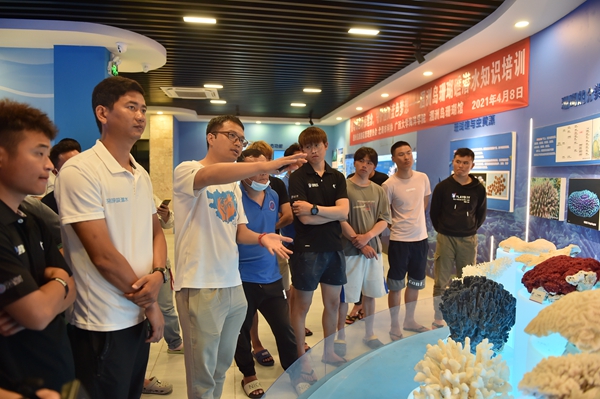
The team composed of researchers from a coral reef research center in Guangxi University, South China's Guangxi Zhuang autonomous region, and local diving instructors, needed to get in the water as soon as possible since the coral reefs had taken a beating.
"The undersea coral reefs have been protecting us, as well as the island by blunting the storm's destructive power," says Huang, 33, a researcher on coral reefs with the center. "Now it's our turn to protect them."
China observed Earth Day on April 22. Scientists have estimated that coral reefs on the planet could be extinct by 2100.
While global warming, typhoons and human activities such as fishery and industrial pollution have largely threatened the existence of coral reefs, Huang and other team members are racing against time for their rescue on Weizhou Island of the Beibu Gulf.
When broken coral rolls around and gets buried in the sand, it soon dies. But coral pieces can still be saved if they are fastened back onto either natural reefs or artificial reefs placed on the seafloor.
"The more days that pass, the less chance they have of survival," Huang says. "Some pieces of coral may need to be repaired in our laboratory, instead of being fastened directly back onto reefs."
Coral reef, known as the underwater Great Wall, protects the coast by cushioning the intensity of sea waves. According to figures, the survival of about one-third of the world's fish species relies on coral reefs.
As someone who majored in aquaculture, Huang knew better than others about the importance of coral reefs for marine biodiversity, a major reason for him to work on coral protection.
After acquiring his doctorate from the Institute of Oceanology, Chinese Academy of Sciences, Huang joined the coral reef research center of Guangxi University in 2015, one year after the center was established.
Over the past seven years, the team has placed more than 100 artificial reefs under the sea to act as coral nurseries. Strains of coral covering over 2,000 square meters of sea area have been rescued.
Huang spends about a quarter of a year on the island. Inspired by his work, Huang's 3-year-old and 5-year-old daughters enjoy playing on the beach as well, retrieving coral remains washed ashore by sea waves.
According to official data, the coverage rate of living corals in Weizhou Island's marine ranch has dropped from some 80 percent to 8 percent over the past 30 years. Apart from the damage caused by typhoons and surges, global warming is another cause of the death of corals.
"Each strain of coral is as precious as any other lives on Earth so they deserve a better living environment and being treated with dignity as living organisms," Huang says.
Zheng Tingyu, another team member, says to avoid touching the corals, they could not stand on the seafloor, but stayed suspended in water while doing the rescue work.
With their efforts, more than 10,000 strains of coral pulled through the toughest time last year and survived. Many once broken strains have grown from 10 to 30 centimeters.
The ecological benefits are visible. Since coral provides marine organisms with places to rest, hide, live and breed, the number of fish in the area with artificial reefs underneath is several times higher than that of neighboring areas without reefs.
Guangxi University has fostered more than 70 postgraduates engaged in coral reef protection. Huang, who is now also a postgraduate supervisor, says he is glad to see young students join them in protecting the coral.