



Hebei reports solid progress as it tackles 'big three' tasks
City cluster, Olympics preparation, Xiong'an New Area construction all making headway









Editor's note: This year, the Communist Party of China is celebrating the 100th anniversary of its founding. China Daily is publishing a series of stories looking at the tremendous changes that have occurred in provinces, autonomous regions and municipalities under the leadership of the Party. They also include stories of the people and places that have left indelible marks in the Party's path to glory.
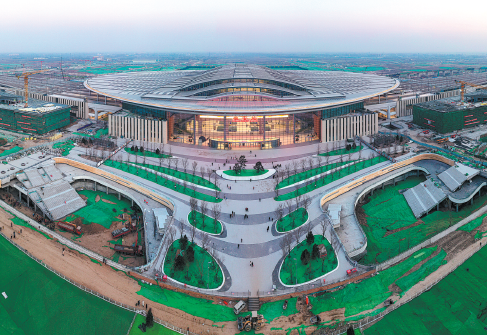
Three tasks that dominated the agenda of North China's Hebei province over the past few years have made remarkable headway, said Wang Dongfeng, secretary of the Hebei Provincial Committee of the Communist Party of China.
He was referring to the coordinated development of the Beijing-Tianjin-Hebei city cluster, preparations for the 2022 Winter Olympic Games and the construction of the Xiong'an New Area.
Progress on the bulk of these tasks is expected to continue over the coming years, he told Xinhua News Agency.
As part of the push to integrate the city cluster, Wang said breakthroughs were made in areas ranging from industrial transference to transportation connectivity during the 13th Five-Year Plan period (2016-20).
More than 20,000 corporations moved from Beijing and Tianjin into the province, which encircles the Chinese capital and the wealthy port city, and bullet train services were established over the period, he said.
The high-speed railways include one between the provincial capital Shijiazhuang and Tianjin, and another linking Beijing with Xiong'an, which sits at the center of the city cluster.
The Beijing-Xiong'an train service has halved the time for one-way travel between the cities to less than an hour.
Wang noted that machines have roared to life at about 300 construction sites in Xiong'an, and "significant progress "has been made in flood prevention, transportation and education projects there since the city was set up in 2017.
"The construction of Xiong'an New Area has forged ahead with efficiency, and the landscape is dotted by cranes and construction sites," Wang said.
In the run-up to the second Olympic Games to be held in China, more than 70 sports venues and other facilities have been completed, and an additional high-voltage electricity transmission project was also completed as part of event preparations, he noted.
Moreover, the provincial government said it has signed up 32 hotels and 19 health institutions, and it has recruited 14,000 volunteers as part of the effort to boost logistics services.
The preparations are concurrent with the growth of the "ice and snow economy", which has been ballooning since Zhangjiakou, a prefecture-level city in northwestern Hebei, won the bid to host the games together with Beijing six years ago.
More than 22 million people in the province have participated in winter sports since then, official figures showed.
"The achievements are encouraging," Wang said.
In a major boost to the three tasks, central government authorities greenlighted a free-trade zone in the province in 2019.
In an interview with the People's Daily, Wang said the zone has bolstered the province's opening-up, has injected momentum into its economic growth and has become a milestone in its modernization process.
During the 13th Five-Year Plan, Hebei made efforts to adjust its industrial structure, which experts and officials said was too "heavy".
Provincial government figures showed that its steel capacity dropped to less than 200 million metric tons over the period, compared with the peak of more than 320 million tons in 2011.
Meanwhile, the number of high-tech firms topped 9,000, almost tripling the level in 2017, and the number of small and medium-sized tech firms reached 85,000.
The last five years have also seen the proportion of the added value of the third industry-the service and technology sectors-surpass that of the secondary industry-manufacturing-for the first time and by the end of last year, a telltale sign of progress in the sweeping structural reforms.
The gap widened to 14 percentage points, further cementing the strength of the third industry.
The past five years were also greener, with the energy consumed per unit of GDP growth falling 21 percent during that period, the provincial government said.
More than 132,000 polluting factories were shut down, and about 11 million families benefited from sweeping coal-to-gas or coal-to-electricity projects.
The average concentration of PM2.5-inhalable particulate matter with a diameter of 2.5 micrometers or less that is considered a health hazard-plummeted 50 percent during the period compared with its 2013 levels, it added.
This year marked the start of the 14th Five-Year Plan period (2021-25), and Wang said his administration will continue to push forward with the three tasks and build the province into an innovation powerhouse with a more "self-reliant" supply chain and a stronger pool of consumers.
It will also proceed with the opening-up of its coastal areas near the Bohai Gulf, he added.
Hebei had more than 2.3 million impoverished residents in 2016 and managed to lift them all out of absolute poverty last year as part of a national effort to eliminate poverty ahead of the Communist Party of China's centenary this year.
The provincial government said the per capita disposable income has jumped from about 18,000 yuan ($2,774) to 27,000 yuan over the past five years, and government funding to support people's livelihoods stayed above 80 percent during the previous five-year plan period.
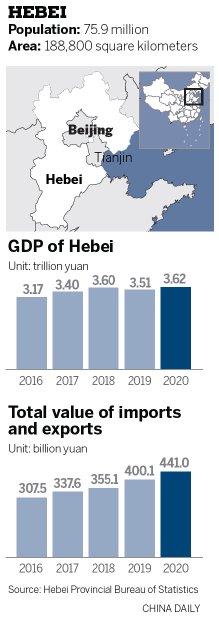
In the face of the COVID-19 pandemic last year, the province also managed to achieve an annual growth rate of 3.9 percent, above the national average of 2.3 percent, it added.


- Consumer rights protection disputes in new business models surge in Guangzhou
- French vloggers explore highland scenery and Tibetan culture in Yunnan
- Village in Jiangxi gives 100,000 yuan bonus to residents turning 100
- World's leading lab service provider opens China headquarters in Wuxi
- 'Ride to spring' becomes a major tourist attraction in Chongqing
- Lawmakers with disabilities advocate AI and robotics to improve lives





