The perfect place to prepare for a revolution









Conditions in early 20th century Shanghai helped lay the ground for change and the foundation of New China
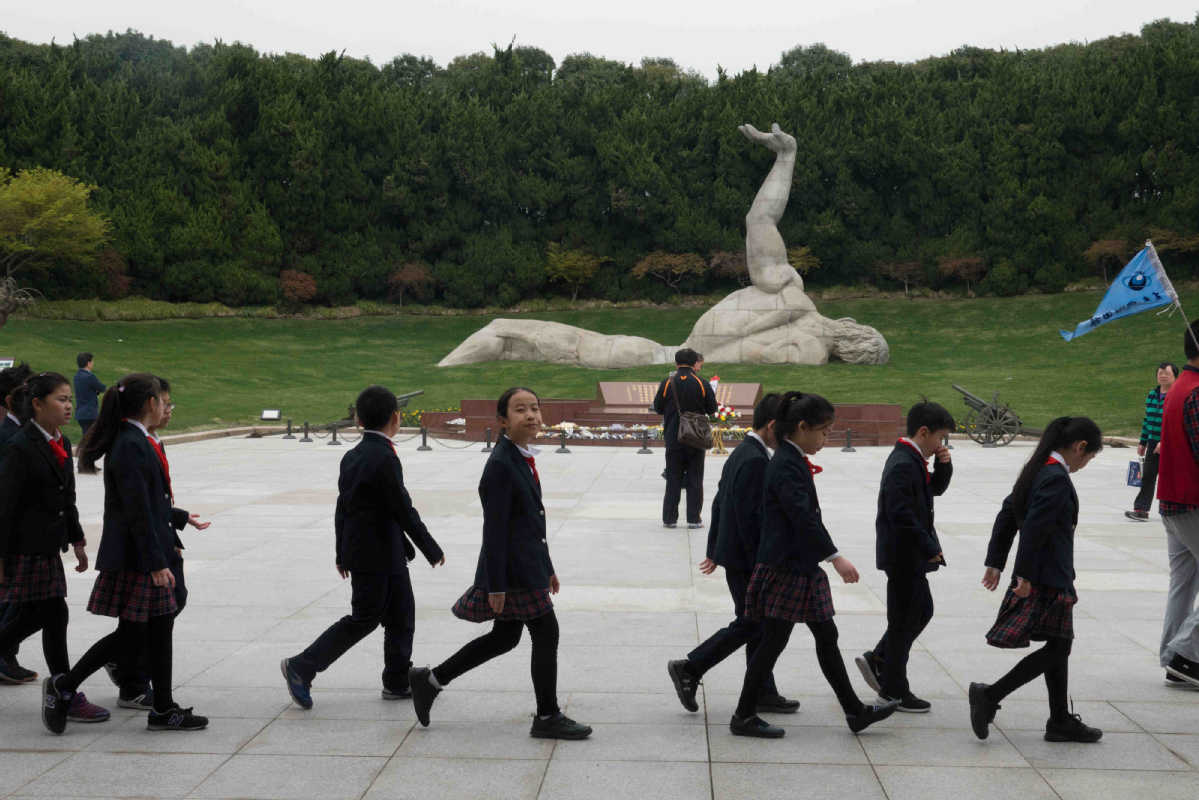
Wrapping a red scarf around his neck, 10-year-old Li Shiran stood in front of a two-story shikumen building-a traditional style featuring Western and Chinese elements-in downtown Shanghai's Xintiandi area and explained the site's history.
"The house behind me is the place that hosted the First National Congress of the Communist Party of China," said Li, as his father filmed the process.
Like many of his youthful peers, Li, a member of the Young Pioneers of China, the CPC's children's wing, has been busy putting together a school project to commemorate the 100th anniversary of the CPC's founding.
The meeting started on July 23, 1921, when 13 delegates from across the country, including future leader Mao Zedong and two representatives from the Communist International organization, gathered at the building for a historic event-the first national congress-and proclaimed the birth of the Party. The meeting was later forced to relocate to Nanhu Lake in Jiaxing, Zhejiang province.
A century later, the CPC is the world's largest political party, with more than 90 million members.
Every year, hundreds of thousands of people like Li and his family members travel to Shanghai to visit numerous sites related to the Party's early activities.
"Shanghai holds a unique place in the Party's history and has played a crucial role in its development. Like Yan'an (Shaanxi province) and Jinggangshan Mountain (Jiangxi province), Shanghai is a sacred place of the revolution," said Zhao Yingang, director of the Party history research department at the Shanghai Administration Institute.
Scholars agree that in the early 20th century, Shanghai had three factors that made it the ideal place for the birth of the Party: it had a large population of "new working class"; it was the center of foreign thought and culture in China; and the city's "foreign concessions" promoted a relatively tolerant political environment. As one of the first open ports in China, Shanghai was the country's most populous city in the 1920s. Of its more than 2 million people, a quarter were workers, according to research by Su Zhiliang, a history professor at Shanghai Normal University.
"Spurred by foreign and national investment, the emergence of modern industries in Shanghai had formed the new working class in China and thus laid the foundations of the future communist revolution," Su said.
During the anti-imperialist May Fourth Movement in 1919, when news of government arrests of patriotic students in Beijing spread to Shanghai, more than 180,000 workers from different sectors, such as cotton mills, steel plants and transportation, went on strike to show their support for the students.
"The collective power of the working class impressed many intellectuals at that time, including Chen Duxiu, one of the CPC's founders, who returned to Shanghai in 1920 to promote Marxism among workers through speeches and publications," Su said.
Gateway
From the late Qing Dynasty (1644-1911), Shanghai had been a gateway for Western culture and thought.
The earliest instance of Marxism being promoted in the city can be found in an 1899 article in Wan Kuo Kung Pao, a monthly magazine, which introduced different socialist schools in Europe, according to Xiong Yuezhi, vice-president of the Association of Chinese Historians.
In his paper on Shanghai's unique resources for the communist revolution, Xiong said that more than 75 percent of new publications in China from the late 19th century to the early 20th century were published in the city.
"The translations of almost all the important Marxist works, including The Communist Manifesto and Das Kapital, were first published in Shanghai," he said.
In addition to the growing working class and the spread of communist ideas, the foreign concessions in Shanghai, which were outside the control of the warlord-led Beiyang government (1912-28) of the Republic of China, provided room for political organizations to flourish.
As a modern metropolis situated at the mouth of the Yangtze River and on the west coast of the Pacific Ocean, Shanghai's geographical advantages also contributed to the CPC's early development.
"After its birth in 1921, the Party's central committee was located in Shanghai for 12 years and held three national congresses in the city. One of the important reasons for this was the city's unique location," said Liu Tong, a professor of modern Chinese history at Shanghai Jiao Tong University.
Today, Shanghai continues to be a pioneer in the country's reform and opening-up process.
Many people consider the site of the CPC's first congress to be the spiritual home that has spurred the development of Shanghai and the rest of the country.
Zhou Yunhua, 80, recently visited the site with his grandson.
"I have been a Party member for 47 years," he said. "While our country has achieved great success under the Party's leadership in the past century, I want to tell the younger generation about the miracles that were forged through difficulties. The road ahead is still long. Striving forward is the only way to go."



- Former Hainan official sentenced in bribery case
- Hangzhou residents enjoy rare snowfall
- Artificial reefs part of successful marine conservation efforts in Guangdong
- Zigong lantern festival combines cultural heritage with advanced technology
- Woman executed for abusing and killing stepdaughter
- Zhangjiakou academy students hit Olympic ski slopes as winter break begins