Chinese vaccine maker aims to increase global markets









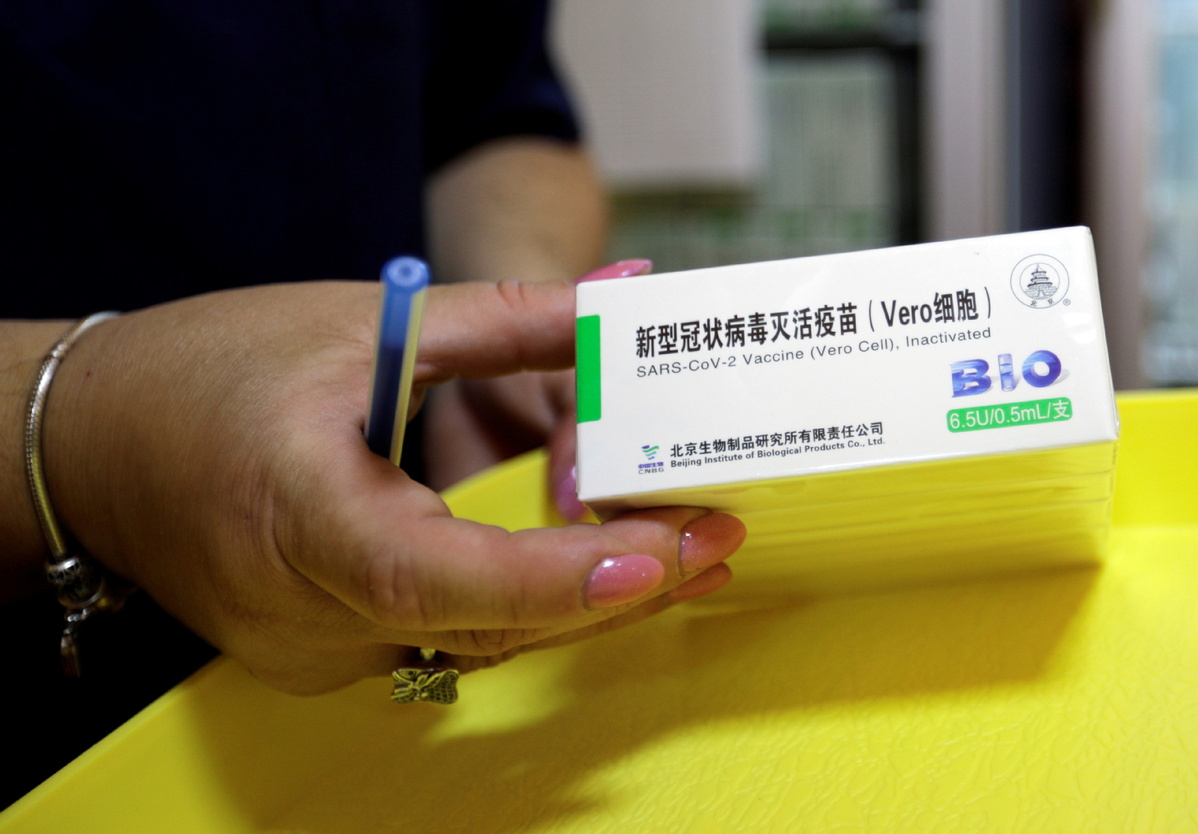
China National Biotech Group, a subsidiary of pharmaceutical giant Sinopharm, has made unprecedented forays into the global vaccine market amid the COVID-19 pandemic, said Zhang Yuntao, vice-president of the company.
The World Health Organization's authorization of one of its vaccines for emergency use and granting of a highly valued European Union certificate are expected to further expand the company's international reach, he said.
Zhang said the group will deliver vaccines to more foreign countries in the future in accordance with those nations' laws and regulations, especially during or after the second half of this year.
"As we are ramping up production capacity and the domestic immunization program is gaining momentum in key cities and among the population, more vaccines can be allocated for export," said Zhang, who is also chief scientist at CNBG.
Two of the four domestic COVID-19 vaccines approved for public use in China were developed by researchers from CNBG.
As of late May, it had supplied vaccines to more than 70 countries and international organizations, and over 100 countries across the world had made procurement requests, according to the company.
Before the novel coronavirus outbreak, the rollout of CNBG's vaccines overseas, including those to combat poliovirus and yellow fever, was mainly concentrated in Southeast Asian countries, such as Thailand, Malaysia and Indonesia, and in Africa.
While these longtime partners are among dozens of countries that have granted some form of regulatory approval to Chinese COVID-19 vaccines, new frontiers in Asia, South America and Eastern Europe represented breakthroughs on expanding the company's reach, Zhang said.
"The company's scientific research has always been a global endeavor and the total output has been massive. But the scope of our sales and distribution in the past has been relatively limited," he said.
As its COVID-19 vaccines are forging paths in previously uncharted territories, including Serbia, Kyrgyzstan and Argentina, Zhang said the company's global presence and influence have escalated.
Global approvals
On May 7, the CNBG achieved a milestone when the WHO announced it had granted "emergency use listing" to a COVID-19 vaccine made by the company's Beijing Institute of Biological Products, paving the way for accelerating access to doses in less-developed countries.
The approval streamlines procurement of vaccines by global organizations. The vaccine from the Beijing-based institute was the sixth COVID-19 vaccine, and the first Chinese-made one, to receive WHO approval.
"Achieving EUL means that our products qualify to be purchased by a number of international organizations, such as the COVAX program, the Gavi Alliance (the Global Alliance for Vaccines and Immunization) and United Nations agencies like UNICEF," Zhang said, adding that the WHO approval opens up much wider distribution.
On June 1, the first batch of its vaccines to be supplied to COVAX, a WHO-led initiative for equitable global access to coronavirus vaccines, rolled off the production line, according to the company.
"We got positive feedback from an on-site inspection conducted in January, the materials we submitted were of high quality and our communication with the WHO's Strategic Advisory Group of Experts on Immunization has been consistent, which all boosted our confidence," he said.
On April 1, another breakthrough was made when Hungarian drug regulators issued a certificate of Good Manufacturing Practice to CNBG's Beijing vaccine. It is the first time that this type of license, which acknowledges a producer's compliance with quality standards, was granted by a European Union member state to a Chinese vaccine company, according to CNBG.
"The certification from the EU regulatory authorities is one of the hardest to earn in the world due to their stringent appraisals," Zhang said.
With the new certificate in hand and an emergency use approval given to the vaccine by Hungarian authorities in late January, CNBG is one step closer to tapping into the European market, he said. The company will proceed with follow-up procedures, such as applying for registration, in order to land their products in the European market.
Underpinning the progress of the company are decades of technological advances, the commitment of researchers and employees and strong support from the government.
Zhang represented CNBG twice during online sessions convened by the WHO to appraise the safety and efficacy of its vaccine. About 250 global experts raised questions during the sessions.
"It took one CNBG unit in Sichuan province eight years to obtain an EUL for the treatment of the Japanese encephalitis virus. This time, we aimed to achieve the same goal in a short period. The workload had surged at an astronomical rate," he said.
"The science and logic behind our products are in alignment with global standards. That's why we are winning increasing recognition from the international community."
In order to meet the expected increase in global demand for Chinese vaccines, Zhang said, CNBG is preparing to scale up its production capacity.
The company is aiming to boost its annual output to 3 billion doses by the end of this year.
Besides CNBG's institutes in Beijing and Wuhan, Hubei province, which each developed a COVID-19 vaccine, four other institutes administered by the company have been mobilized to produce and package vaccines.
Zhang said CNBG plans to build a global packaging and logistics network. A joint venture is already underway in the United Arab Emirates, which will see raw material provided by CNBG and production completed in the UAE.
"Our goal has always been and will continue to be striking a balance between domestic and global supplies," Zhang said.


- 10 dead and 84 injured in explosion at steel plant
- China unveils flexible urban planning rules to improve lives, foster new industries
- Ex–China Construction Bank executive gets 18 years for bribery, loan violations
- First batch of eco-friendly pioneer zones for construction of beautiful countryside unveiled
- Woodpeckers, finches captured in Jilin winter scenes
- Mainland reiterates 1992 Consensus as foundation for resuming cross-Strait dialogue