Corner grocer just a click or two away









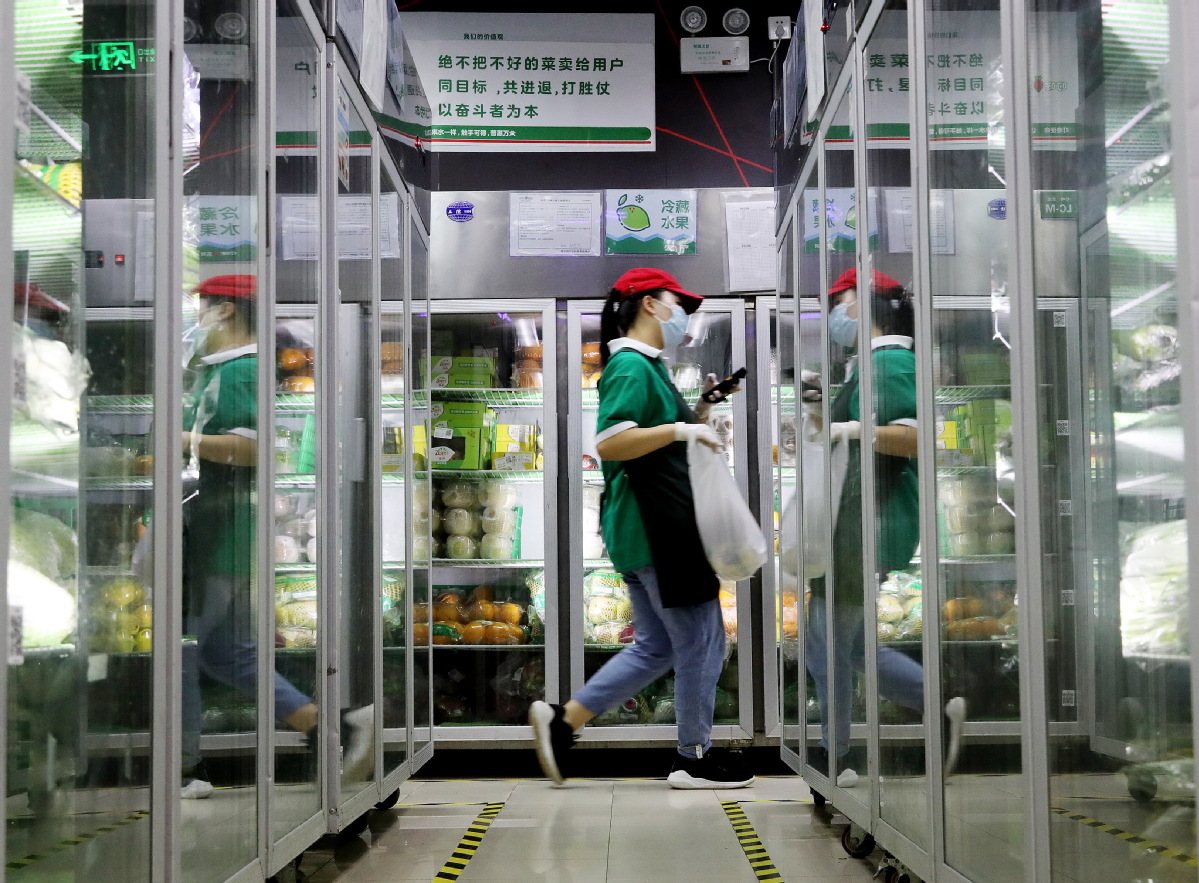
It was within weeks of the initial outbreak of the COVID-19 pandemic that millions of Chinese made drastic changes to the way they purchased fresh food. Instead of heading to supermarkets, online e-commerce platforms have become more attractive options for many.
Now, more and more consumers are increasingly getting used to searching for fresh fruits and vegetables online, quickly placing orders and snatching "red envelopes" to receive discounts.
"Before the outbreak, people only bought fresh vegetables, fruits and certain other foods online. But now they are buying everything online, including rice, flowers and many other items. This will have a long-lasting effect on the country's fresh food sector," said Wang Jun, chief finance officer at online fresh food startup MissFresh.
According to iResearch, sales revenue of the country's fresh food e-commerce market hit 458.5 billion yuan ($71.36 billion) last year, up 64 percent year-on-year.
Official data showed that a group of medium-sized and large e-commerce platforms were delivering over 160,000 daily orders in Wuhan, Hubei province, in late February last year when the contagion was in full force.
Most of the deliveries at the time were contactless, meaning that packages were delivered to designated locations to avoid person-to-person interactions. A number of cities used intelligent lockers situated outside residential areas and communities to better manage risks.
Wang Zhibin, a researcher at the National Engineering Laboratory for Logistics Information Technology, said, "Though most consumers are choosing contactless deliveries to reduce risks and remain safe, they will get into the habit of using such services long term along with an increasing number of intelligent lockers and other infrastructure being built in the future."
Benefiting from the rapid growth, fresh-food delivery firms have seen great momentum in the past year. MissFresh and Dingdong Maicai have recently been vying to raise funds via IPOs on United States bourses.
MissFresh, backed by tech giant Tencent Holdings, plans to raise funds from the Nasdaq through a listing of its American depositary shares. The company is likely to raise $500 million to $1 billion from the share sale, Bloomberg said.
Dingdong Maicai plans to list its shares on the New York Stock Exchange, according to its filing. The Shanghai-based e-grocer is backed by investors like Sequoia Capital and Tiger Global Management.
Established in 2014, Miss-Fresh has created front-end warehouse deliveries through which it can offer fresh food deliveries from its 631 warehouses across 16 cities. Front-end warehouses refer to small stations located close to residential neighborhoods, which help realize speedy deliveries.
Wang Peng, an associate professor at the Hillhouse Research Institute, Renmin University of China, said: "Fresh food is a trillion-yuan scale market and also a high-frequency portal for online community retail. Capabilities based on digital and supply chains will become the only underlying driving factor for sustained and healthy growth, and also act as the core competitive barrier in the future."
MissFresh is the market leader in China in terms of gross merchandise volume in the nation's on-demand warehouse retailing industry, said a recent iResearch report.
The company said in December that it had raised 2 billion yuan ($305.6 million) of strategic investment from a Qingdao government fund while Dingdong Maicai raised $330 million in the recent fundraising led by SoftBank Vision Fund.
However, Wang added that many companies in the fresh food e-commerce sector also face bottlenecks in being profitable over the long term. "Unlike other business models for group purchases, which are able to generate steady cash flows, building front-end warehouses is an expensive proposition," he said.