



Why commodity prices will likely decline









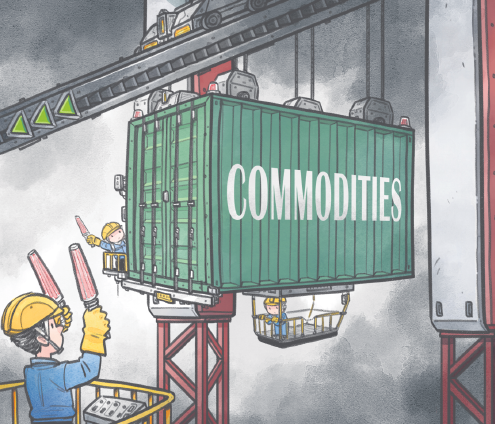
Considering that the downward trend of the global economy has not yet changed in the medium and long term, I expect to see a significant decline in commodity prices by the end of this year.
The global economy was in a mild downward cycle before the COVID-19 pandemic. Because of the pandemic, supply of commodities cannot meet demand, thus leading to a decrease in inventory. Therefore, the latest round of commodity price hikes is mainly caused by restocking, which will not last long.
As the long-term downward trend of the global economy will not reverse after the pandemic, this round of rise in commodity prices will likely be brief but huge, and we have already entered the late period of price hikes. It is unlikely that we are witnessing the start of a new supercycle of commodities.
On the demand side, China's demand for commodities has not largely increased during this round of economic rebound. Its infrastructure investment growth is below market expectations, and the government repeatedly stressed the principle that "housing is for living in, not for speculation". As China is a major consumer of commodities in the world, there is no strong demand to drive up commodity prices.
In the United States, Joe Biden's $2.3 trillion infrastructure plan is likely to be scaled back, rather than being fully realized, considering that it is facing resistance from Republicans. Besides, infrastructure construction may take eight or nine years. If we break down the US demand for infrastructure, we will find that the annual growth is actually not too much.
Under these circumstances, investors are speculating on the US demand for commodities, while the expectations are not backed by real demand.
As the COVID-19 pandemic will not last forever, the supply of commodities will recover sooner or later. Neither the supply side nor the demand side will support a continuous commodities rally.
Apart from supply and demand, another factor that will affect commodity prices is liquidity, which is the most difficult to predict among the three factors.
Unlike the economic stimulus package, which was mainly backed by monetary policy, introduced by the US during the 2008 global financial crisis, the US responded to COVID-19 with both fiscal and monetary policy measures.
Starting in March 2020, the US provided economic impact payments of up to $1,200 per adult for eligible individuals and $500 per qualifying child under age 17, to increase the spending power of the residents. Its expansionary fiscal policy pushed up inflation.
Household consumption in China, on the contrary, is still fairly weak at the current stage, although the country has a better economic recovery than other countries. It shows that not all countries are carrying out an expansionary fiscal policy.
What is hard to predict is market expectations. The more the investors expect to see commodity price hikes, the stronger the speculative atmosphere. In addition, people expect that the supply of commodities will shrink, as China pledged that it would peak its carbon dioxide emissions by 2030 and achieve carbon neutrality by 2060.
We need to increase supply to change the market expectations. In this way, it is possible that the rise in commodity prices will come to an end.
Some commodity analysts said although China is the world's largest consumer of certain types of commodities, it lacks commodity pricing power, so the prices will inevitably increase under speculation.
However, if the prospect of the downstream supply chain remains gloomy, it may put too much cost pressure on businesses, lead to bankruptcies and affect the improvement of household incomes.
If it is difficult to increase household incomes, and if effective demand is inadequate in the downstream supply chain, commodity price hikes will show signs of weakness. We will eventually see a decline in commodity prices, which will return to their fundamental values, but there is a time-lag effect.
In my view, China does not have to worry about inflation but needs to strengthen commodity price controls.
Ever since the United States announced the suspension of the dollar's convertibility into gold in 1971, effectively bringing the Bretton Woods system to an end, many central banks have over-issued currencies to inject money into the economy.
A larger part of the over-issued currencies flowed into assets, rather than commodities, thus triggering asset bubbles to a greater degree, instead of causing inflation.
Currently, commodity prices have rebounded from record lows reached during the pandemic. The sharp rise exceeds market expectations, and there is not much room for further increase. So I don't expect to see a round of continuous or large commodity price hikes.
From my observation, in the past, there was a strong correlation between China's inflation and GDP growth rate. None of the huge inflation occurred when GDP growth slowed down. It is mainly because China is the world's largest manufacturing country, so we don't need to worry too much about insufficient supply of most commodities.
Having said that, I still hope the Chinese government will take more measures to rein in commodity price surges, to safeguard small and medium-sized enterprises and stabilize employment, for commodity price increases usually have negative effects on SMEs and businesses in the midstream and downstream supply chain. I want to make three suggestions in this regard:
First, in the context of China's carbon goals, and amid a huge trend of commodity price hikes, local governments and central State-owned enterprises can appropriately increase supply of commodities and slow down the progress with the long-term carbon neutrality goal, while focusing on accomplishing the emissions peaking target in the near future, so as to change market expectations.
Policymakers should put greater emphasis on using macroeconomic policies to control the expectation for price increases and should take measures accordingly to reduce the shocks. If we further shrink supply of commodities, it obviously won't be good for stabilizing China's economy and commodity prices.
Second, China's monetary policy should remain stable. It is unnecessary to tighten monetary policy due to commodity price hikes because monetary policy, which has long-term goals, is not a contingency measure, whereas the price increases are temporary.
Third, China should improve the international status of the renminbi.
During the COVID-19 outbreak, the US adopted an expansionary monetary policy and exploited the advantage of the US dollar's dominance to issue Treasury securities, thus raising money to provide economic impact payments for eligible individuals, with the aim of boosting the US economy.
Only if China raises the international status of the renminbi can it offset part of the negative impact of this kind of measures taken by the US, which collects seigniorage from other countries.
The views don't necessarily reflect those of China Daily.
The writer is chief economist and head of Zhongtai Securities Co Ltd's research institute.



















