Always young at heart









Japanese scholar and longtime China hand, Kazuteru Saionji, says the success of the Communist Party of China and the development of the nation rest on the shoulders of its youth, Wang Xu reports in Tokyo.
The ability to follow the tides of change and modernization, as well as ensuring that new generations take up the unfinished work of the last and carry it further, are the main characteristics and appeal of the Communist Party of China's leadership, according to Japanese scholar and longtime China hand Kazuteru Saionji.
"If one takes a closer look at the CPC's history, it is not hard to find out that one of the attractions of the Chinese Communist Party is that the successors of the revolution will appear one after another and carry out their missions from time to time," says Saionji, a visiting professor of Higashi Nippon International University who spent his youth in China before the normalization of China-Japan diplomatic relations.
Born into the inner circle of the Japanese emperor's court, Saionjithen 16 years old-moved to Beijing in 1958 with his father Kinkazu Saionji, a former Japanese lawmaker who promoted friendly relations between China and Japan as a "private ambassador" and was on friendly terms with then-premier Zhou Enlai. He is also the great-grandson of Kinmochi Saionji, one of the most influential political figures in modern Japan.
Kazuteru Saionji lived in Beijing until 1967, when he graduated from Peking University and returned to Japan.
Conduit to understanding
In the 1950s, when direct government ties between China and Japan was a distant prospect, Zhou already had an important place for Japan in his strategic vision. At that time, Zhou started cultivating ties with Japanese people from all walks of life, both inside and outside politics, which later became known as the "promoting government relations via people-to-people exchange policy".
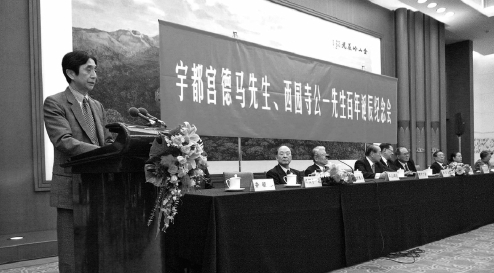
In 1958, Zhou established the groundwork for his Japan policy by cultivating "pipes", a direct personal connection between two people of importance from both the Chinese and Japanese sides. The practice later proved to be highly effective, both before and after the 1972 rapprochement of the two countries. One of those "pipes" from the Japanese side was Kazuteru Saionji's father Kinkazu Saionji, and on the other end, the Chinese side, was Liao Chengzhi (1908-83), who had grown up in Japan and was fluent in Japanese.
It was his aristocratic background that gave Kazuteru Saionji an opportunity to have close contact with the first generation of leaders of the CPC, such as Mao Zedong, Zhou Enlai, Deng Xiaoping and Xi Zhongxun. His years in Beijing also made Kazuteru Saionji a perfect witness to China's development and the normalization of Sino-Japanese ties.
"When I lived in Beijing during my teenage years, I was lucky to have the opportunity to meet with the first generation of CPC leaders and their simple way of life impressed me a lot," says Kazuteru Saionji.
"To my understanding, it could be said that the lives of all of them were, in so many ways, exceptional but surprisingly, they all chose to lead a life as simple as that of much of the general public."
According to Kazuteru Saionji, the perfect example of this was the "model" couple of Zhou Enlai and Deng Yingchao (1904-92), with whom he was very familiar and two people for which he has great admiration.
"At that time, I referred to Deng as 'Deng Mama'," says Kazuteru Saionji, adding that he was inspired by their spirit of "working for the nation and the people".
"They had no personal interest at all and they were very friendly in the way they treated people. Before the 'cultural revolution' (1966-76), I had many opportunities to visit their house. They both wore old cotton clothes and left you with a sense of intimacy," Kazuteru Saionji adds.
He remembers vividly that Zhou told him to make many good friends in China.
"'You're going to live in, and enter a school in, Beijing,' Zhou told me, adding that 'you should make many good friends and they will not only be your great property in the future, but also will be a valuable property for China and Japan'."
Kazuteru Saionji says through his interactions with Zhou, he was surprised to learn that Zhou knew a lot about Japan and he also got the first clue how the CPC could transform China from an isolated agricultural society into the world's second-largest open economy.
In fact, many of the early members of the CPC studied in Japan. Zhou went to study in Japan in 1917 at the age of 19, when the country was a gateway to new ideas from the West and a place where various social trends were forming.
In her book, The Origins of Contemporary Sino-Japanese Relations, Mayumi Itoh claims that Zhou received his enlightenment in Marxism in Japan, and his time in the country gave him a profound understanding of Japanese people and society.
By presenting a comprehensive examination of primary sources, including diaries and letters of Zhou, Itoh writes, "The formative experiences of Zhou in Japan became the foundation for post-war Chinese foreign policy toward Japan and the origins of contemporary Sino-Japanese relations."
Itoh's conclusion could be partly proved by a restored monument dedicated to Zhou in Kyoto's Arashiyama Park.
A poem, Arashiyama in the Rain by Zhou is engraved in the stone monument, in which he wrote:
A ray of light peeked through the clouds
The more I looked upon this beauty-
The realities of the human world
The more I want, the more confused I become-
In the confusion I suddenly chanced upon this point of light
The more I truly sensed its beauty.
The poem was written by Zhou before leaving Kyoto in 1919 to return to China, and it is widely believed that the "point of light" was a metaphor of the idea of socialism and Marxism, with which the young man had just come into contact.
"It is the faith of pursuing the 'light' to save China from total destruction by imperial powers, and the faith to seek fulfillment for the Chinese people and rejuvenation of the Chinese nation that made Zhou and many other CPC members devote their lives to the revolution," Kazuteru Saionji says.
"Their faith was tested again and again to produce a Party with unbreakable perseverance and it is people like Zhou, as much as everyone in the CPC's history, that brought China a little bit closer to today's prosperity," he adds.