



Veteran composer recognized for revolutionary composition









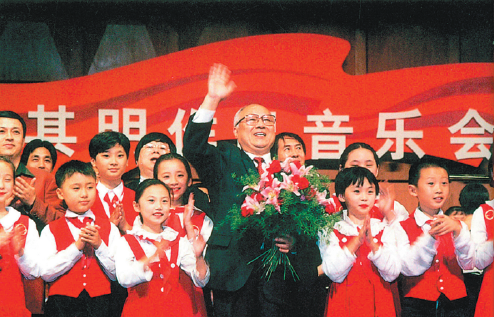
Singing the nation's glories has been 91-year-old musician's lifelong quest
Lyu Qiming vividly remembers the day in 1965 when he was commissioned to compose the Ode to the Red Flag.
A young composer at the Shanghai Film Studio at the time, the then 35-year-old Lyu had risen to fame for the soundtrack he'd composed for the popular Chinese movie, The Railway Guerrillas, just under a decade earlier in 1956.
Ode to the Red Flag was the name chosen for the piece by well-known conductor Huang Yijun (1915-95) and was due to be premiered during the 1965 Shanghai Spring festival, China's longest lived music festival, which was founded in 1960 and later renamed the Shanghai Spring International Music Festival.
"It was a huge and challenging task for me then. I spent months working on it," recalled the now 91-year-old Lyu. "Ode to the Red Flag portrays the exciting scene when the national flag was first raised on Tian'anmen Square during the founding of the country in 1949. Many people sacrificed their lives for that to happen and the piece pays tribute to the revolutionary martyrs."
Lyu borrowed musical elements from China's national anthem, March of the Volunteers, which was composed by Nie Er, with lyrics by poet Tian Han. He also included elements of Chinese folk songs.

In May 1965, Ode to the Red Flag, conducted by Chen Chuanxi (1916-2012), was performed by three Shanghai-based symphony orchestras at the opening ceremony of the 6th Shanghai Spring festival-the Shanghai Symphony Orchestra, the Shanghai Film Orchestra and the Shanghai Wind Ensemble.
The composition won wide applause at its premiere and has continued to do so ever since. Ode to the Red Flag has been adapted on multiple occasions and has been performed by Chinese symphony orchestras around the world, receiving a warm response from audiences of different generations.
On the occasion of the 100th anniversary of the Communist Party of China, Lyu, who became a Party member in 1945 at age 15, was awarded the July 1 Medal, the highest honor given by the CPC Central Committee. It's the first time that the medal is being awarded to outstanding Party members and is part of this year's centenary celebrations.
As is Ode to the Red Flag. This year, the piece has been revived by a number of Chinese symphony orchestras to mark the centenary.
During a concert on April 29 at the Shangyin Opera House for the 37th Shanghai Spring International Music Festival, it was performed by the Shanghai Philharmonic Orchestra, conducted by Zhang Yi. The concert featured several of Lyu's classic pieces.
At the end of the concert, Lyu came on stage and spoke excitedly to the audience. "My work is inspired by the country's achievements and development, as well as by the Chinese people, who work hard to contribute to the country. I am proud that my compositions are well-received by audiences of different ages. The greatest wish of any composer is for their music to be enjoyed by as many listeners as possible, and the longevity of a piece matters most," he said. "I am glad that Ode to the Red Flag is one such piece."
Born in Wuwei county in Anhui province, Lyu had a tough childhood. He lived with his family and anti-Japanese troops at the New Fourth Army base in southern Anhui.
His father, Lyu Huisheng, who was a Party member, was arrested and killed by the Japanese in 1945 at age 43. Ode to the Red Flag also expresses Lyu's love for his father.
At the age 12, he met He Luting (1903-91), a musician who encouraged him to learn the violin. After joining the Party, Lyu performed in the military art troupe.
He arrived in Shanghai along with the army the day before the city was liberated on May 27, 1949, and has lived there since.
In 1949, he became a violinist at the Shanghai Film Studio, and in 1951, he started to compose.
Many of his pieces feature in movie soundtracks and are patriotic and revolutionary. Between 1959 and 1964, Lyu studied composition and conducting at the Shanghai Conservatory of Music.
The productive composer has written music for 200 movies and TV dramas, among them Sentinel Under the Neon Lights (1964), Romance on Lushan Mountain (1980), and Jiao Yulu (1990). One of his most famous compositions is a song entitled Playing My Beloved Pipa, which was made famous by the 1956 movie, The Railway Guerrillas.
The song, which riffs on the folk songs of Shandong province, reflects the optimism and positive spirits of soldiers during a time of war.
"I've seen with my own eyes those lovely soldiers who, despite their struggles, were full of passion and confidence," the composer said.
He retired in 1990, but not even that has slowed him down.
In 1997, Lyu was commissioned to compose music for the Yuhuatai Scenic Area in Nanjing, Jiangsu province, which is known for tourist attractions that preserve the stories of the revolutionary martyrs. The 60-minute composition, which is divided into 15 chapters, has been played at Yuhuatai since 1999.
When the novel coronavirus hit last year, Lyu wrote a new piece entitled Caprice Norman Bethune in the Jin-Cha-Ji Base Area, which was based on the soundtrack he composed for the 1965 movie about a well-known Canadian thoracic surgeon who served as a doctor for the Chinese guerrilla army during World War II. He dedicated the new composition to medical workers fighting against the pandemic worldwide.
"I wrote many pieces for movies, which enabled me to tell stories through music. Music is a great way of doing that, and a way to deliver messages directly to the heart. The stories I tell with my work are about the country and its people, which I am proud of," he said.





