Young Chinese: Confident in themselves and their country










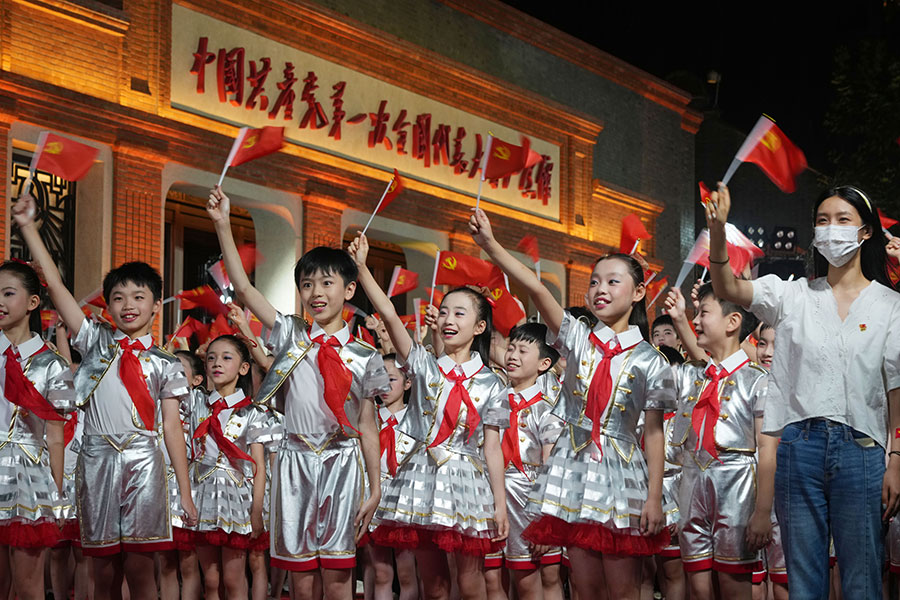
A 'red' generation
Young Chinese are strongly patriotic – this is not an exaggeration fabricated by the government.
According to a survey of nearly 20,000 people across China conducted in April 2020 by Cary Wu , a sociology professor at York University in Canada, Chinese citizens had become more trusting in all levels of government since the COVID-19 outbreak, with more than 90 percent of respondents saying they were satisfied with how China's national leaders managed the outbreak. Another poll in May that year, conducted by the China Data Lab at UC San Diego's School of Global Policy and Strategy, also showed an increase in public trust of the state.
Young people in China are willing to serve their country because they believe it represents the public interest.

These youngsters played a key role in China's fight against the outbreak. Among the more than 42,000 medical workers from across the country who rushed to Hubei province, more than 12,000 were born in the 1990s, with many born after 1995, or even after 2000. In addition, thousands more young people joined the fight on construction sites, in communities and factories or by guaranteeing transportation.
"It seemed as if people's true colors were suddenly revealed," said Hua Yuchen, who was praised as the "most beautiful volunteer" during the epidemic response. She thinks their true color is "Chinese Red," or patriotic.
This post-1990s teacher was one of the first people in Wuhan to volunteer their services after the outbreak. She drove from home to offer volunteer work, unloading cases of disinfectant each weighing 25 kg, and broadcasting news and music to patients at a makeshift hospital.
In 2018, Liu Zhongwen, who then worked at a government agency in Beijing, went to a village in neighboring Hebei province hundreds of kilometers away to serve as its First Party Secretary and head the working team dispatched to station at the village to carry out targeted poverty alleviation.
This is a typical village in northern China. In the past it had the largest number of impoverished people among all villages in the county, and farming provided the only source of income for the villagers.
Answering the nationwide call, the 34-year-old came to the village with his guitar and created tailored plans to boost their income so as to help lift them out of poverty as soon as possible.
In little more than two years, he has led villagers to build roads, establish poverty-relief workshops and set up a computer classroom and a water tower for the local elementary school. He has also taught them how to sell produce online via livestreaming.
In his spare time, he composed a song expressing that although he feels sorry for his family, he is living up to the expectations of a youth in his duties.
There are more than one million young people like Liu in China, who go to rural areas to help with poverty relief. On top of that, hundreds of thousands of university graduates have served as "leaders" in the countryside, while almost 400,000 young people have volunteered their services, providing educational, medical or other public services in the rural areas.
They make the choice of their own will, just like their parents' generation did decades ago, bringing much-needed knowledge, skills and connections with more-developed areas.
Thanks to their efforts, and those of China as a whole, nearly 99 million rural residents have shaken off poverty. By February 2021, as a country with a population of 1.4 billion, China had lifted all of its people out of absolute poverty by current standards.
The countryside is the cradle of the Communist Party of China. Despite being founded in Shanghai, the most prosperous city in China at the time, the CPC has always listened attentively to farmers and won the Chinese revolution with their help.
Nowadays, a growing number of young Chinese are revisiting this period of history – not via textbooks or in the classroom, but by traveling to revolutionary sites.
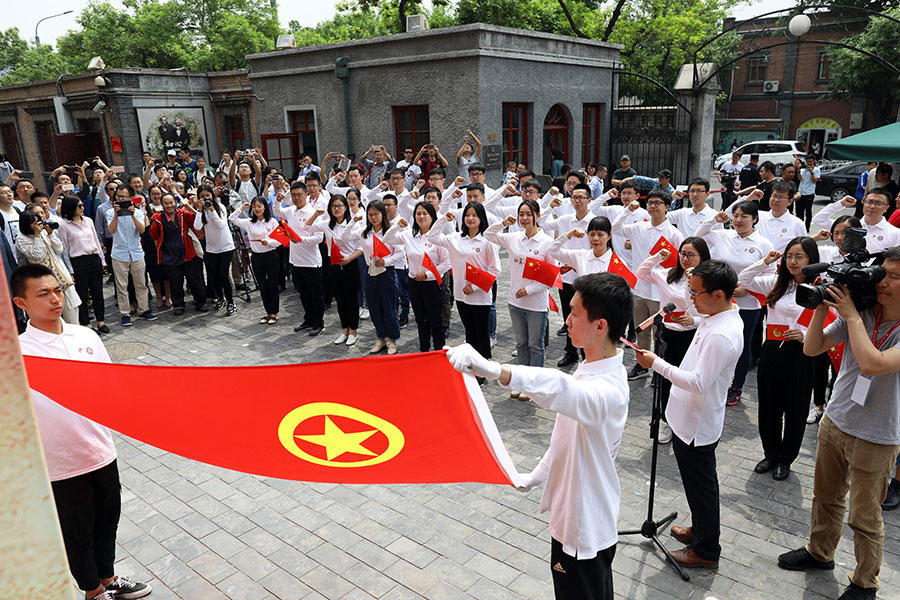
Known as "red tourism," such trips are becoming increasingly popular in China. In 2019, more than 73 million tourists visited Yan'an, a former headquarters of the CPC, nearly double the number from three years earlier. During the May Day holiday in 2021, visitors aged 21-30 accounted for 40 percent of bookings and searches for "red tourism", according to Tongcheng-Elong, an online travel agency.
Films and television series about China's revolutionary history have also proven extremely popular.
One example is the recent hit TV series, The Age of Awakening, which examines the founding of the CPC. Actors from the series also appeared on the streets of Shanghai and interacted with residents. Dressed as the revolutionary heroes and martyrs they played in the series, they had conversations with the young people of today.
When asked about their favorite way to learn about the history of the CPC and the country, 70.2 percent of the respondents chose "watching movies, TV series, documentaries and performances," according to an April survey. Additionally, 74.7 percent believed it could help young people better understand China's present situation and develop a strong sense of mission by studying the history of the Party and the country.
"Young people nowadays are more proud and confident and identify more strongly with our nation and country," Zhang Yiwen, a young woman from Southwest China's Sichuan province, told CNN. "They want to learn how China grew from a poor country to what it is today."
Chinese people are good at drawing wisdom and strength from history. The country has perhaps the most detailed historical records in the world, and its cultural heritage allows young people today to read documents unearthed thousands of years ago with relative ease.
History lives on in the lives of the Chinese people: The Old Summer Palace, in the northwest of Beijing, was a large imperial garden built during the Qing Dynasty (1644-1911) which was sacked and burned down by British and French troops in 1860. Today it has been turned into a memorial site, and like the Memorial Hall of the Victims in Nanjing Massacre, the silent ruins are a reminder of China's experience of colonial oppression since 1840.
Some Western scholars worry these historical narratives will fuel nationalism, although such thinking does not correspond to the reality in China. China is more familiar with the concept of a diverse and inclusive culture of "tianxia" – or "all under heaven."
The Chinese people attach great importance to introspection and reflection, and greatly admire the Confucian concepts of "cultivating one's morality, regulating one's family, governing the country and pursuing world peace," rather than embarking on foreign wars and expanding territory.
The Chinese people have a natural aversion to military expeditions, as typified by the line from a poem: "Few men return from their faraway expeditions ."
Chinese philosophy stresses "equilibrium" and "harmony," which is expressed by ordinary people in the saying "amiability begets riches."
These idioms show traditional culture retains a strong vitality in today's China. Generations of Chinese have been brought up under this gentle and silent influence, and Gen Z is no exception.