Rural dwellings stand as proud legacies in Fujian
Ancestral homes of Hakka people fuel tourism influx









Defensive features
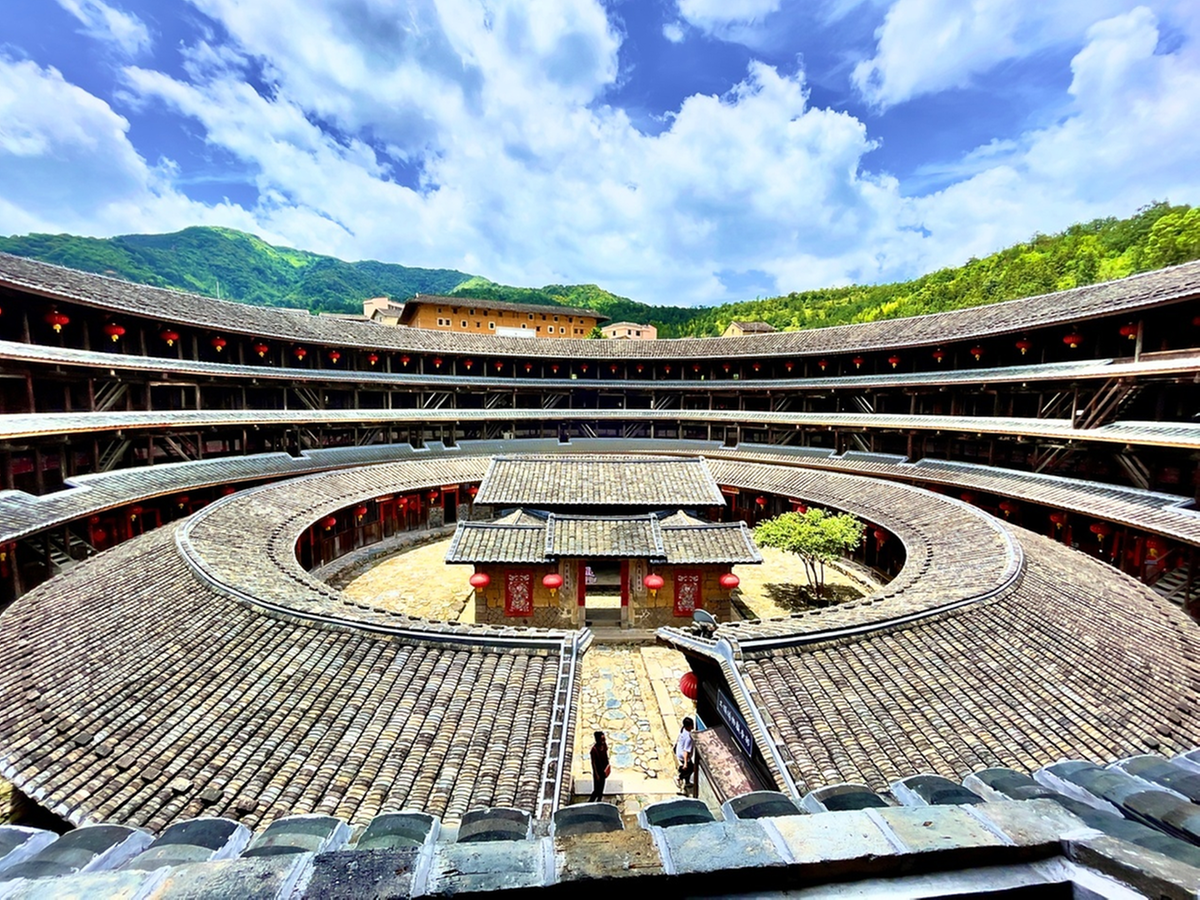
Throughout history, tulou residents have mostly been Hakka-migrants in southern China who originated from lands adjoining the Yellow River. Population pressures created conflict between the Hakka and their neighbors, so they built their homes to double as fortifications.
The buildings are mainly four or five stories high. The first floor serves as the kitchen, the second is used for grain storage and the upper floors act as living areas.
The structures are mainly symmetrical, and their defensive features include ironclad gates, escape tunnels, slits for weapons under the dark-tiled roofs, and a water well. Because of their defensive function, only rooms on the third floor and higher have windows, which are very small. With sufficient food, the residents could survive in the event of a lengthy conflict.
Despite being similar in design, each tulou is unique. Every structure essentially doubles as a self-contained village. While the tulou are now open to the public, some are still occupied by residents, most of them from the same family clan.
Communal living is integral to these villages, where the closed-wall design fosters social interaction. Although individual families have their own areas in tulou, residents gather in the courtyard for ceremonies such as ancestor worship and weddings.
After visiting the Fujian tulou in 1999, Neville Agnew, principal project specialist at the Getty Conservation Institute in Los Angeles, said, "This is the most beautiful folk architecture I have seen in harmony with the surrounding environment."
Due to rapid economic growth, locals' livelihoods have greatly improved and many of them have bought modern homes in neighboring cities, resulting in a significant decline of tulou occupants in the past two decades.
Today, the structures that once housed hundreds of people are now home only to two dozen permanent residents, most of them elderly.
For the locals who grew up in tulou, the structures are just normal houses, but through his conversations with visitors, Lin came to realize that each of the structures is an extraordinary piece of architecture.
"What surprised me most is that people were really interested in our communal lifestyle as well as our Hakka culture. They thought it incredible that so many people could live together in harmony," he said.
As tourist numbers soared, Lin sensed a business opportunity. He gave up farming to enter the tourism industry in the late 1990s, working as a guide for visitors.
Lin is proud to tell stories about the tulou. Visitors are impressed by his passionate explanations of the buildings. He makes notes of visitors' comments so that he can improve his skills as a tour guide. After years of making these notes, he has put together a series of tour commentaries that are used by other guides in Yongding.
He tells visitors that, according to an old story, satellite images of tulou once worried some countries, as they thought the giant mushroom-like structures resembled nuclear shelters, and feared they were the site of a Chinese missile base. "This story still raises a laugh among visitors," Lin said.
The tourism boom has brought drastic changes to him and his family in all aspects of life, Lin said, adding that the legal protection and proper development of cultural and architectural legacy has been guided by the local government.
When President Xi Jinping worked in Fujian in various posts from 1985 to 2002, he attached great importance to heritage protection. As urbanization developed in the 1990s, some areas of the province were found to have placed economic growth first, without considering the conservation of historical and cultural relics, along with environmental protection.
In 2002, when he was governor of Fujian, Xi wrote an article about protecting ancient buildings in Fuzhou, the provincial capital, in which he said properly safeguarding such structures and relics serves to preserve the history and culture of a city.
He underlined the need for local officials to attach equal importance to environmental protection and to safeguarding relics and economic development, saying, "Developing the economy is a leader's important responsibility, so is protecting ancient buildings, traditional streets and lanes, and cultural relics. Both are equally important."
Since he became general secretary of the Communist Party of China Central Committee in 2012, Xi has issued numerous instructions on protecting cultural and historical relics in order to retain cultural roots and safeguard the nation's soul.
He also considers the proper development and use of cultural and historical legacies to be important. "We need to bring all collections in our museums, all heritage structures across our lands and all records in our classics to life," Xi said in a speech while visiting the UNESCO headquarters in Paris in March, 2014.
In July, 2018, Xi presided over the third meeting of the Central Committee for Deepening Overall Reform, at which a guideline on strengthening reform for the protection and use of cultural relics was approved.




- Tianjin launches youth program to cultivate university talent for tech market
- Local farmers combat desertification in Moyu county of Xinjiang
- N China's Hohhot launches winter amusement programs to boost local economy
- Viral app bares 'safety anxiety' among solo dwellers
- Research suggests causes of moon's two different 'faces'
- AI software under lens for facilitating porn talk