



The world's a stage for veteran actor
Household name awarded in recognition of contributions to modern Chinese theater









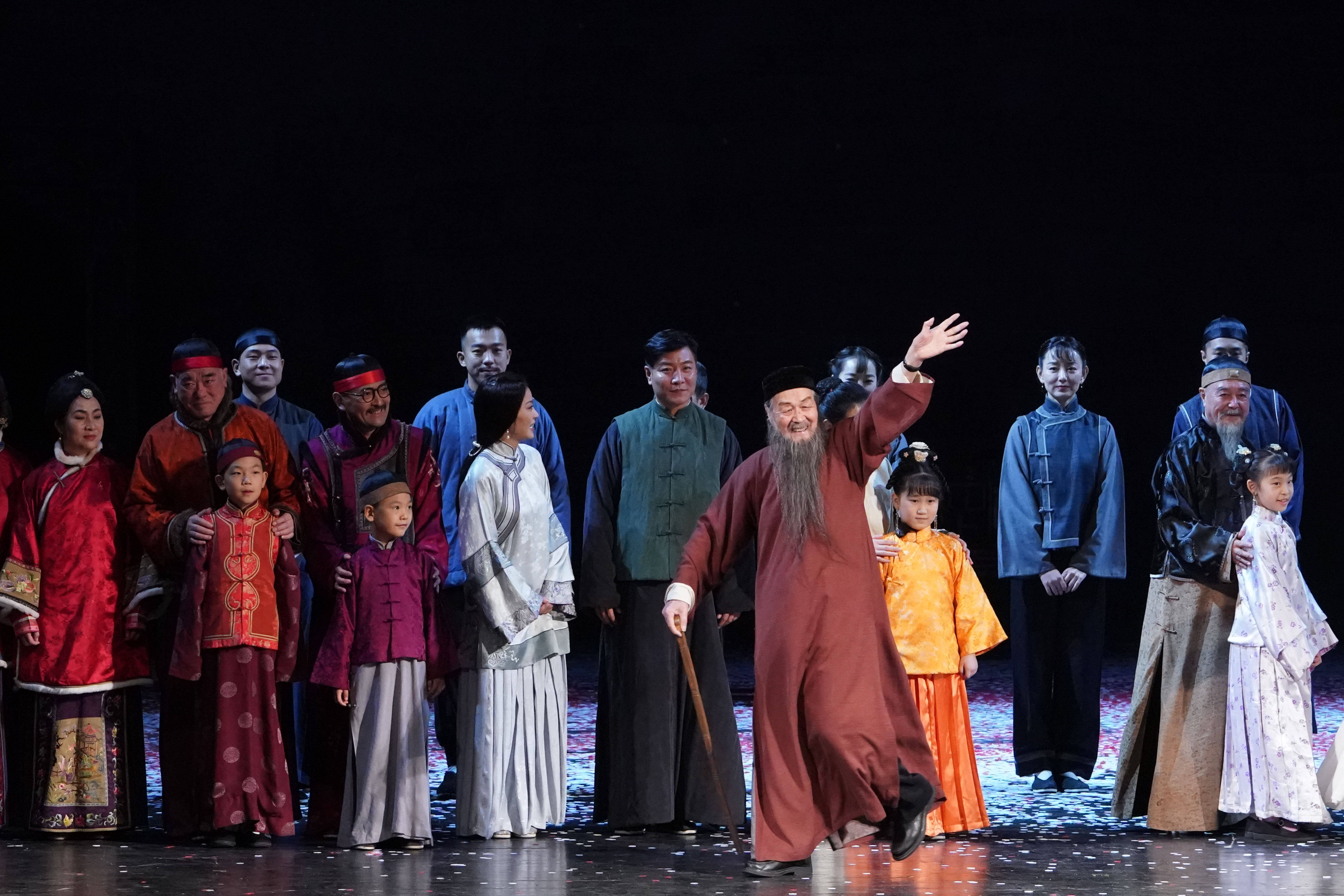
As an actor and director, he is a household name in China. His career spans seven decades and even now, age 94, he remains active in the theater, leaving many in awe of his longevity.
Lan Tianye, who is known for his many roles in movies and TV dramas as well as theater, joined the Communist Party of China on Sept 23, 1945.
It's a date he says he remembers as clearly as his birthday. He was 18 years old at the time.
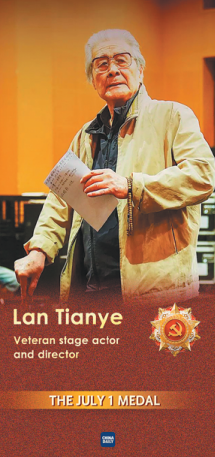
In recognition of his achievements and contributions to the country's performing arts scene, he is among those being awarded the July 1 Medal for outstanding Party members, the highest honor given by the CPC Central Committee. The medal is being conferred for the first time this year as part of the founding centenary celebrations of the CPC.
Born in Raoyang, a county in Hengshui, Hebei province, on May 4, 1927, Lan, whose real name is Wang Runsen, moved to Beijing the same year with his family.
He was a child with many interests. He owes his love of literature to his grandfather, Wang Shengzhong, who was a fan of pingshu, a traditional Chinese form of oral storytelling that dates back to the Song Dynasty (960-1279).
Most pingshu stories are adapted from ancient Chinese literature, and Lan's grandfather would tell him the stories at bedtime.
It was thanks to his mother, a diehard fan of Peking Opera, that he first became interested in theater. He recalled her taking him to see performances, and said that he was impressed by the colorful stage sets and martial arts scenes.
"Although I was a child and didn't really understand the stories being told, I was intrigued by the music, and the way the actors sang and moved onstage," he said, adding that he often imitated Peking Opera performances at home and for his childhood friends.
He also began to learn martial arts, which laid the foundations for his later performances onstage.
In 1937, following the Lugou Bridge Incident in Beijing on July 7-the event recognized as the start of Japan's full-scale invasion of China and the nationwide resistance to Japanese aggression-Beijing was occupied.
Just 10 at the time, Lan lost his father and his grandparents within the space of two months. The remaining family lived a difficult life, but this didn't stop the young boy's pursuit of art.
As a middle school student, he studied traditional ink painting. Almost at the same time, he met Su Min.
The two would become lifelong friends and Su, who shared Lan's love of art, would go on to become a famous actor and director in his own right. At school, the pair painted together, and at high school, they joined the student theater organization.
It was there that Lan saw Su performing in Peking Man, a play by renowned playwright Cao Yu.
"It was the first time I'd seen a play. I was hooked instantly," he said.
After this first experience, Lan began to avidly watch plays, not just amateur productions, but also professional performances.
The history of modern Chinese theater dates back to 1906 when artist, Li Shutong, who was studying Western art at the Tokyo University of the Arts, founded the country's first modern theater group with a number of fellow overseas Chinese enthusiasts.
Known as the Chunliu (Spring Willow) Society, they performed a number of plays in Tokyo, including an adaptation of Alexandre Dumas' The Lady of Camellias (La Dame aux Camelias), the first modern drama performed by Chinese actors.
During the 1930s and 1940s, Chinese theater flourished as many playwrights, among them Guo Moruo, Cao Yu and Xia Yan, used the stage as a weapon to boost patriotism during the War of Resistance Against Japanese Aggression (1931-45).
"Theater is an art form which expresses emotion and both reflects society and influences it. In Beijing, which was suffering under the Japanese invasion, there were many theater organizations in schools, and students were eager to express themselves through theatrical productions," Lan said.
At the end of 1944, he made his debut at Beijing's Chang'an Grand Theater, in the role of Huang Xingsan in Sunrise, a play by Cao Yu.
The following year, at the age of 18, he joined in the Party to help his elder sister, who was working secretly with the Party.
In 1949, following the founding of the People's Republic of China, modern Chinese drama received a boost and in 1952, the Beijing People's Art Theater was established. Lan and Su both joined the company.
Cao Yu was a founding member, and the theater's first president. Today, the Beijing People's Art Theater is still considered the preeminent home of Chinese drama. It was there that Lan met his future wife, actress Di Xin (1927-2018). They were married in 1954.
Lan said that it was former premier, Zhou Enlai, who presided over the theater's founding. Zhou took personal interest in every detail: the scripts; the color of the costumes; the set designs; even the theater's construction.
"My generation was lucky because we had the government's support," Lan said. "We worked with great dramatists like Cao Yu and Jiao Juying. We were pioneers, exploring and creating unique, and realistic Beijing-style dramas."
Ren Ming, current president of Beijing People's Art Theater, said: "He (Lan) is a great artist, with passion and vision. He is the great pride of our theater.
"Modern Chinese theater has been around for more than a century, and Lan Tianye has witnessed its development," he added. "He has performed in more than 100 plays, which makes him a legend of the Chinese theater scene."
The 94-year-old has played roles in many classic plays. These include Lao She's Teahouse-arguably the company's best show, which has been performed more than 600 times at home and abroad since its 1957 premiere-renowned historian and playwright Guo Moruo's Cai Wenji and He Jiping's Jiazi Garden, a play commissioned to celebrate the 60th anniversary of the theater in 2012.
In May 1963, along with dramatist Jiao, another of the founders of the theater, Lan had the opportunity to codirect Guan Hanqing, a play by Tian Han. The first version of the play premiered at the theater in 1958.
This marked the start of his career as a director. Since then, he has directed more than 10 plays, including Luo Binji's Before Marriage, which centers on people living in Beijing's villages during the 1960s, and The Visit, a Chinese adaptation of the play by Swiss dramatist Friedrich Duerrenmatt.
Since retiring in 1987, Lan has focused on educating the younger generation of theater actors.
"He's one of our favorite teachers and is keen on observing life," actress Song Dandan said. "I remember that he asked me to play three older women, each with different personalities, which was very challenging but also rewarding. He inspired me to observe people in real life."
In 2011, to celebrate the CPC's 90th anniversary, the Beijing People's Art Theater restaged Cao Yu's adaptation of Ba Jin's 1933 novel, Jia (Family).
Then aged 84, Lan returned to the stage as an actor.
Last year, when Family was again staged by the theater to mark the 110th anniversary of Cao Yu's birth, the then venerable 93-year-old again returned, amazing audiences as the hypocritical Feng Leshan, villain of the legendary story about the sins and decadence of an extended family in Chengdu in the 1920s.


- Exploring ancient China: How procuratorial work helps revive porcelain
- Running for beauty and fun
- A new scroll along the river: The prosecution chapter
- National lawmakers: birth-friendly policies must extend beyond childbirth
- Hebei farmers gain from modern cultivation skills
- Feedback helps top court upgrade case database





