



One Country, Two Systems is the Most Ingenious Vision - The Pearl of the Orient's Journey Back Home









Editor's Note: To celebrate the 100th founding anniversary of the Communist Party of China, we are launching the "100 CPC Stories in 100 Days" series, featuring foreigners who witnessed and participated in the CPC's history and helped the world better understand the CPC. The following is the 59th story of the series.
At the stroke of midnight July 1 of 1997 came a moment forever engraved in history: accompanied by the national anthem of the People's Republic of China, the national flag of China and the flag of the Hong Kong Special Administrative Region (SAR) were hoisted in the Hong Kong Convention and Exhibition Centre. With that, China resumed the exercise of sovereignty over Hong Kong which finally returned to the motherland after a century of vicissitude. Recollection of this historic event invokes our memory of Deng Xiaoping, a great statesman, and his ingenious vision of One Country, Two Systems.
The Hong Kong issue is a historic overhang of the British colonial aggression against China. In the aftermath of the Opium War in 1840, the British government imposed on the Qing government a string of unequal treaties including the Treaty of Nanking, the Convention of Peking and the Convention Between Great Britain and China Respecting an Extension of Hong Kong Territory, through which Britain occupied Hong Kong Island and Kowloon, and "rented" the "New Territories."
The visit by British Prime Minister Margaret Thatcher to China in September 1982 opened the chapter of Sino-British negotiation on Hong Kong. Mrs. Thatcher claimed that Hong Kong's prosperity depended on British rule, and that any enforcement or announcement of major changes to the UK's administration would have disastrous effect in Hong Kong. She strongly opposed unilateral abrogation of the three Hong Kong-related treaties. Deng replied firmly that sovereignty is not a question open to discussion. He made it clear that China would recover Hong Kong in 1997, not only the New Territories but also Hong Kong Island and Kowloon. It must be on that understanding that China and the United Kingdom held talks. If China failed to recover Hong Kong in 1997, when the People's Republic would have been established for 48 years, no Chinese leaders or government would be able to justify themselves for that failure before the Chinese people or before the people of the world. Deng stressed that if the announcement of the recovery of Hong Kong has, as Madam Thatcher put it, "a disastrous effect," we shall face that disaster squarely and make a new policy decision. Through this meeting, China gained the initiative on securing the return of Hong Kong and set the tone of resolving the Hong Kong issue in line with the aspirations of the CPC and the Chinese people.
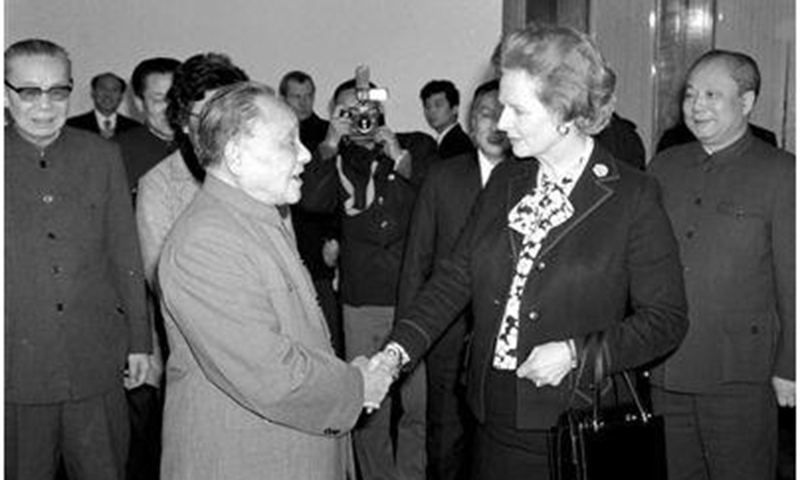
After 22 rounds of tough negotiation that lasted more than two years, the Chinese and British governments signed a Joint Declaration on Hong Kong in December 1984 to affirm that China would resume exercise of sovereignty over Hong Kong on July 1, 1997. Hong Kong had since entered a transition period before its return to the motherland. The dust over the Pearl of the Orient was finally washed away. Mrs. Thatcher, seeing Deng as a worthy interlocutor, told him that the One Country, Two Systems was the most ingenious vision.
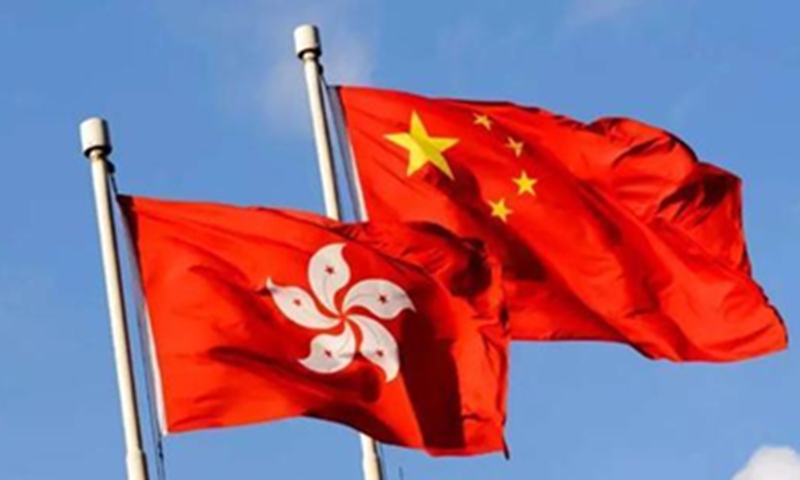
Hong Kong remains one of the most free, open, prosperous, and dynamic places in the world following its return to the motherland. The CPC has never wavered in its commitment to the principles of One Country, Two Systems, Hong Kong people administering Hong Kong and a high degree of autonomy. Unfortunately, due to the incitement of some external forces, Hong Kong suffered instability caused by the "Occupy Central" movement in 2014 and the turbulence over the amendment bill in 2019. What happened proves that when national security was not upheld, there would be no prosperity to speak of in Hong Kong. Like deep roots that make a tree flourish, One Country is the root of One Country, Two Systems. On June 30, 2020, the Law of the People's Republic of China on Safeguarding National Security in Hong Kong Special Administrative Region was adopted. The SAR has since moved from chaos to stability, a change supported and applauded by the Hong Kong residents. Opinion polls show that over 70 percent of Hong Kong residents are satisfied with the implementation of the National Security Law for Hong Kong, and more than 2.38 million Hong Kong residents signed their names in support for the National People's Congress's decision on improving the electoral system of the SAR.
Another successful example of One Country, Two Systems is Macao's return to the motherland. This once again demonstrates that One Country, Two Systems is workable, feasible and widely supported. Today, Hong Kong has got back to the right track after some twists and turns. In 2020, the Canadian Fraser Institute again ranked Hong Kong as the world's freest economy. In June 2021, the International Monetary Fund in its report reaffirmed Hong Kong as an international financial center. Hong Kong residents now enjoy democratic rights they never had before and a degree of freedom rarely seen in other parts of the world. Hong Kong ranks high on the "rule of law index." It has been proven that One Country, Two Systems is the best institutional arrangement for securing long-term prosperity and stability of Hong Kong.


- Beijing-Pyongyang passenger rail service to resume Thursday
- Shanghai and Jiangsu integration boosts sports-tourism development
- China Eastern Airlines restores direct flights between Shanghai and Stockholm
- RedNote targets AI-run accounts with new governance rules
- China's draft law on ethnic unity aims to serve as global model, political adviser
- Spring blossoms complement the Honghe Hani Rice Terraces in Yunnan





