Nation sees results from efforts to revive its marine life









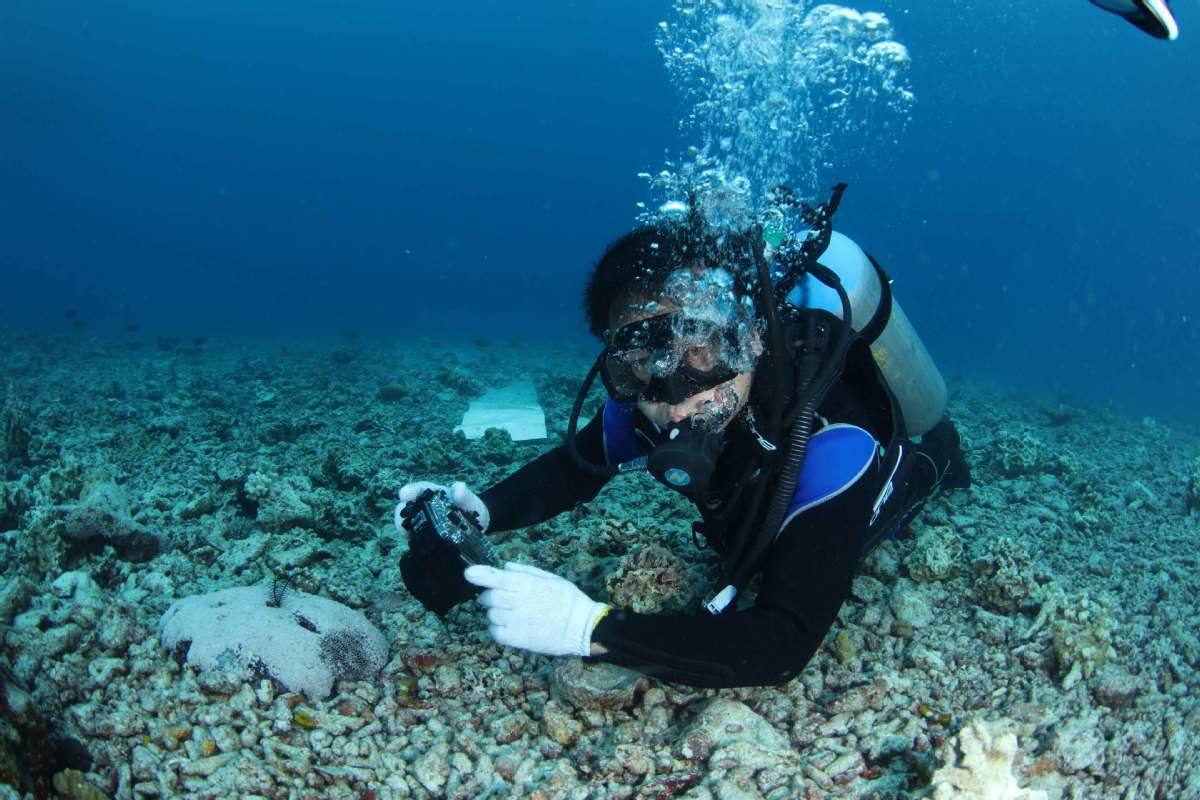
China's efforts to clean up its marine environment and restore coral reefs are starting to show results, according to the Ministry of Ecology and Environment.
Ke Chang, director of the ministry's Department of Marine Ecology and Environment, told the media last month that the quality of the country's marine environment had "generally improved" in recent years.
Coastal wetlands are being restored and land-based pollution sources have been improved, reducing the amount of wastewater flowing into the sea.
The government has made marine biodiversity one of the key components of the nation's 14th Five-Year Plan (2021-25).
One area of increased focus is the nation's coral reefs, which cover more than 38,000 square kilometers.
Such reefs are an integral part of marine biodiversity and provide rich breeding grounds for marine life, but they have come under threat due to global warming, and their future in many parts of the world is in peril.
China's coral reefs are situated along the south coast and off Hainan Island and the island groups of Dongsha, Xisha, Zhongsha and Nansha.
A report by the coral reef branch of the China Pacific Society released late last year said the main threats to the nation's reefs are climate change, human activities and coral disease.
It said climate change had contributed to rising water temperatures, increased acidification, rising sea levels and extreme weather events such as increased intensity of typhoons and flooding.
One of the main contributors to the report, Lian Jiansheng, a professor at the South China Sea Institute of Oceanology, or SCSIO, said other factors such as overfishing, illegal fishing, coastal development and tourism have also impacted reef development and growth.
He said the pressures on China's reef systems are complex, citing pollution and destructive fishing as two examples.
Lian said in the report that reef areas such as the Xisha Islands have been degraded on a large scale, largely due to the crown of thorns starfish, a marine creature that preys on hard coral.
A concerted push is being made, not just by China but other countries around the world, to protect coral reefs, he said.
In the late 1980s and in the 1990s, China established several coral reef reserves.
Lian said, "In the past four decades, the protection of reef-building corals and coral reefs has been listed as an indispensable content in the laws, regulations, rules and plans of my country's marine ecological environmental protection and species protection.
"The research and practice of coral reef ecological restoration carried out by some scientific research institutions in the South China Sea and the coast of South China, as well as the private contribution to coral reef protection, have jointly contributed to the protection and restoration of coral reefs in China."
The nation started researching its coral reefs in the 1950s, but only a few institutions and scientists were involved, with little overall planning or funding.
The scope and continuity of research were limited, but picked up in the early 2000s. In 2005, the "908" project was launched, which at the time was the largest survey of China's coastal waters.
Since then, improved coastal management and protection laws have led to more-robust coral reef conservation and research.
Lian said there are now coral research and monitoring teams at the Chinese Academy of Sciences and the Ministry of Natural Resources, as well as at some universities. NGOs have also become involved.
Two years ago, China embarked on a 10-year plan to revive ravaged marine life in the South China Sea, creating a body to protect coral reefs.
Experts from agencies, including the SCSIO, which is responsible to the Chinese Academy of Sciences, and the Chinese Academy of Fishery Sciences, will contribute to a China coral reef protection association set up in December 2019 in Hainan province.
According to the 10-year plan released by the Ministry of Agriculture and Rural Affairs, China has to contain erosion of coral in key reefs and create conservation areas to protect 90 percent of its coral by 2030.





- Xi's vision for China's winter sports
- China's social security funds post 10-trillion-yuan balance at end of 2025
- China drafts policies to buoy job market amid tech, trade shift
- Chinese scientists identify key Ebola virus mutation
- University of Chinese Academy of Sciences unveils the School of Space Exploration
- Senior CPC official urges high-quality development of social work