



Lesson for market, hope for society









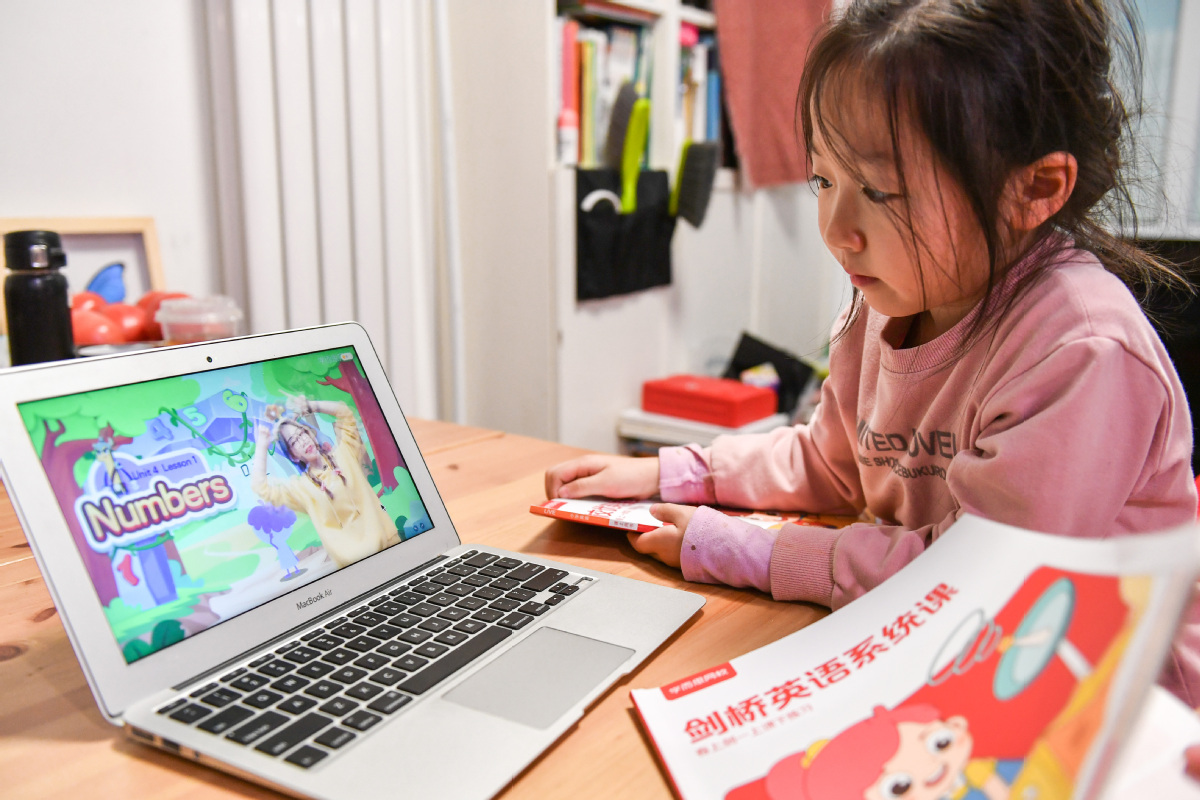
New guideline aligns education with national goals, gives edtech startups fresh way
Until China firmly cracked the whip on haphazard private-sector education in late July, not many among the business and investment communities engaged in the multibillion-dollar sector realized the joy ride on the gravy train, characterized by a cart-before-the-horse approach to market shares and bottom lines, cannot be an endless one, insiders said.
Jiang Ya and Feng Chongguang, analysts at CITIC Securities, said: "The new guideline (issued in July) is just the starting point. We expect the K9 (kindergarten to 9th grade) after-school tutoring segment will embrace a long period of supervision in both business development and fundraising."
For one, education, from society's perspective, has sanctity and cannot be allowed to be trifled with by runaway market forces.
For another, if, in the name of competitive education, both students and their parents are driven to untold stress and desperation, then the hoped-for payoffs of pursuing such curriculum-intensive, expensive education-better grades and, ultimately, a solid foundation for a better life that can add value to society and economy-would be in jeopardy.
So, the 4.12 million businesses-startups, partnerships, listed companies, what have you-that constitute China's private education sector have put themselves on the path of a quick course correction, in order to sustain their pursuit of billions of yuan in annual profit and double-digit annual growth, and, more importantly, to align themselves with national goals, experts said.
Nowhere is this change of mindset more apparent than in the nation's online education segment that, in the estimates of iiMedia Research, grew by about 10 percent to 454 billion yuan ($70.1 billion) in 2020.
Well-known startups, their investors-some 30 domestic and global big-name labels such as Hillhouse Capital, Sequoia Capital China, DST Global, SoftBank Vision Fund, Tiger Global, Temasek and GGV Capital have all helped incubate and nurture stars in the sector-and aspiring icons with an eye of the IPO bandwagon are redrawing their future plans, even as students and parents wonder with bated breath about the present.
To understand the current tumult in China's education sector and its implications for economy and society, it is important to digest recent history.
China, the world's most populous nation, is also home to the world's largest vocational education system. A Xinhua report stated that in 2020, the central government allocated 25.71 billion yuan to boost vocational education.
That was preceded by a mushrooming of private-sector firms offering a plethora of courses and programs-English-language modules, skills and crafts, fine arts, so forth-designed to complement formal education offered at schools.
The idea behind cocurricular courses coupled with curriculum-reinforcing programs of the private sector was to ensure the holistic growth of nation's future manpower remains consistent with the needs of 21st-century industry and economy.
In rising China, there were hundreds of millions of takers for such programs among the upwardly mobile, increasingly affluent middle-income group. For instance, in major cities like Beijing, most of the students, especially middle school students, enroll for at least one or two after-school tutoring programs.
Technologies-the internet, mobile apps, big data, artificial intelligence and 5G-were incorporated innovatively and imaginatively in this endeavor, spawning a whole new sector called edtech (short for educational technology) that gave birth to iconic startups, which went on to raise billions of dollars via IPOs, private equity deals or venture capital.
But cutthroat competition and brazen market-oriented approach to education ensued, finally forcing the hand of China's top leadership to issue a stern guideline in July, proposing wide-ranging reforms in the sector.
What made everyone sit up and take notice was the way stocks of some education companies got savaged by retail and institutional investors alike.
For instance, New Oriental Education and Technology Group Inc and TAL Education Group, which are considered giants of the sector, dropped between 30 percent and 40 percent immediately on the Hong Kong and New York stock exchanges.
For perspective: on Feb 5, shares of New Oriental Education and Technology Group traded at HK$142($18.25) in Hong Kong. But, by Aug 5, they crashed a staggering 89 percent to HK$16.24. TAL fared worse-its shares tanked by 93 percent from $80.37 to $5.71 during the same period.
Investors, it can be argued, understood the implications of the new guideline that states all educational institutions offering tutoring on school curriculum will have to register as nonprofit organizations.
So should businesses offering classes on weekends, holidays, summer and winter breaks. Effectively, this allows tutoring only on weekdays for a limited number of hours.
- Homework reduction to be reported regularly
- China promotes social equity, protects rights of special groups: white paper
- Younger generation less enthusiastic about marriage
- Population and Family Planning law revision prominent in Standing Committee schedule
- Schools ready help for pandemic-stressed students




















