Xi leads the way in promoting ethnic unity, development









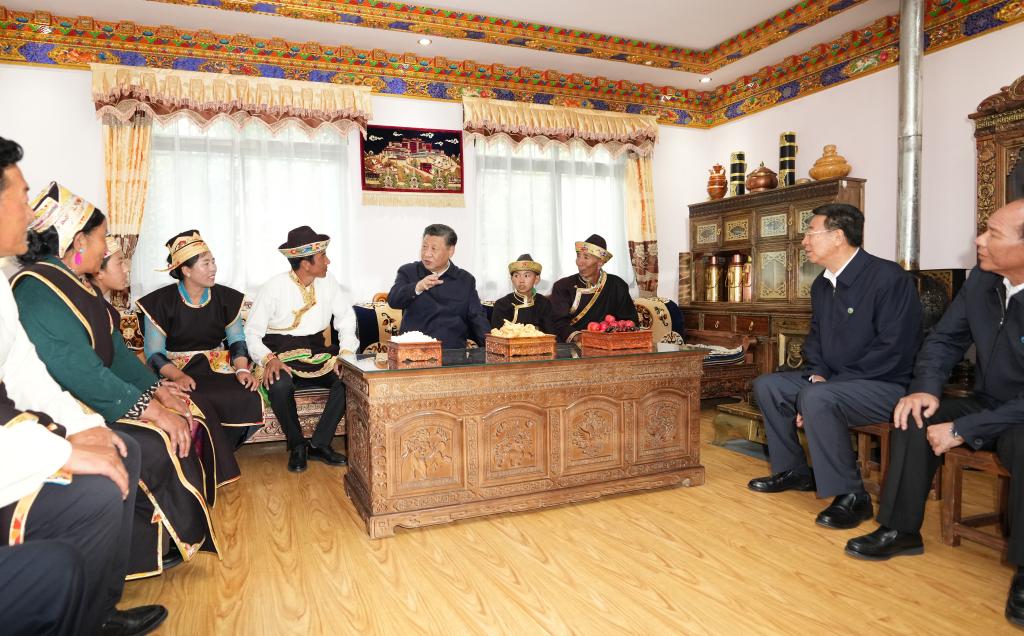
BEIJING - In China, a unified multi-ethnic country, the proper handling of ethnic affairs concerns the lasting security and prosperity of the entire country and the Chinese nation's rejuvenation.
President Xi Jinping, also general secretary of the Communist Party of China (CPC) Central Committee and chairman of the Central Military Commission, has said that ethnic unity is the cornerstone of development and progress.
Since the 18th National Congress of the CPC in 2012, the CPC Central Committee with Xi at the core has been making long-term policies to consolidate the foundation for ethnic unity and development.
By putting forward the call of heightening a strong sense of community for the Chinese nation, Xi has been leading China's efforts in making innovative progress in the work related to ethnic affairs.
INNOVATIVE IDEA
The central leadership has always attached great importance to ethnic affairs and development in areas with large ethnic populations.
In May 2014, Xi put forward an important notion -- the sense of community for the Chinese nation.
In September 2014, at a central work conference on ethnic affairs, Xi once again highlighted the importance of laying a solid foundation for the sense of community for the Chinese nation.
He has since on many occasions stated the profound implications and great significance of consolidating such a sense.
At the 19th CPC National Congress in October 2017, the idea was officially written into the Party's Constitution.
Four inspections to regions with large ethnic populations have been made by Xi so far this year, deepening and extending the implications of the theories and practice of the sense of community for the Chinese nation.
RESEARCH-BASED INSIGHT
In 2014, Xi carried out frequent inspections and research to learn about the opinions on ethnic affairs at the primary level.
During his inspections to Inner Mongolia and Xinjiang, Xi had face-to-face talks with people from multiple ethnic groups.
He also joined lawmakers from Guizhou Province during the annual session of the National People's Congress (NPC) and visited members from the ethnic minority groups of the National Committee of the Chinese People's Political Consultative Conference (CPPCC).
Based on in-depth research, Xi noted that strengthened Party leadership is a must for advancing the work of ethnic affairs in China.
The system of regional ethnic autonomy has played an important role in promoting ethnic equality and unity, fueling development in ethnic areas, and enhancing the cohesion of the Chinese nation, he said.
He also noted that to enhance the unity of the Chinese nation, the long-term and fundamental way is to strengthen the cultural identity and consolidate the sense of community for the Chinese nation.
"An ethnic group will enjoy sustainable development only when it integrates into the big family of the motherland," said Kurban Niyaz, a primary school principal in south Xinjiang.
DEVELOPMENT IN ALL ASPECTS
Xi has long paid close attention to the economic and social development of areas with large ethnic populations.
On the eve of the Spring Festival in 2018, he paid a visit to Sanhe Village, a poor village inhabited by the ethnic Yi people in Sichuan Province.
In February 2021, at a gathering to mark the country's poverty eradication achievements, Li Kai, a Party official of Sanhe Village, expressed the villagers' gratitude to Xi using the Yi ethnic language.
All the 28 ethnic-minority groups with relatively smaller populations in China have shaken off poverty.
What is more, ethnic areas have sped up efforts in fostering and promoting high-quality development in all aspects. In 2020, these areas contributed more than 10 percent of the national GDP.
During the 13th Five-Year Plan period (2016-2020), these areas registered an annual GDP growth of 6.6 percent, 0.9 percentage points higher than the national rate. During the same period, 12.8 million new urban jobs were created in these areas, accounting for nearly one-fifth of the country's total.
Also, the traditional cultures of ethnic groups are flourishing. More than one-third of China's cultural heritage items inscribed on the UNESCO Intangible Cultural Heritage List are related to ethnic minorities.
Ecological conservation has also been pushed forward in these areas, where people enjoy bluer skies, lusher mountains and clearer waters.
Safe housing, safe drinking water, accessible medical services and education all speak volumes about the improved livelihoods of various ethnic groups.
Earlier this month, 10 veteran Party chiefs from nine border villages of the Wa ethnic group in Yunnan Province wrote a letter to Xi, reporting local progress in poverty relief and expressing their willingness to build a more beautiful and prosperous home under the CPC's leadership.
MIRACLES TO COME
After securing a victory in fighting poverty, China has embarked on a new quest to fully build a modern socialist country. Xi has personally drawn the blueprint for the modernization drive in the ethnic areas.
During the annual sessions of the NPC and the CPPCC National Committee in March, Wei Zhenling, a representative of the Maonan ethnic group, one of the 28 ethnic groups with relatively smaller populations, from south China's Guangxi Zhuang Autonomous Region, told the poverty-to-prosperity story of her hometown, expressing her villagers' confidence in a brighter future.
"I used to think that my hometown would never be connected to the outside world unless a miracle happened," said Wei, a member of the CPPCC National Committee. "That miracle has really happened."




- Xi says China's high-quality development to provide more opportunities for cooperation with Brazil
- China Coast Guard rescues 13 Filipino sailors in the South China Sea
- Xi holds phone talks with Lula
- Chinese mainland reaches 5.32m invention patents, trademarks close to 50m
- Chongqing railway attendants undergo training ahead of travel rush
- China's railway gears up for Spring Festival travel rush