



Ambassador details China's democracy concepts









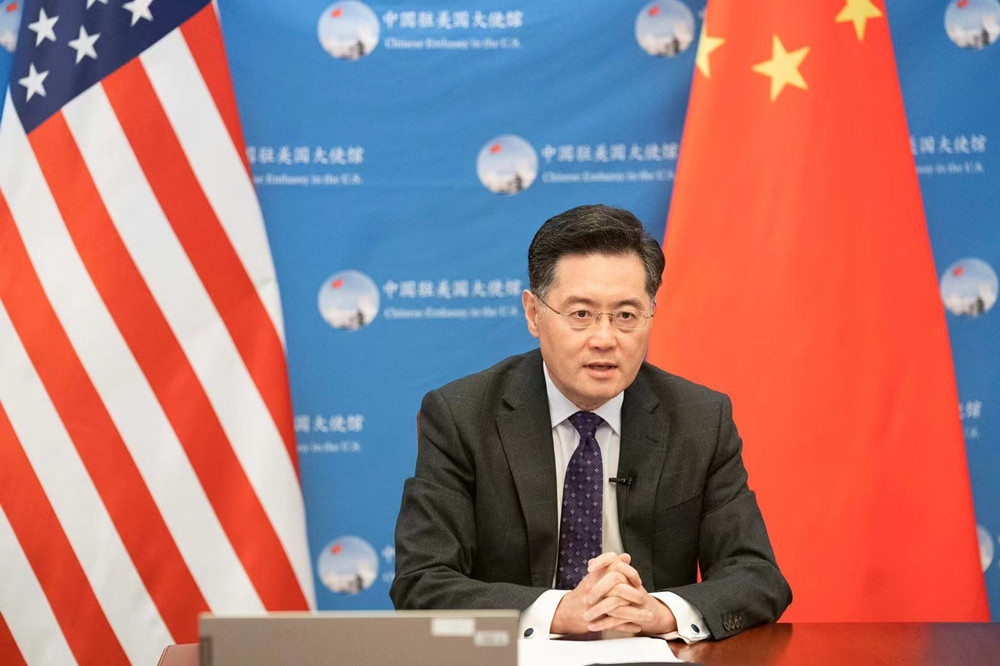
China's ambassador to the US said his country applies democratic concepts differently but rejected the portrayal of the nation as authoritarian.
In an online discussion Wednesday hosted by the Carter Center and the George H.W. Bush Foundation for US-China Relations (Bush China Foundation), Ambassador Qin Gang spoke extensively on the Chinese concept of democracy.
"A fundamental (misunderstanding) is to define America's relations with China as democracy versus authoritarianism, and to stoke up ideological confrontation, which has led to serious difficulties in China-US relations," Qin said.
China is a democracy in a different form, the ambassador said. Traditionally, people have always been regarded as the most important element of a country. An ancient Chinese ruler believed that the people are to the monarch what water is to a boat. The water can carry the boat; it can also overturn the boat. The Communist Party of China (CPC) was founded for the poor with people in mind.
Qin said today's China enjoys a whole-process democracy. People have the right to election. People's Congress from local level to national level is similar to US state legislatures and Congress. Deputies are directly elected to the people's congresses at county level. Those above the county level are indirectly elected. In addition, China has a unique "political consultation system" for the people to exercise democracy.
Using the 14th Five-Year Plan (2021-25) as an example, Qin said more than 1,000 suggestions were summarized from more than 1 million online posts with further adjustments made after deliberations by the national-level people's congress and Political Consultation Conference.
China also has a long history of choosing talents based on their merit and abilities, Qin pointed out. China implemented an exam system more than 1,000 years ago to select talents regardless of their age or wealth. Today, China's officials are also tested and start from the local level of government.
"President Xi Jinping became a farmer in a poor village in northwestern China at the age of 16. He was appointed Party secretary of Shanghai, the biggest city in China, at 54. The decades in between saw him work on various posts and in different places, and the populations he served varied from several hundred to several hundred thousand, millions and to tens of millions," Qin said, in illustrating China's system.
China's model of democracy has produced good results, Qin said. A 10-year survey by the Harvard Kennedy School has shown that the Chinese people's satisfaction with the CPC has been above 90 percent for each of the past 10 years.
"Isn't it obvious that both China's people-centered philosophy and President Lincoln's 'of the people, by the people, for the people' are for the sake of the people? Shall we understand China's socialist whole-process democracy as this: from the people, to the people, with the people, for the people?" Qin asked.
"China and the US are different in history, culture and political systems," Qin said. "Our two countries should not and cannot change each other. Instead, we should break ideological barriers, discard zero-sum mentality, respect other countries and accommodate each other without losing our own distinctions, so as to get along with each other in peace."
Qin said he's worried that the US uses competition to define China-US relations. "Competition on the US side often takes the form of confrontation, especially on major issues concerning China's core interests. If this does not change, it will undermine China's effort to promote our mutual trust and cooperation," said Qin.
In a letter to the online event, former US president Jimmy Carter expressed the hope that "this meeting will steer US-China relations in a more amicable direction in the years to come".
The conversation was joined by about 10 individuals, including scholars, former diplomats, experts in US-China relations and people who have engaged with China extensively.
The ongoing conflict in the bilateral relationship and the hope for improvement were at the center of the online conversation.
Eric Yang, vice-president at the Harvard College China Forum, expressed such concerns eloquently.
"In more than one way, citizens in the two countries are not speaking the same language discussing the current and future state of the US-China relations," Yang said. "As China continues to develop, I am concerned that the difference in perceptions will also grow to distort both sides' best intentions and diplomacy."
Bush China Foundation Chairman Neil Bush said the two largest economies need to cooperate on things like climate change, green development, food security, poverty alleviation, responses to current and future pandemics, and all issues related to everything digital.
"There has been an onslaught of anti-Chinese sentiment in the US over recent years that has led to growing suspicions about China and her motives. It is with this backdrop that the job of the ambassador to the United States from China is so critical," Bush said.
David Firestein, CEO and president of the Bush China Foundation, said he hopes to see soon "a modicum of improvement in both the substance and tenor of the relationship" especially in "low-hanging fruit" areas such as educational and cultural exchanges, and in trade, including by removing "the imbecilic, job-killing" tariffs that were imposed over the last three years.
Some participants expressed the hope of seeing the reopening of both the Consulate General of China in Houston and the Consulate General of the US in Chengdu.
Qin said that because it was the US that took the unilateral action to shut down the Chinese consulate, it will be up to the US to initiate the action to reinstate the two consulates.










