



Counting the cost of 'war on terror'









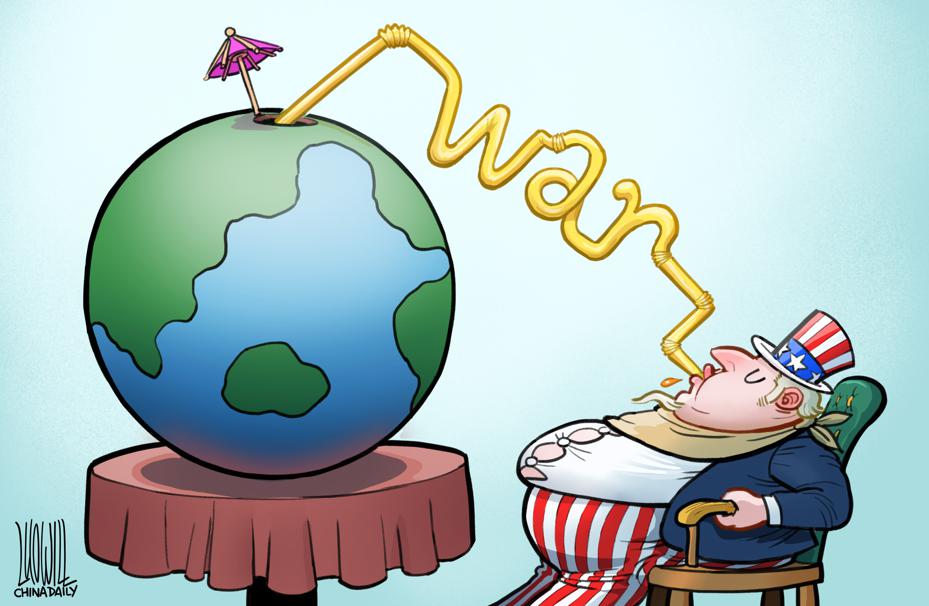
Twenty years ago, following the events of 9/11, former US president George W. Bush declared a "war on terror." Since then, the United States and its allies have launched several wars around the world. According to the former general of the US Army Wesley Clark, the military strategy after 9/11 sought to "take out seven countries in five years: Iraq, Syria, Lebanon, Libya, Somalia, Sudan, and finishing it off with Iran."
Indeed, the first war began in Afghanistan in 2001. From there, it found its way to Iraq in 2003 to find weapons of mass destruction, that are yet to be found, and spread democracy that has brought nothing but wars and inflicted suffering to the Iraqi people. The United States also supported the Israeli war on Lebanon in 2006 as part of what the US Secretary of State called at the time "the birth pangs of a new Middle East." After the events of the so-called Arab Spring, which began in 2011, the United States declared war on Libya to promote American democracy in that country. During this same period, the US was also participating in an international alliance in the war on Syria and Iraq and at the same time stifling Iran, Venezuela, North Korea with the chief objective being to bring down these countries. In short, the post-9/11 world is the world of mobile American warfare.
Heroes and terrorists
The United States preferred not to provide a clear definition of "terrorism." This loose concept allowed the United States to designate any country that did not submit to it as a terrorist (they're using the same approach today with technological companies). The "imperial" logic they adopted gave the United States the right to discipline the "unruly" country, wage a war, or impose harsh sanctions on it. One can see the aftermath of these measures in the devastating repercussions on countries that were once prosperous and safe.
Needless to say, the United States used this term selectively. Yesterday's hero is today's terrorist, and yesterday's terrorist is today's hero. For example, in 1985, then-US president Donald Reagan greeted a group of Afghans, describing them as "the moral equivalents of our Founding Fathers" because they were fighting America's enemy, the Soviet Union. However, these heroic Afghans were none other than the "Afghan jihadis" who would, later on, turn into "terrorists."
Figures about the costs of the war
Researchers from Brown University released a report titled "Cost of War", showing that the costs of the Afghanistan war have ripped away at least $2.3 trillion from the US Treasury so far. The report notes that these costs are undervalued. The researchers also estimated that the United States spent $5.8 trillion on the wars and conflicts that followed the events of September 11, 2001, which included Afghanistan, Pakistan, Iraq, Syria, Yemen, Libya, Somalia, and other places. This report consists of four main sections attempting to show the enormous human costs of the American wars that followed 9/11, which totaled nearly 292,000 deaths. It is estimated that 241,000 people died in the Afghanistan war, including 2,442 members of the US military, and many more who have took their own lives. In addition, nearly 4,000 American contractors, and 1,150 people from the military, and contractors from the countries of the international coalition died. As well as losses on the Afghani side, 141,000 Afghans have been declared dead, among them, there were 43,000 Taliban members, and nearly 60,000 Afghan police and army members, and more than 38,000 Afghan civilians. The injured are estimated to be hundreds of thousands. As for the rest of the countries, estimates showed that the number of deaths in Pakistan reached 67,000, and in Iraq 306,000, while in Syria the number is estimated at 266,000, and Yemen 112,000. "These figures do not include indirect deaths caused by hunger, disease and water shortages."
The third section of the report shows that 38 million people have been displaced by the post-9/11 wars in Afghanistan, Pakistan, Iraq, Syria, Libya, Yemen, Somalia, and the Philippines. As for the fourth section, it reveals that the United States carried out what it called "anti-terrorist operations" in at least 84 countries.
Immeasurable loss
After many years of the "war on terror", it's safe to say that these wars have failed to fulfill their purpose. The total count of active terrorists today has more than trebled since 2001. Also, the Taliban have returned to power in Afghanistan, taking control of Afghanistan in record time, even before the US withdrawal was completed. The main goal of the war was never achieved. As for al-Qaeda, they made a mockery of the US plans, as they are actively present in several countries under different names, especially in Syria (al-Nusra), where its fighters are indirectly supported by America. The damage resulting from the wars waged by "empires" or imperialists throughout history goes beyond dollar bills and body count. Some immeasurable costs could be even more destructive than the war itself. How can we measure the losses resulting from the displacement of millions of people from their countries?
They lost their homes and most of them have been living in refugee camps for years. They won't be able to contribute to rebuilding their country. This kind of loss cannot be measured and its effects are for life.
An imperialist country such as the United States wages a war with one goal in mind: causing massive destruction that serves a bigger profit to the ruling elites. This destruction is systematic and with a clear objective, which is often prolonging control and power over these countries. For instance, Japan can be a great example of the US intentions when going to war. Destroying Japan in World War II was the first step to subjugate this country and tie it to the United States' long-term plans. Therefore, all the losses have produced a political and economic system in this country that served the interests of the United States. This plan can be seen more clearly in Africa as well as in the Middle East, where mobile warfare seeks to keep these countries in a never-ending state of conflict that eventually weakens the system and facilitates American domination.
In this sense, the direct cost of the war for the United States becomes an insignificant detail that the ruling elites look past it. When it comes to people, numbers cannot begin to describe their losses. They are left with domination, looting and policies that hold back their development. Looking at the big picture, it is clear that all the profits collected by the weapons companies pale in comparison to the strategic gains achieved by the "empire."
The beginning and end of the US war on Afghanistan coincided with the aging phase of US imperialism. In old age, the setbacks become greater, so what was previously achievable from such wars is much more difficult today. We learn from history that dying empires breed wars that are paid for by innocent people. Their only fault is that ruling elites tried to prolong the life of their empire by feeding on other people's blood. This scenario is still happening today in Afghanistan, Iraq, Syria, and other countries. But someone has to say the empire is dying, and no medicine will ever save it.
Adham Sayed is a researcher with the China-Arab BRI Research Center at Zhejiang Gongshang University, author of the book "This is How it was in Wuhan, Diaries of Quarantine Days".





