



China's Epic Journey from Poverty to Prosperity









Panel 1 Technological Advances and Strategic Innovations
More R&D spending
In 2020, China spent RMB2.4 trillion on R&D, ranking second in the world. Its R&D intensity (ratio of R&D to GDP) reached 2.4 percent. A total of 1,345,000 utility patent applications were filed with domestic agencies and 441,000 were granted. In addition, 69,000 international patent applications were submitted through the Patent Cooperation Treaty. China ranked 14th on the Global Innovation Index in 2020 and was the only middle-income economy in the top 30 on this list.
More innovation centers
By the end of 2020, China had established 533 key national labs, 350 national engineering research centers (also known as national engineering labs), 1,636 national enterprise technology centers, 212 mass entrepreneurship and innovation bases, 1,287 national technology enterprise incubators, and 2,251 makerspaces approved by the Ministry of Science and Technology.
The central government is supporting efforts to build Beijing, Shanghai and the Guangdong-Hong Kong-Macao Greater Bay Area into international centers for science and technology innovation, and is developing comprehensive national science centers in Huairou of Beijing, Zhangjiang of Shanghai, the Greater Bay Area, and Hefei of Anhui Province.
Major breakthroughs in basic research and strategic high technology
The quantum communication satellite Mozi, the Hard X-ray Modulation Telescope satellite Insight, the dark matter probe satellite Wukong, and the Tianwen-1 Mars probe were successfully launched. The moon probe mission landed Chang'e-4 on the far side of the moon-the first probe ever to do so.
China completed its BeiDou Navigation Satellite System, inaugurated the Five-hundred-meter Aperture Spherical Radio Telescope (FAST), and developed a broad spectrum of deep-sea exploration equipment such as the underwater glider Haiyi, the deep-sea submersible Qianlong, the research vessel Tansuo, the unmanned submersible Haidou, and the underwater robot Haixing. The manned submersible Fendouzhe completed a test dive to a depth of 10,000 meters. In such fields as C919 airliners, high-speed railways, third-generation nuclear reactors, and renewable energy vehicles, China's progress attracted worldwide attention.
Science and technology are widely applied in manufacturing. Innovation-driven development has made serious headway. Advances in science and technology have contributed to over 60 percent of economic growth.
Science and technology have also raised the capacity of governance by a substantial margin. The application of digital technology is fast expanding in government, the countryside and society at large, in forms such as smart cities and internet-based government services. A grid-based social management network and smart governance are gradually penetrating daily life.
Life has changed significantly because of science and technology. As more people turn to online education, shopping, food ordering, mobile payments, ride hailing, bike sharing, telecommuting, remote medicine, and smart homes, they now enjoy greater convenience, more choices, and a fuller life.
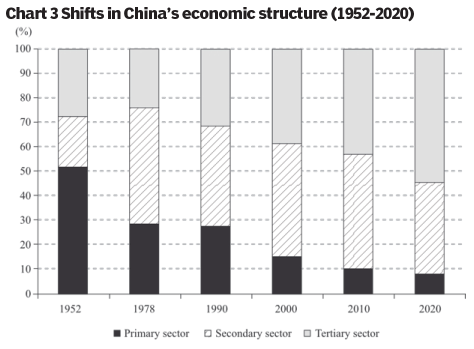
The industrial structure has been continuously upgraded. China has built the world's most complete industrial system and is moving up the value chain. In 1952, the shares of added value from the primary, secondary and tertiary sectors in China's GDP were 50.5 percent, 20.8 percent, and 28.7 percent. In 2020, the figures were 7.7 percent, 37.8 percent and 54.5 percent, marking the transformation of China from a traditional agricultural country to a country with large manufacturing and service industries (Chart 3). China's economy has shifted from relying mainly on the primary sector to being driven by a combination of the primary, secondary and tertiary sectors.
Significant headway has been made in agricultural modernization. The wider application of machinery, digital and green technologies as well as functional and community-shared farming has reduced the need for manual labor, and rural productivity has risen sharply. Grain production capacity has steadily increased, to the extent that China has now achieved basic self-sufficiency in grain supply, which ensures the country's food security.
An independent and complete modern industrial system with a whole range of sectors has been built. The integration of industrialization and IT application has expanded in depth and extent. "Made in China" is being replaced by "smart manufacturing in China". Industrial and supply chains have been further modernized. Strategic emerging industries represented by the new generation of information technology, biotechnology, high-end equipment, and green technology are growing fast, serving as a key engine for high-quality development.
The digital economy has unleashed the vigor of businesses. Digital transformation of traditional industries and growth of the digital industry are both making headway. Modern service industries are picking up speed. New forms and models of business based on the internet continue to emerge. The platform economy and the sharing economy are booming. Producer services have become more specialized and moved up the value chain, while consumer services are better targeted and of higher quality.
The steady improvement and upgrading of the industrial structure has promoted balanced and extensive economic development. Consumers' needs for individualized, high-quality and diverse supply are being met.
Modern infrastructure networks have been improved. Thanks to efficient information networks and an extensive network of roads, railways and bridges, temporal distance inside China has been significantly shortened, and it has become much easier to travel across the country, even on difficult terrain (Panel 2). An integrated transport network encompassing five north-south corridors and five east-west corridors connects the whole country. China leads the world in the total route length of high-speed railway, urban rail transit and expressway, and in the number of deep-water berths. For many years, its civil aviation sector has ranked second in the world in terms of total traffic turnover.
Panel 2 Achievements in Infrastructure
China's infrastructure network is among the largest in the world.
The country has built the most advanced railway and high-speed railway networks in the world. In 2020, it had 146,000 km of railway routes in operation, including 38,000 km of high-speed railways. China has the world's largest expressway network, with a total length of 161,000 km.
China now has 22,142 quay berths in service, including a world-leading 2,592 berths of 10,000 tonnes or above. It also has the world's longest navigable inland waterway system, reaching 127,700 km, and the highest inland waterway cargo transport volume. China has the world's highest liner shipping connectivity index, with eight of the world's top 10 ports based on cargo throughput, and seven based on container throughput. As a world leader in intelligent ports, China is renowned for the efficiency of its specialized terminals in major coastal ports.
China has 241 civil airports nationwide.
The route length of China's urban rail transit with high and medium passenger capacities is close to 6,700 km. More cities in China are opening metro services than in any other country in the world. The total network length of postal and express delivery service (one way) reached 52.8 million km.
Internet penetration has risen fast. By June 2021, China had put 960,000 5G base stations into service, and 5G terminal connections had surpassed 365 million. Fixed broadband penetration reached 96 percent, mobile broadband use was 108 percent, and the number of internet users topped 1 billion. .
The country is quickly building itself into a leader in transport. Its extensive network has had a huge impact on the configuration of China's cities, and on its population distribution, economic activities and even the life and work perimeters of the residents.
Energy supply capacity, development technology, and efficiency have continued to improve. A diversified high-quality energy production system has been established, concurrently driven by coal, oil, natural gas, nuclear power, and renewable energy.
Thanks to the constantly improving water resource management and infrastructure, China is able to support around 20 percent of the world's population and 17 percent of the global economy with only 6.6 percent of the planet's fresh water.
Progress in internet infrastructure has brought about wider service coverage, lower prices, faster internet speed, and easy connection anytime and anywhere. The information highway enabled by the internet has improved people's lives.


- Protection for minors enhanced
- Regional hub sets sights on world-class innovation
- Hainan FTP off to a good start, sees imports and arrivals soaring
- Emerging sectors in legislative focus
- Nation intensifies crackdown on telecom, online fraud
- Fudan University president suggests 'Lego thinking' to transform academic disciplines





