



AUKUS could lead to serious consequences









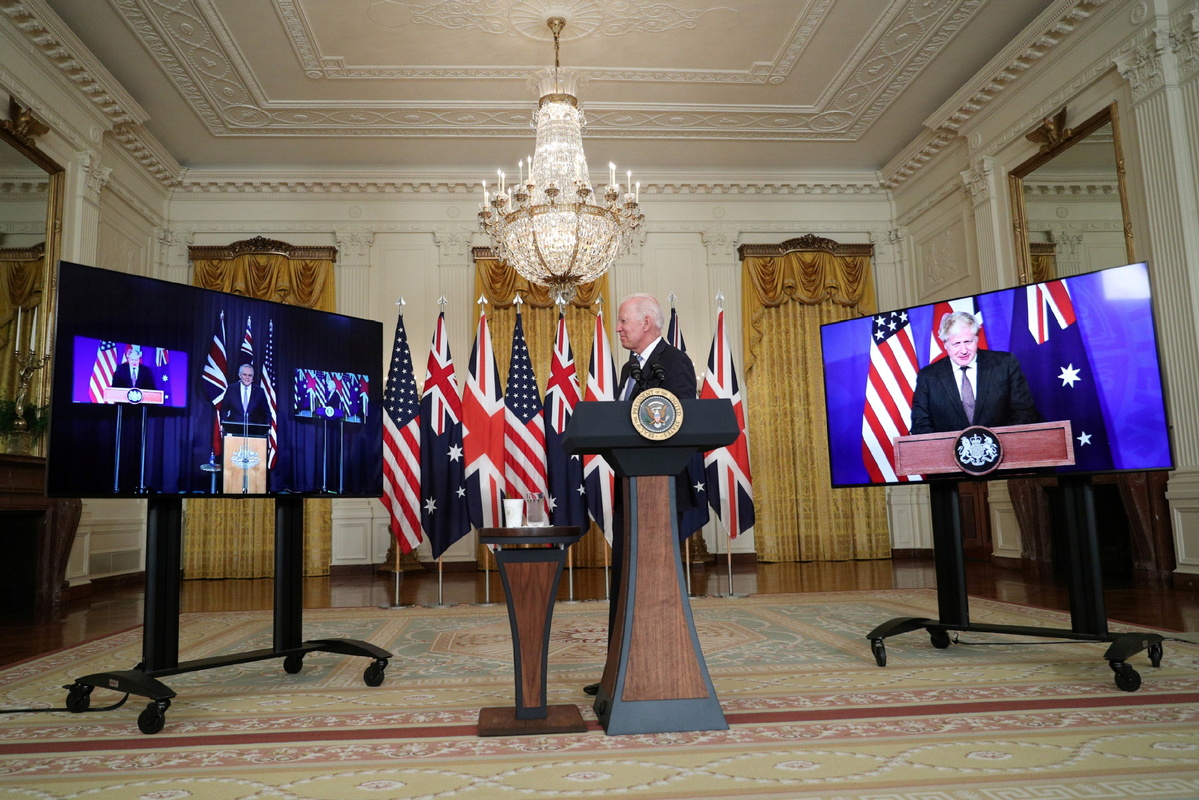
AUKUS, the trilateral security partnership of the United States, the United Kingdom and Australia, alarmed the world on Sept 15 by announcing a plan to build a nuclear-powered submarine fleet for Australia over 18 months. The deal could lead to serious consequences.
The first consequence would be to create an enormous risk of nuclear proliferation, once rules are broken.
While the rhetoric of the US, the UK and Australia has never been absent on the rules-based order, they themselves have been the actual and biggest rule breakers.
The Nuclear Non-Proliferation Treaty is the cornerstone of the international nuclear disarmament and control regime and one of the most fundamental rules of global security. Yet the US and the UK, which both are nuclear-weapon states bound by the NPT, decided to provide Australia, a non-nuclear-weapon state, with highly enriched uranium, which could be applied to manufacturing nuclear weapons.
This is an outright betrayal of the NPT spirit and the most consequential violation of the international rules of nuclear nonproliferation, and it discredits Australia as a self-proclaimed nation with "exemplary nonproliferation credentials".
The three parties claim to follow the highest nonproliferation standard and have informed the International Atomic Energy Agency of the latest development. However, the IAEA has no safeguards for naval reactors, which, together with nuclear-powered submarines, are usually regarded as militarily confidential.
This would mean that the US and the UK would hand over to Australia a large amount of highly enriched uranium with no reliable verification in place. As a result, a huge loophole would be created in global endeavors for nuclear disarmament and nonproliferation, making nuclear proliferation much riskier.
The second consequence would be to intensify the regional arms race and force regional countries onto a slippery slope toward a new Cold War.
The US claim of not turning "stiff competition" with China into a "new Cold War" turns out to be hypocritical, in that US actions actually go in the opposite direction.
Nuclear-powered submarines could be the means of delivery for all kinds of advanced offensive weapons. Moreover, Australia also announced a plan to buy Tomahawk cruise missiles from the US, and these could be deployed on its nuclear submarines.
These developments show the determined intention of the three parties to create tension and division in the region, so that the Asia-Pacific could be turned into a theater of rivalry. With AUKUS setting the precedent, some other regional countries-those would-be possessors of nuclear submarines in particular-would feel encouraged and are thus more likely to follow suit. Two of the four candidates in the recent leadership election of Japan's Liberal Democratic Party suggested that Japan consider possessing a nuclear-powered submarine.
Unfortunately, an intensified arms race in the region and continuous tensions would bring about a lucrative arms industry and, perhaps more important, better excuses for US interference in regional affairs. It is regional countries that would get hurt. Thirty years after the end of the Cold War, AUKUS has put the sound external environment, a fundamental factor that has enabled prosperity in East Asia for decades, under huge pressure to be altered.
The third consequence would be to undermine ASEAN centrality and disrupt cooperation in East Asia.
While the US has never grown tired of paying lip service to ASEAN centrality, ASEAN centrality is nowhere to be found whenever the US is determined to realize its self-interests. The same is also true for the UK and Australia.
As a key part of the US' Indo-Pacific strategy, the new trilateral security partnership is, in essence, another "Anglo-Saxon" circle defined by close Anglosphere affinity and geopolitical calculations. These small circles would disintegrate the existing regional architecture with ASEAN in the driver's seat and thus significantly undermine ASEAN centrality.
Australia's acquisition of highly enriched uranium and the formation of a nuclear-powered fleet runs contrary to the purposes and principles of ASEAN's Southeast Asian Nuclear-Weapon-Free Zone Treaty. It goes against the will of ASEAN to keep Southeast Asia free of nuclear weapons and other weapons of mass destruction. The US itself once again proves to be the true driving force of militarization in the region.
ASEAN members long for no other than the peaceful coexistence of major powers in East Asia, an open and inclusive regional architecture to be consolidated, and a cooperation-oriented agenda with the focus on anti-pandemic endeavors and economic recovery. In no way would the answer be endless geopolitical rivalry, a worrisome military and security agenda, or being forced to side with anyone.
Unfortunately, the policy orientation of the US administration is drifting further away from the wish of regional countries. With the newborn AUKUS, regional countries will get to know better what the Indo-Pacific strategy of the US is truly about.
Australia could well have heeded the advice of Kishore Mahbubani, former Singaporean permanent representative to the United Nations, to "use its special relationship with America to educate America on the long-term values and strategic significance of ASEAN". On the contrary, Australia has abandoned its strategic autonomy in recent years, danced to the US' tune and implemented a self-destructive policy toward ASEAN.
It has been almost nine months since US President Joe Biden took office. Be it the "Kabul moment" or AUKUS, it is more than obvious that the Biden administration's foreign policy points to preservation of hegemony, sometimes even at the cost of the interest of its allies. True, "America is back", yet not in the way that regional countries wish to see.
The author is China's ambassador to ASEAN.










