Technology boosts high-quality agriculture development in Xinjiang









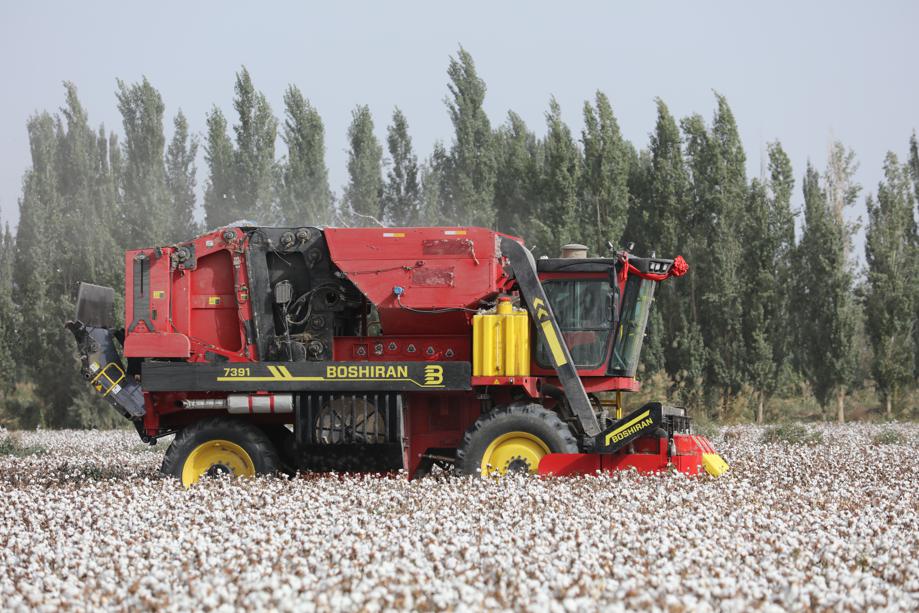
URUMQI -- When the cotton harvest season started in October, the vast cotton fields in Northwest China's Xinjiang Uygur autonomous region saw roaring cotton-picking machinery instead of cotton farmers.
Thanks to the machinery, Dilshat Memet, a cotton farmer in Yuli county, Bayingolin Mongolian autonomous prefecture, completed cotton picking in just one day. But in the past, he would be busy collecting cotton all through the harvest season.
"The high-efficiency cotton picker can handle the workload of several hundred people. For generations, my family used to harvest cotton by hand and traditional implements," Dilshat Memet said.
Unlike his father, Dilshat Memet began to use cotton pickers several years ago. The great convenience of mechanical operation compelled him and his partners to set up an agricultural company, introducing types of agricultural machinery like cotton pickers and drone sprayers and providing services for farmers in need.
"The rapid development of mechanization has greatly reduced costs for cotton farmers, and more and more farmers have been liberated from the land to make more money from other fields," said the 32-year-old man.
Xinjiang is the largest cotton-growing area in China. The region's cotton output hit 5.16 million tonnes in 2020, accounting for 87.3 percent of the total in the country, said the National Bureau of Statistics.
Therefore, the region has encouraged cotton farmers to apply modern agricultural machinery to boost the development of the industry in recent years. Meanwhile, the income of local farmers has increased due to the improvement of productivity.
Apart from the cotton industry, modern agricultural machinery and technologies apply to several fields such as crops and fruit plantations.
Previously, pear trees in southern Xinjiang were pollinated by bees or by men. But recently, pear farmers have been using unmanned aerial vehicles to pollinate their pear trees.
"At least two workers are needed to manually pollinate for each mu (0.07 hectares) of pear trees. But a drone can pollinate 2.6 hectares of pear trees within an hour, and the yield of pears can increase at least 500 kg per mu," said Peng Wenjun, an expert of the Chinese Academy of Agricultural Sciences.




- Nobel winner speaks to youth in China: what makes a great research question?
- China's first reusable liquid rocket test offshore platform set for operation
- Chinese mainland reaches 2.29m high-value invention patents in IP quality pursuit
- Xi says China's high-quality development to provide more opportunities for cooperation with Brazil
- China's military retrieve 17 Filipino sailors from South China Sea shipwreck
- Xi holds phone talks with Lula