



Agricultural centers advance win-win BRI ties









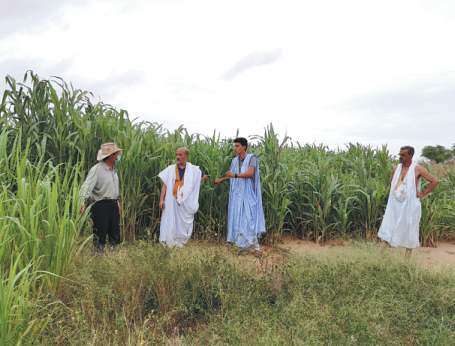
A visit to Mauritania in January 2011 heralded the beginning of Zhang Hong'en's special relationship with Africa.
Zhang, president of Ningxia Jinfulai Goat Industry Co, made a fact-finding trip to the African nation as part of a delegation organized by China's ministries of commerce and agriculture.
"Ningxia and Mauritania have a lot in common," Zhang said.
For example, the Yellow River leaves a plain in Northwest China's Ningxia Hui autonomous region, while the Senegal River, the third-longest in Africa, runs through Mauritania. There are three deserts in Ningxia. Mauritania is in the Sahelian and Saharan zones, and a vast, hot wilderness covers more than 80 percent of the country.
Slash-and-burn agriculture has contributed to soil erosion in Mauritania, one of the poorest agricultural areas in West Africa.
As part of China's "go out" policy, which encourages Chinese enterprises to invest overseas, Zhang's company decided in 2013 to establish an agricultural technology demonstration center in the village of Idini, which is 55 kilometers from Nouakchott, which is Mauritania's capital and largest city.
Helping other countries
As agricultural development is crucial to poverty reduction in developing countries, China has made efforts to help other developing countries raise their agricultural productivity to effectively cope with food crises. It has established agricultural technology demonstration centers, sent agricultural experts to provide consultations and conduct technical cooperation, and trained technical and managerial personnel on agriculture in some developing economies.
The demonstration center in Mauritania, which the company from Ningxia has built up in the past six years, has become an oasis in the Sahara.
Ningxia Jinfulai Goat Industry Co turned to breeding Mauritanian oxen separately for milk and meat. It also began growing certain plants to provide well-balanced fodder for milk cows and beef cattle. Farm tools and equipment have been introduced to the center and, as a result, the efficiency of the African nation's animal husbandry industry has been raised.
Animal husbandry is the main source of income for most Mauritanians, and also provides protein for their diet. But it is very difficult to have large-scale planting in Mauritania, whose annual rainfall is a mere 200 millimeters.
Ren Xueshan, an expert in grass and herbage, was sent from Ningxia to the center in Mauritania. He tried 32 varieties of plants and came up with an approach for controlling water and fertilizer and to deal with the land in the desert area.
In April 2017, the first alfalfa that the center planted survived. Large-scale planting of alfalfa succeeded for the first time in Mauritania, thanks to the efficient, water-saving irrigation methods designed by Ningxia agricultural expert Wang Yeshou.
Seeing the vastness of green alfalfa on a visit to the center in March 2018, then Mauritanian president Mohamed Ould Abdel Aziz touched the sand and asked the Chinese staff how this was possible.
On Dec 17, 2019, Mauritanian President Mohamed Ould Ghazouani awarded Ren a medal of national contribution for his extraordinary achievement in the large-scale planting of grasses and herbage as fodder for sheep and oxen.
More than 1,000 Mauritanians have been trained at the center in the past seven-and-a-half years, with around 100 young people from Mauritania and neighboring countries working there.
Moctar Mahamed Ndery, 29, started working at the center as a translator and driver. Now he is the assistant to the center's general manager.
"The project has found problems in Mauritania's husbandry and agriculture," Ndery said. "Chinese experts have helped us make good use of our land by planting quality forage grass."
The demonstration center in Mauritania is one of the eight platforms that China has established for the transfer of agricultural technology in countries along the Belt and Road Initiative route. Besides Mauritania, the other countries that host the platforms are Jordan, Kyrgyzstan, Kenya, Uzbekistan, Pakistan, Morocco and Mongolia.
The BRI comprises a Silk Road Economic Belt-a transcontinental passage that links China with Southeast Asia, South Asia, Central Asia, Russia and Europe by land-and a 21st century Maritime Silk Road. The latter is a sea route connecting China's coastal regions with southeast and south Asia, the South Pacific, the Middle East and Eastern Africa, all the way to Europe.
The collaboration between China and the eight countries has been done under the principle of win-win cooperation.
'Competitive edge' honed
"Developing cooperation on livestock breeding, vegetable cultivation, crop seeding, forage grass planting, deep processing of agricultural products and agricultural machinery, Ningxia has honed its competitive edge on the world stage," said Yang Minghong, deputy director of Ningxia's agriculture and rural bureau.
In Jordan, Ningxia helped build a demonstration area for growing more than 100 varieties of vegetables, which have been introduced to 15 countries and regions in Central Asia, Middle East and Africa.
In Kyrgyzstan, Ningxia supports a demonstration center for greenhouse vegetables, which are sold to Central Asia and Russia during the winter.
In Kenya, a cooperation center has been built that focuses on silkworms, beef and raising hens for eggs.
At the cooperation center in Pakistan, China's approach to growing fruits and vegetables has been introduced, and the South Asian nation has benefited from additional varieties of vegetables and other crops, as well as better yields.










