


A man of character









Seeking answers
As he studied, Sears realized quickly that many of the explanations could not possibly be true. Even the experts had many opinions. He decided to computerize it, so that he could "separate good opinions from bad ones".
In the 1990s, computers were primitive. Sears knew Chinese archaeologists had studied characters on oracle bones. And he found important books such as Guwenzi Gulin (explanations of ancient Chinese characters), Liushutong (methods and examples of the invention of Chinese characters) as he talked to experts during his trips to the Chinese mainland and Taiwan.
What happened in 1994 made Sears realize time was of the essence-he suffered a nearly fatal heart attack.
"I did not know if I would live another hour," he says. "And then I had my first heart surgery and I had to think about my life. I had to plan as if I was going to die maybe in a year. So I decided to computerize Shuowen Jiezi."
Sears scanned the book and started to computerize the ancient characters. He then scanned about 96,000 other ancient characters from three more books, Liushutong, Jinwen Bian (a compilation of Chinese characters on bronze ware), and Xujiaguwen Bian (an updated compilation of Chinese characters on oracle bones).
The database of ancient characters came into being, but that was not the end of the story. He wanted to explain the step-by-step evolvement of these characters from the original pictographs to the modern simplified forms.
Over thousands of years, Chinese characters have gone through at least seven stages of transformation from oracle bone character to bronze character (jinwen), then from xiaozhuan to the present simplified characters.
Sears spent about $300,000 from his own savings on the website and later he lost his job in Silicon Valley due to the slack economy. He even worked on a night job as a security guard for several years so that he could study characters at night and get some rest during the day. "I didn't earn much, but at least I had time to read Chinese books," he says.
Website draws clicks
He finally got his website up in 2002 and named it Chinese Etymology, where visitors can check for free the evolvement of Chinese characters in various forms.
He continued to work on the maintenance of the website. In 2003, Sears moved to a rural area in Tennessee to work as an engineer for Tennessee Valley Authority.
Between 2002 and 2011, the website would get 11,000 or 15,000 hits a day, and donations on the website would be no more than about $100 a year.
But then in January 2011, it suddenly went up to 600,000 visitors in one day. That was when he became Uncle Hanzi, a nickname from Chinese netizens, after one of them shared his website on Chinese social media. That week, he received 3,000 emails.
"I like the nickname. I've been studying Chinese characters since I was 40. Thinking of the money and energy spent, most people thought I was crazy. Now finally people think it's worthwhile," he says.
Some visitors are keen to learn Chinese characters, others are researchers looking into Chinese etymology.
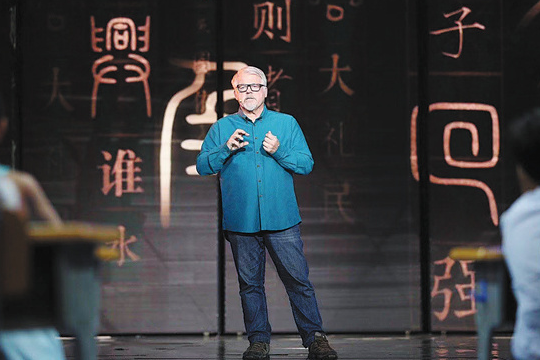
More people got to know Sears and his story after he appeared on a number of shows, including First Class for New Semester, an annual program for primary and secondary school students on China Central Television, and Chinese Bridge on Hunan Satellite TV.
Currently, the website receives about 300,000 visits every month on average across more than 170 countries and regions. Half of the hits are from China.
In addition to the database, he has explained the etymology of 15,000 modern characters on the website, which means 99.99 percent of all the characters that the average Chinese is going to see.
"You can put in any simplified character or any traditional character. And you can see the change over 3,500 years. And you can see the logic explained," he says.
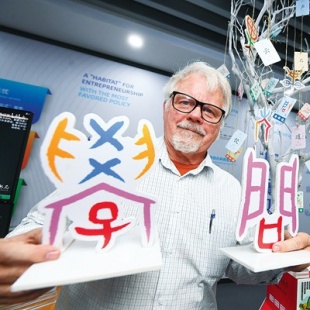
For example, the character jia (home) has a rooftop and a pig underneath. The pig is there to share one roof, he explains. In southern China where it rained a lot, people would put the house on stilts, so if it flooded, the inside of the house would not get wet. So the pigs lived underneath the house.
Sears says he likes to go out in the countryside and talk to farmers and look at how they grow their crops.
"And I look at ancient technology, spinning and weaving. And I think does this correspond to some ancient Chinese character? So I learn more by going out in the Chinese countryside, looking at how people do things."
He says there are probably 400 characters that are based on spinning and weaving. "Like the word for grandson, one character component looks like a cheese ball. That's because it was a job of small children to spin thread. So that would be the sunzi (grandchild). So this is very interesting."
Through years of study, Sears says he has found that many modern Chinese have blindly memorized Chinese characters, and they don't understand that characters come from pictographs. "But if you understand the ancient Chinese pictographs, you can understand a lot about ancient Chinese people," he says.
"So if you know the history of Chinese characters, then you know something about everyday life of ancient Chinese."
If you look at the sky, can you tell where huangdao (ecliptic) is, Sears asks.
"Every ancient Chinese knew where it was," he continues. "It's the star that goes from due east to due west. And it was extremely important to ancient Chinese. It was a matter of life and death.
"It was important to understand astronomy. That's the way they arranged agriculture. But most people today don't think about that. They hear the words, but they don't understand what it's about."