



Building China's impressive high-speed rail









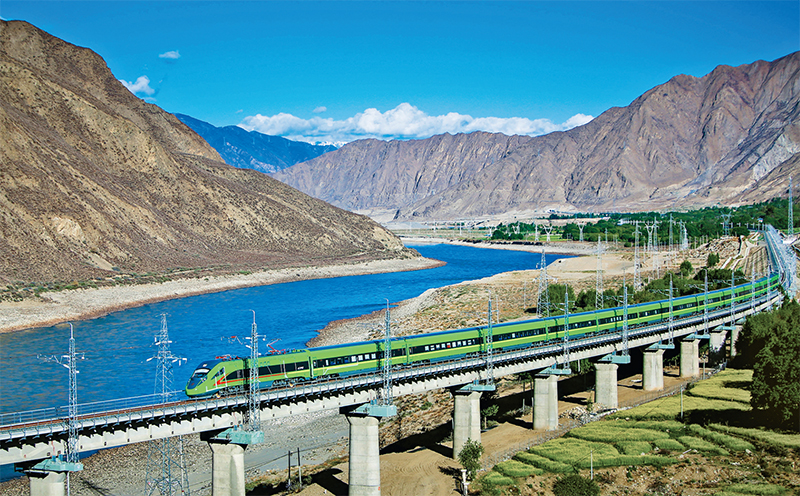
High-speed rail (HSR) is an important indicator of the modernization of a country's transportation and a significant reflection of its level of industrialization. Despite developing HSR more than four decades later than some developed countries, thanks to the tireless efforts of several generations of railway workers, China has made historic progress in HSR, from trailing other countries, to keeping pace with the competition, and to leading the world.
China has built the world's largest and most modern HSR network.
Since the Beijing-Tianjin intercity railway — China's first train line with a design speed of 350 km/h — was completed in 2008, dozens of HSR routes have been completed and gone into service. After the 18th CPC National Congress in 2012 in particular, the development of HSR moved onto fast track, with average annual construction of 3,500 km of railway. Both the speed and quality of this construction have received global acclaim.
—China has the longest operational HSR network in the world.
At the end of 2020, China had 37,900 km of operational HSR, accounting for 69 percent of the world's total. This included 13,700 km (36 percent of China's total) of railways with a maximum operating speed of 300-350 km/h, and 24,200 km (64 percent) with a maximum operating speed of 200-250 km/h.
—China has the fastest commercial railways in the world.
China's Fuxing trains operate at a speed of 350 km/h on 1,910 km of HSR lines, including the Beijing-Shanghai, Beijing-Tianjin, Beijing-Zhangjiakou, and Chengdu-Chongqing routes. China is the only country in the world with commercially operated HSR trains that travel at 350 km/h. The country's HSR network stretches from northeast forests and snowy plains to the Yangtze River Delta in the south, from the northwest Gobi Desert to the eastern coast of the East China Sea, traversing rivers and mountains to reach every corner of the country. The HSR system was originally designed along four major north-south routes and four major east-west routes, but is being expanded to create a dense network of routes based around eight major north-south routes and eight major east-west routes. The system already covers 92 percent of Chinese cities each with a population of more than half a million.
China has built a world-leading HSR system with independent intellectual property.
China has a complete HSR technology system consisting of three main areas: engineering construction, equipment manufacturing, and operations management. Its HSR technology is at the global forefront, and has become a world leader in a number of fields, making the significant transition from straggler to pacesetter.
—Engineering construction
Due to China's complex and diverse terrain and climate, construction of the HSR network has required overcoming some of the world's most difficult technical challenges, including in the areas of railway foundations, tracks, long and large bridges and tunnels, mass transit stations, and system integration. With the focus on original innovations, China has developed a complete set of technologies for the construction of HSR under varied geological and climatic conditions. These achievements include the construction of the Shanghai-Sutong Yangtze River Bridge and the Wufengshan Yangtze River Bridge, both of which have main spans exceeding 1 km; six world-class HSR bridges each with a span exceeding 500m, including the Tianxingzhou Yangtze River Bridge in Wuhan; more than 100 HSR tunnels over 10 km in length, including the Shiziyang Tunnel on the Guangzhou-Shenzhen-Hong Kong express rail link and the Qinling tunnels on the Xi'an-Chengdu HSR route; and many modern HSR hub stations, including Beijing South, Shanghai Hongqiao, and Guangzhou South. In recognition of these feats, several HSR bridges and tunnels have won the industry's highest awards issued by the International Tunnel and Underground Space Association (ITA-AITES) and the International Bridge Conference (IBC).
—HSR technology and equipment
Following the introduction of advanced technology from abroad, China jointly designed and built the Hexie bullet (also known as electric multiple unit (EMU)) train with its partners. Then, after persevering with independent innovation, China broke through technical bottlenecks to develop the world-class Fuxing Chinese Standardized EMU, featuring completely independent intellectual property, which includes the Fuxing Intelligent EMU model, the world's first train capable of automatic operation at 350 km/h. China has developed a range of Fuxing train products at different speed grades in the range of 160-350 km/h, which can be adapted to operate in harsh environments, such as plateaus, extremely-cold areas, high winds, and sandy conditions. To meet the unique requirements of HSR, China independently developed the CTCS-3 control system and built a dispatch control system using SCADA, giving the network a powerful, safe, and reliable central nervous system and power supply system. Other advanced technologies, such as the BeiDou Navigation Satellite System, 5G, and big data, have been successfully applied to HSR.
—Operations management
China has mastered the full gamut of HSR operations management technologies despite the complexity of the rail network. It has created scheduling technology for high-density, cross-line (running on HSR and conventional rail) routes operating at different speeds. The system has overcome the difficulties posed by operating various EMUs and speed classes over long distances and across line types to offer high-density public transportation on busy high-speed main lines and intercity railways, with departure intervals of just 4-5 minutes at peak times.


- Xi'an workshop lets tourists hand-make their own Terracotta Warriors
- Xinjiang's Changji welcomes visitors with festive Spring Festival flavors
- Guizhou seed specialist helps Nigerian farmers develop rice cultivation
- Ministry refines safety measures ahead of Spring Festival holiday
- Chinese scientists awarded for sci-tech innovation and leadership in frontier research
- Bilingual tour guide turns passion into dream career








