Tibetan opera takes center stage, prepares for encore









Editor's note: From arts and crafts to knowledge and skills, China's intangible cultural heritage is invaluably embedded in its ethnic communities. This series looks at the latest efforts to preserve and promote the country's inherited traditions and living expressions.
When Nyima Tsering was a boy herding livestock in the mountains of the Tibet autonomous region, he was often joined by an elderly woman who sang with him and shared her knowledge and skills in Tibetan opera.
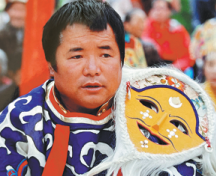
"I learned to play different characters in the opera," Nyima Tsering, 49, said. "At 16, I was accepted by the opera troupe in our village because I was very good at memorizing all the scripts of the opera," he added.
Nyima Tsering is an 11th-generation practitioner of Tashi Sholpa, or yellow mask, one of four types of Tibetan opera.
He is now at the forefront of the region's latest efforts to preserve and promote Tibetan opera, which is known as a living embodiment of traditional culture in Tibet.
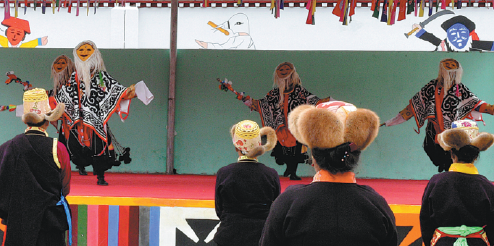
The colorful art form has been performed at major events such as the Shoton Yogurt Festival, the 2008 Beijing Olympic Games and the Shanghai World Expo in 2010.
It was listed as a national intangible culture heritage in 2006 and put on the United Nations Educational, Scientific and Cultural Organization's list of oral and intangible heritage of humanity in 2009.
Performing for the present
Despite the many modern entertainment choices available today, villagers in Lhokha are committed to practicing and preserving the ancient opera tradition.
Tashi Choten, Nedong county, with more than 500 residents, is known as "the village of Tibetan opera" and is famous for its Yarlung Tashi Sholpa opera troupe. Nyima Tsering is its director and plays the lead roles in most of its operas.
Over the past 25 years, the troupe has mainly performed Chogyal Norsang, one of the eight Tibetan operas, which tells of the battle between two kings.
Tibetan opera performers wear masks, and the operas are divided into several schools based on color. Tashi Sholpa performers wear yellow, while performers from other schools wear blue, white and black masks. The blue-mask school is the most popular style of opera performed in Tibet.
Nyima Tsering said there were only 16 opera performers in his village before 1968. After that, the opera troupe was disbanded for almost two decades.
In 1987, a new troupe was set up to revive the art form. Today, it has 30 performers ages 22 to 51. The troupe's 16 men and 14 women are mainly farmers who perform in their spare time.
Ready for the future
Nyima Tsering has trained 25 opera performers over the past 30 years. Among them is Norbu Tsering, 41, one of his major successes. Norbu Tsering enrolled in the troupe when he was 15. In his childhood, he enjoyed watching and learning about Tibetan opera stories from his grandfather who was a well-known performer, he said.
Norbu Tsering served his apprenticeship under Pema Dondrub, an opera master in the village. He also learned from Nyima Tsering, who had head become head of the troupe after becoming a fully qualified Tibetan opera actor following five years of training.
The troupe mainly performs Chogyal Norsang, and Norbu Tsering plays the roles of a doctor and fisherman, and sometimes fills in as director.
"We have performed the opera during Tibetan New Year, or Losar, for a month, 20 days during Lhasa Shoton (Yogurt) Festival, and for a week during the summer outdoor festivals," he said.
"Nowadays, we also perform for tourists from June to September every year. In all, we spend more than five months of the year performing," Norbu Tsering said.
"By performing the operas, I have learned more things about Tibetan culture and Tibetan Buddhism. I am proud of our culture and working as an opera actor. When I perform in opera, I feel I am the character."
Norbu Tsering said in the future he would like to work with master Nyima Tsering to save and pass on the ancient opera tradition. "We hope to train more actors so that we will have two teams," he said.
Since 2017, the troupe has added more operas to its repertoire, such as the blue-mask school Drowa Sangmo and Pema Wopar operas. Drowa Sangmo is about two queens, one who is virtuous and the other evil, and Pema Wopar tells the story of the son of a government minister fighting and defeating demons.
Traditionally, Tibetan opera performances take five to eight hours, however some performances in recent years have been shortened to accommodate audiences.
Since 2011, the troupe has received annual subsidies of 40,000 yuan to 200,000 yuan ($6,200 to $31,000) from the government to aid its efforts to preserve traditional Tibetan opera.
The subsidies, together with income from the exhibitions and performances for tourists, help each performer earn 10,000 yuan a year on average.
"Our village has become a tourist attraction. The tourists come to watch opera and traditional Tibetan dances and songs," Nyima Tsering said.
He wants to take Tibetan opera to more villages in the region, and he hopes that more people-especially young ones-will learn about the culture. On occasions, he gives talks about Tibetan opera in the village primary school.
"I hope the tradition of opera will be practiced in more villages of Tibet, and the ancient cultural practice will continue in modern times," he said.





- Xinjiang reports highest foreign trade growth in China
- Harbin authorities demand return of pensions paid out to deceased
- Global research project on AI guardrails launched in Beijing
- Partnering with China, embracing opportunities
- China's cyberspace regulators announce measures for protection of minors
- Beijing's 'Rocket Street' promoted at aerospace conference