Benefits flowing from plan for river basin protection









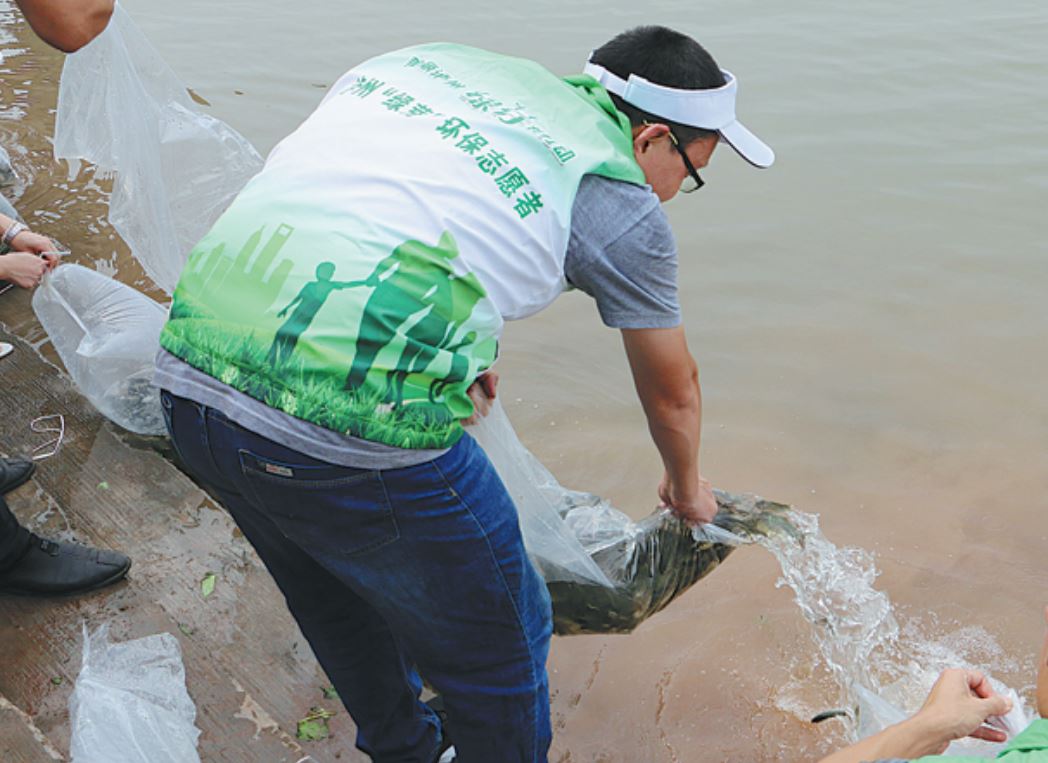
Yunnan, Sichuan and Guizhou work together to tackle Chishui pollution
A mechanism that protects river basins by compensating upstream areas for their environmental conservation efforts has promoted environmental protection and socioeconomic development, with the Chishui River in Southwest China being a prime example.
Flowing for over 400 kilometers, the Chishui runs across three provinces. Rising in Yunnan, it joins the Yangtze River, Asia's longest watercourse, in Sichuan. Most of the tributary, however, is in Guizhou.
With no dams along its length, it's the last free-flowing tributary on the upper reaches of the Yangtze. Home to more than 160 species of fish, the Chishui is key to biodiversity conservation in the entire Yangtze basin.
In 2018, the three provincial governments signed an agreement to introduce the mechanism to the Chishui and committed to contributing a total of 200 million yuan ($31 million) a year to a fund dedicated to the river's conservation.
As the region that will gain the least economic benefit from the joint environmental protection efforts, Yunnan will only contribute 10 percent of the fund. However, it will get 30 percent of the proceeds.
Guizhou and Sichuan, each with an alcohol industry heavily dependent on water from the river, will contribute 50 percent and 40 percent, respectively. When it comes to distribution, Guizhou will be allocated 40 percent and Sichuan 30 percent.
In Yunnan, the Chishui only runs through the city of Zhaotong. The city's ecology and environment department said Zhaotong has received 140 million yuan from the fund, which it has used to roll out 11 pollution control projects.
Zhang Ning, the department's deputy head, said nine of the projects have been completed.
In one of the projects in the town of Chishuiyuan-which means the source of the Chishui-a sewage disposal plant with a daily capacity of 1,500 cubic meters has been completed. A sewage pipe network extending 16.5 km has also been built.
"Thanks to these projects, all areas in the Chishui basin have been preliminarily covered by disposal facilities for domestic waste and sewage," Zhang said, adding that the facilities have greatly improved the living environment in the city's rural areas.
The department says the quality of water flowing into Guizhou from Yunnan was kept at or above Grade II, the second-best level in the country's five-tier quality system for surface water, from 2018 to last year.
Aside from reducing economic losses caused by pollution in Zhaotong and giving downstream areas relief from environmental problems, Zhang said the improved water quality has helped boost the city's tourism industry and increase residents' incomes.
Li Yong, deputy head of Zhenxiong county, where the Chishui originates in Yunnan, also lauded the compensation mechanism.
He said governments on the Chishui's upper reaches have seen their financial stresses from promoting environmental management in the basin ease substantially, which has motivated further pollution control efforts.
The environmental improvement has not only benefited locals but also people far afield in downstream areas.
In Guizhou, the provincial government is eyeing further expansion of the alcohol industry, which has most of its production capacity concentrated near the Chishui, as the watercourse continues to improve.
A total of 266.2 million liters of alcohol was produced in Guizhou last year, according to the provincial government.
Guizhou plans to increase production to 600 million liters by 2025, when the production value of the industry in the province is expected to reach 250 billion yuan.
Zhong Fangda, president of Guizhou-based liquor producer Xijiu, has emphasized the importance of the Chishui's environment to efforts to further develop the province's alcohol industry.
"Only when the ecosystem of the Chishui gets well protected can we have a good living environment that could guarantee a happy life for the people," he said. "This is also a must for the high-quality development of the liquor industry."
Yang Jun in Guizhou contributed to this story.





- 10 dead and 84 injured in explosion at steel plant
- China unveils flexible urban planning rules to improve lives, foster new industries
- Ex–China Construction Bank executive gets 18 years for bribery, loan violations
- First batch of eco-friendly pioneer zones for construction of beautiful countryside unveiled
- Woodpeckers, finches captured in Jilin winter scenes
- Mainland reiterates 1992 Consensus as foundation for resuming cross-Strait dialogue