



Conscientious team assists birds in their search for food









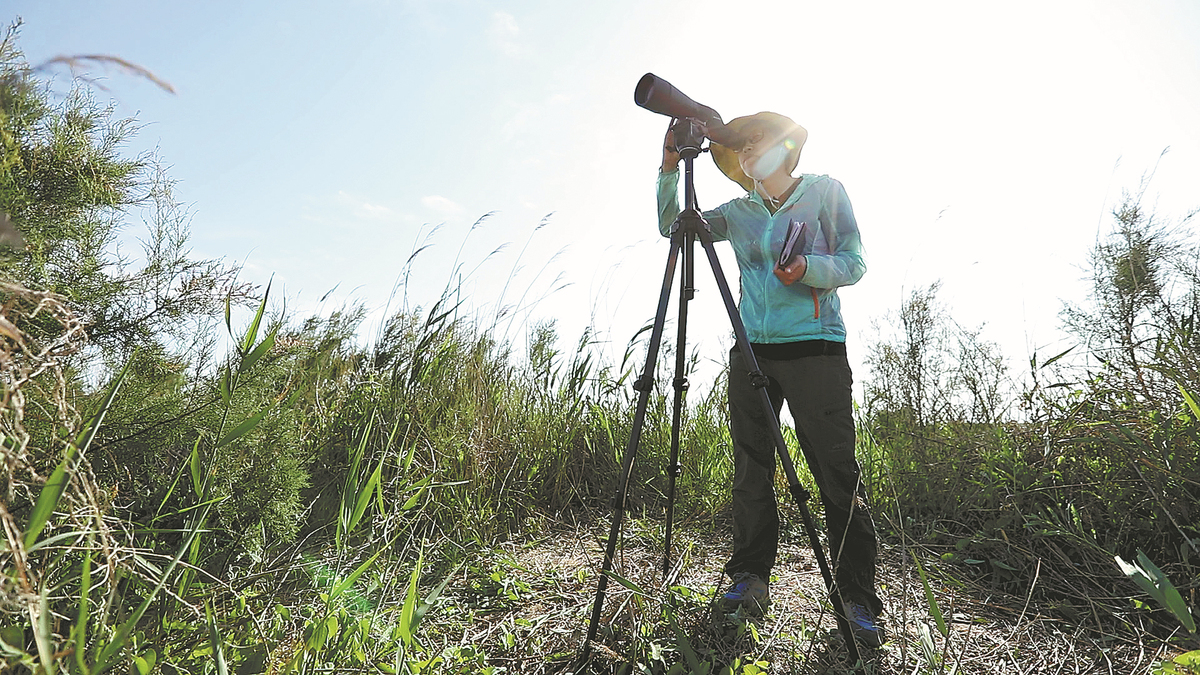
Millions of migratory birds start arriving at the Yellow River Delta National Nature Reserve in Dongying, Shandong province, in mid-October.
They rest in the wetlands, feeding on a rich variety of food such as fish, shrimps and grain to build their strength. Some birds even make the wetlands their home all year.
Zhao Yajie, 34, is a member of a team patrolling the wetlands every day to ensure a safe environment for the birds.
After being awarded a doctorate in ecology by the China Academy of Sciences' Institute of Applied Ecology, Zhao started work at the reserve in 2014. Her main jobs are conducting scientific research on ecological restoration and protection, and monitoring the birds' conditions, such as their numbers and the different types of species at the reserve, along with the birds' environment.
In October and November, Zhao and her colleagues collect samples from the birds, such as fresh droppings.
"We analyze the droppings at our laboratories to see whether the birds are carrying flu," Zhao said.
The team carries out a comprehensive survey of birds at the reserve in winter. This work also includes checking the number of species, the population of a particular species, and the birds' habits.
"Species such as the red-crowned crane like looking for food in the tidal-flat areas, and crabs are their favorite. To avoid being disturbed, these birds prefer to stay on land surrounded by water or in an area packed with reeds," Zhao added.
Information gathered on the birds' habits helps Zhao and her colleagues create a better environment for them. To ensure that arrivals have sufficient food, the team has created what it terms "small dining tables" for the birds.
In the marshes, an area of water 10 centimeters to 25 cm deep has been created for Oriental storks and egrets to look for food. Next to this shallow area, an expanse of water 30 cm to 100 cm deep has been set up for swans and gray geese to eat water grass.
When spring and summer arrive, Zhao and her colleagues conduct a survey on the birds' breeding habits. They count the number of nests, eggs and nestlings. Zhao likes this work best, as she loves to welcome new life to the wetlands.
"I'm amazed by some Saunders's Gull chicks who stay in my shadow to avoid the sun and potential enemy birds flying in the sky. The chicks are weak, but so cute, so I feel a strong need to protect them," Zhao said.
Every time a chick stands in her shadow, Zhao is reluctant to leave until its mother appears. The moment Zhao departs, the mother swoops down and covers the young bird with her wings.
"As a mother myself, I can sense their love," said Zhao, who has a 4-year-old daughter.
Working on such a large wetland area is not always easy.
"When we walk on the mud flats, every step is so hard, because we need to pull our feet out each time," Zhao said.
From 2015 to 2018, the reserve teamed up with Qingdao Agricultural University in Shandong to survey insects at the reserve.
Zhao and her teammates carried a positioning system to find their way back to their work station.
"This system is very helpful, especially when we walk among reeds growing more than 2 meters high in the wetlands," Zhao said.
The team also has to contend with mosquitoes in summer that are larger than those seen typically in China.
Over the past seven years, Zhao has visited all the reserve's main areas. This year, a center using digital technology, including a remote monitoring system, was put into use, making her job easier.
"Every year, I welcome migratory birds at the reserve and see them depart. I have seen some species several times, but on each occasion, I am just as excited as the first time," she said.
In her spare time, Zhao gives speeches to students conducting field studies at the reserve.
"The students are very interested in the birds, plants and landscape at the reserve. They will learn a lot, such as why Oriental storks communicate by clattering their bills and why some grass tastes salty. Students can also try their hand at making nests," she said.





- IP protection for new fields to improve
- Draft rules define premade dishes in consumer interest
- Self-powering pacemaker could last a lifetime
- China intensifies crackdown on misuse of personal data
- China issues new rules classifying online content harmful to minors
- Chinese vice-premier urges efforts to consolidate poverty alleviation achievements














