New rules prove game-changer in livestreaming









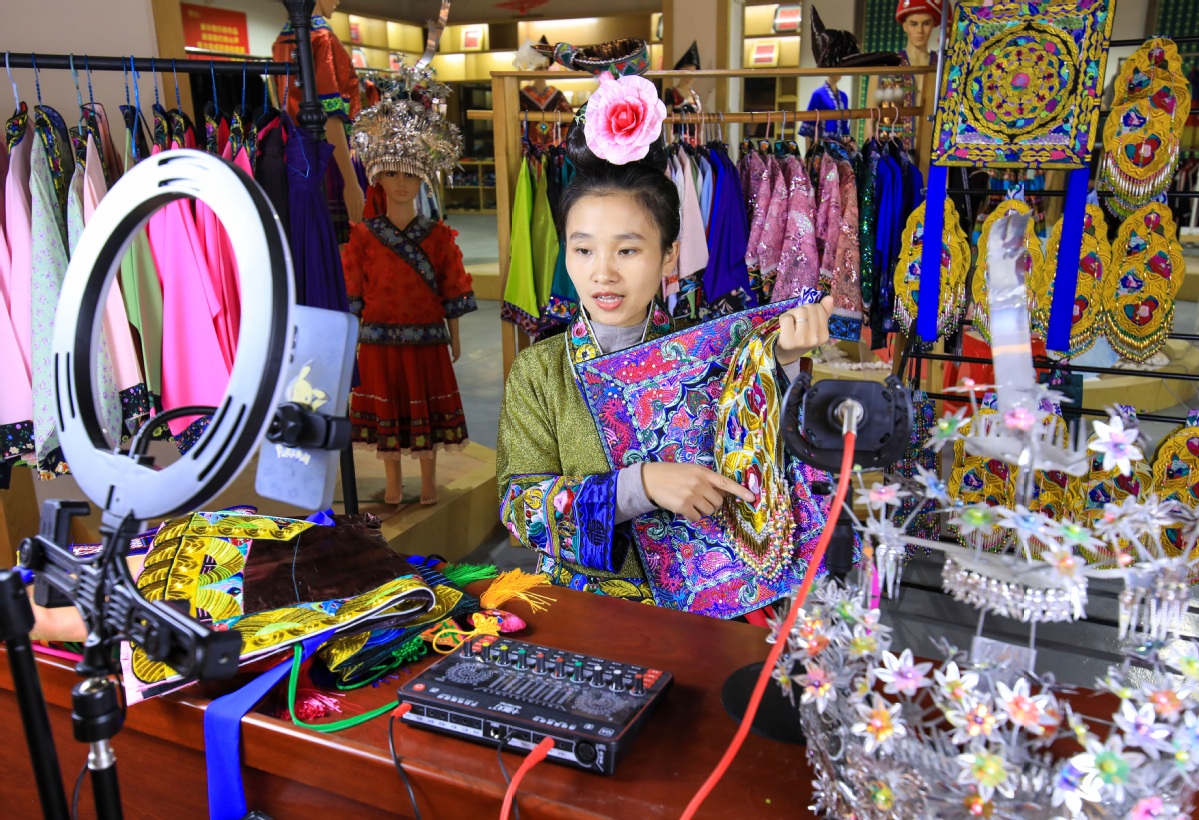
Emerging e-commerce segment set to flourish in orderly fashion for long-term growth
Livestreaming has become such an integral part of e-commerce in China that the new format raked in sales worth an estimated 1.2 trillion yuan ($188.28 billion), or nearly 9 percent of the total, by the end of last year.
That piece of data from consultancy iiMedia acquires significance given the fact that in 2017, livestreaming contributed no more than 19 billion yuan to e-commerce sales, or just 0.26 percent of the total.
Livestreaming's success is partly attributable to the peculiar market situation created by factors relating to the COVID-19 pandemic, which forced the format to quickly evolve from a nice-to-have option to a necessity for brands to power online sales.
Confined to indoors during the pandemic lockdowns, consumers turned to e-commerce for supplies, and the new phenomenon of livestreaming caught on and experienced a meteoric rise, market experts said.
An average of 1.5 million livestreaming sessions were conducted on a daily basis, according to the China Internet Network Information Center.
What's more, it spawned stars and icons called influencers who can orchestrate online sales worth billions of yuan in a jiffy, themselves becoming multimillionaires in the process.
Now, new rules and regulator scrutiny are seeking to better regulate the emerging livestreaming segment of the e-commerce sector, the backbone of the retail industry.
A slew of fines were levied on topnotch livestreaming influencers who failed to declare personal income honestly. Hence, they incurred massive backlogs of unpaid taxes, late fees and penalties.
For instance, Huang Wei, an influencer better known by her professional name Viya, was slammed with a record 1.34 billion yuan in fines on Dec 20 for hiding her commissions. In her income tax filing, Viya declared personal wages as corporate income, and omitted reports of taxable income between 2019 and 2020.
Just weeks before that, two other notable livestreamers, Zhu Chenhui (better known by her online avatar Xueli Cherie) and Lin Shanshan, were also fined for tax evasion, with their social media accounts and Taobao stores temporarily inaccessible.
All these influencers were fined by the local taxation authorities in Hangzhou, Zhejiang province, where e-commerce giant Alibaba has its headquarters.
These events sent shock waves across the country's livestreaming sector, said Ma Kainong, a lawyer at Zhejiang Zeda Law Firm. He said he believes the moves were essential to restoring market order.
"The likes of Viya are concealing personal income and declaring personal wages as income for proprietorships. These are clearly ill-intentioned tax evasion moves that are subject to taxation regulations," said Ma, adding such violations have disrupted the order of tax collection and undermined market environment for fair competition.
In a note explaining the rationale for fining Viya, the Zhejiang Taxation Service said the current decision is for the long-term benign development of the platform economy. Meanwhile, taxation authorities should implement all favorable policies possible to optimize services and create a sound taxation environment.
Despite an obscure start in 2016, livestreaming has mushroomed into a common practice for consumer brands over the years, to retain existing users and to attract new ones.
For consumers, livestreaming provides immersive experiences and personalized recommendations from key opinion leaders, or KOLs, and other hosts, and serves as an entertaining alternative to physical shopping trips, said Derek Deng, partner of Bain& Co, who leads the consultancy's consumer products practice in China.
Unique personas hold the key to diverting online traffic to virtual livestreaming rooms, which have the potential to become cash cows for livestreamers.
According to Mo Daiqing, senior analyst at Hangzhou-based Internet Economy Institute, leading livestreaming hosts such as Viya and Li Jiaqi (who is known for his incomparable techniques for selling lipstick) carry typical "rags to riches "stories that in part boost and solidify their cult following.
"So, this wave of tax evasion incidents is expected to deal a huge blow to these icons," said Mo. "Viya's Taobao Live account has over 90 million followers. It might be time that they knock her off the pedestal."
In addition to severe dents in personal image, hosts are facing increasing conflicts with the very brands they endorse over the split of profits and the fight for user loyalty, Deng said.
"For example, goods promoted by KOLs are usually sold at deep discounts and require commissions as high as 30 percent as well as a listing fee to advertise," Deng said.
"Moreover, by selling via a KOL's livestreaming room, brands lack full access to the consumer data that has become critical to retargeting and retention."
Such tensions ballooned into a major public outcry in November, when cosmetics giant L'Oreal Group fell afoul with the livestreaming duo over a promise of "deepest discounts", which failed to materialize.
The company's mass market marque L'Oreal Paris had advertised that customers stand to secure the steepest discount for a facial mask if they tuned into Li's livestreaming sessions during a pre-sale for the Nov 11-Singles Day or Double-Eleven-campaign, China's largest shopping spree.
Consumers later found out they were able to buy the same product at nearly half the price by snatching vouchers during L'Oreal Paris' own livestreaming sessions. In light of Li and Viya boycotting the brand before a deal was properly settled, L'Oreal apologized and offered compensation plans.
But the snafu is also indicative of the distorted pricing system led by certain livestreamers, suggesting that the industry requires scrutiny and regulation, Mo said.
"We are seeing surging fees of all kinds being imposed on merchants, such as commission fees, traffic fees and the fees to promise offering the lowest price possible," she said. "This is clearly a great departure from where the practice first started out, and should be rectified outright."
As such, more established brands are aggressively moving toward starting their own livestreaming activities. According to Deng, brands are now taking a share of data from KOLs, though many still remain popular.
"So-called 'self-livestreaming' positions the brand to retain consumers for repurchase, and enables timely consumer interaction and support that can improve loyalty and the possibility of lowering refund rates," Deng said.
Such a trend was picked up by consultancy Kantar, which polled 1,000 customers participating in last year's Nov 11 shopping gala.
Among the 747 people who watched at least one livestreaming session during the event, 83 percent said they watched sessions conducted by their beloved brands, which is significantly higher than those conducted by KOLs at 43 percent and those participated in by celebrities at 30 percent.
Zheng Zhuoran, an independent analyst of digital marketing, said the "collapse" of Viya is unlikely to give rise to other lesser-known individual livestreamers, given the business is in essence a "winner-takes-all game".
But he said he remains optimistic about the prospects of merchant-driven self-livestreaming, suggesting new formats such as talk shows or cosplays, could emerge.
"During self-livestreaming sessions, merchants don't need to compete intensely with sales efficiency and track how many items are sold in an hour," he said. "Instead, they manage to focus on customer education and daily engagement with followers, which is valuable to brands over the long term."
More importantly, regulation of the sector is also fostering customers to shop in a more informed and rational manner, "thus squeezing unnecessary intermediary costs and enhancing the efficiency of business circulation", he added.