



RCEP: Victory for an open region









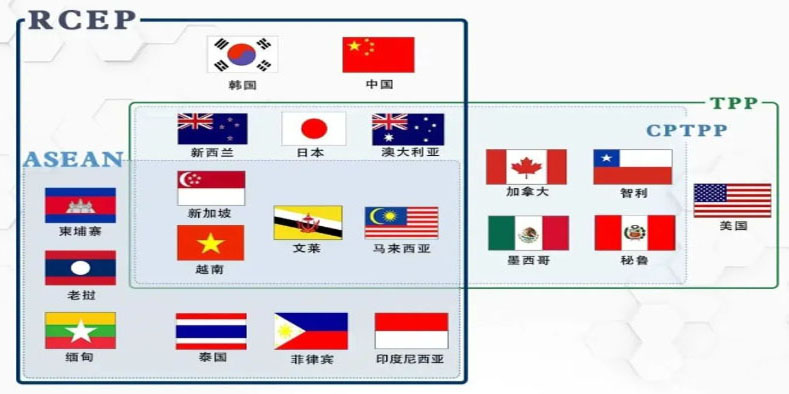
After seven years of marathon negotiations, the Regional Comprehensive Economic Partnership Agreement, or RCEP — a mega FTA spanning two continents — was launched at last on Jan 1. It involves 15 economies, a population base of about 3.5 billion and a GDP of $23 trillion. It accounts for 32.2 percent of the global economy, 29.1 percent of total global trade and 32.5 percent of global investment.
The RCEP is a victory for open regionalism. Against the backdrop of rising global protectionism and unilateralism, compounded by trade restrictions imposed by some countries with a mindset of "my own interests first," the RCEP, with a major goal of eliminating tariff and non-tariff barriers and promoting trade and investment facilitation and liberalization, has injected new momentum into open and inclusive cooperation and revitalized multilateralism and free trade globally.
As a regional trade agreement covering the major economies in the Asia-Pacific region, the RCEP, together with the North American and European trade networks, has formed a "triad" for trade. In the past five years, the average economic growth rate of RCEP members reached 5.2 percent, which not only exceeded the growth rate of the CPTPP (2.2 percent), the EU (2.3 percent) and the USMCA (2.4 percent), but also eclipsed the global average growth rate of 3.4 percent, making the RCEP region the fastest-growing and most promising one in the world.
In terms of trade in goods, tariff concessions allow for substantial reductions in tariff barriers between RCEP parties. With the RCEP agreement taking effect, the region will achieve tax concessions on trade in goods in different formats, including immediate reduction to zero tariffs, transitional tariff reductions, partial tariff reductions and exception products. Eventually, more than 90 percent of trade in goods covered will achieve zero tariffs.
In particular, the implementation of the cumulative rules of origin, one of the hallmarks of the RCEP, means that as long as the criteria for cumulation are met after changing the approved tariff classification, they can be accumulated, which will further consolidate the industrial chain and value chain in the Asia-Pacific region and accelerate economic integration there.
In terms of trade in services, the RCEP reflects a strategy of gradual opening. A negative list approach is adopted for Japan, Korea, Australia, Indonesia, Malaysia, Singapore and Brunei, while the remaining eight members, including China, have adopted a positive list approach and are committed to shifting to a negative list within six years. In addition, the RCEP includes finance and telecommunications as areas of further liberalization, which greatly improves the transparency and consistency of regulations among members and leads to continued institutional improvement in economic integration in the Asia-Pacific region.
China is bound to play a more active role in open regionalism. This is the first truly regional FTA whose membership includes China and, thanks to the RCEP, trade with FTA partners is expected to increase from the current 27 percent to 35 percent. China is one of the major beneficiaries of RCEP, but its contributions will also be significant. The RCEP will enable China to unleash its mega market potential, and the spillover effect of its economic growth will be fully brought out.
Regarding global demand, China is gradually becoming one of the three hubs. In the early days, only the US and Germany claimed that position, but with the expansion of China's overall market, it has largely established itself at the center of the Asian demand chain and even factors in globally.
In recent years, China has sought to rebalance its economic development, which means that while it further expands its exports it will also actively expand its imports. China is the largest trading partner and source of imports for ASEAN, Japan, South Korea, Australia and New Zealand. In 2020, China’s imports from RCEP members reached $777.9 billion, exceeding the country’s exports to them of $700.7 billion, nearly one-fourth of China’s total imports during the year. Customs statistics show that in the first 11 months of this year, China’s imports and exports to the other 14 RCEP members topped 10.96 trillion yuan, representing 31 percent of its total foreign trade value in the same period.
In the first year after the RCEP agreement takes effect, China’s average import tariff rate of 9.8 percent will be reduced, respectively, to ASEAN countries (3.2 percent), South Korea (6.2 percent), Japan (7.2 percent), Australia (3.3 percent) and New Zealand (3.3 percent).
Among them, the bilateral tariff concession arrangement with Japan particularly stands out. For the first time, China and Japan have reached a bilateral tariff concession arrangement under which both sides substantially reduce tariffs in a number of fields, including machinery and equipment, electronic information, chemicals, light industry and textiles. Currently, only 8 percent of the Japanese industrial products exported to China are eligible for zero tariffs. Under the RCEP agreement, China will exempt approximately 86 percent of Japanese industrial manufactured products from import tariffs in phases, mainly involving chemicals, optical products, steel products, engine parts and auto parts.
In general, the RCEP has raised the bar higher than previous FTAs in the Asia region, and the level of openness under the RCEP is significantly higher than the 10+1 FTAs. In addition, the RCEP will help foster consistent rules in a relatively integrated market, not only in the form of more relaxed market access and lowering non-tariff barriers but also in terms of overall customs procedures and trade facilitation, which go further than the WTO’s Trade Facilitation Agreement.
However, the RCEP still needs to work out how to upgrade its standards against the next generation of global trading rules. Compared with the CPTPP and the prevailing trend of new global trade rules, the RCEP is thought to focus more on tariff and non-tariff barrier reduction, rather than emerging issues such as intellectual property protection. Therefore, in order to steer regional economic integration toward a higher level, the RCEP must hold upgraded negotiations on emerging issues such as government procurement, intellectual property protection, competition neutrality and e-commerce.
The author is a Senior Fellow at China Center for International Economic Exchanges.
The article was first published on chinausfocus on Jan 24, 2022.
The views don't necessarily reflect those of China Daily.





