



Veteran diplomat: Steady ties essential









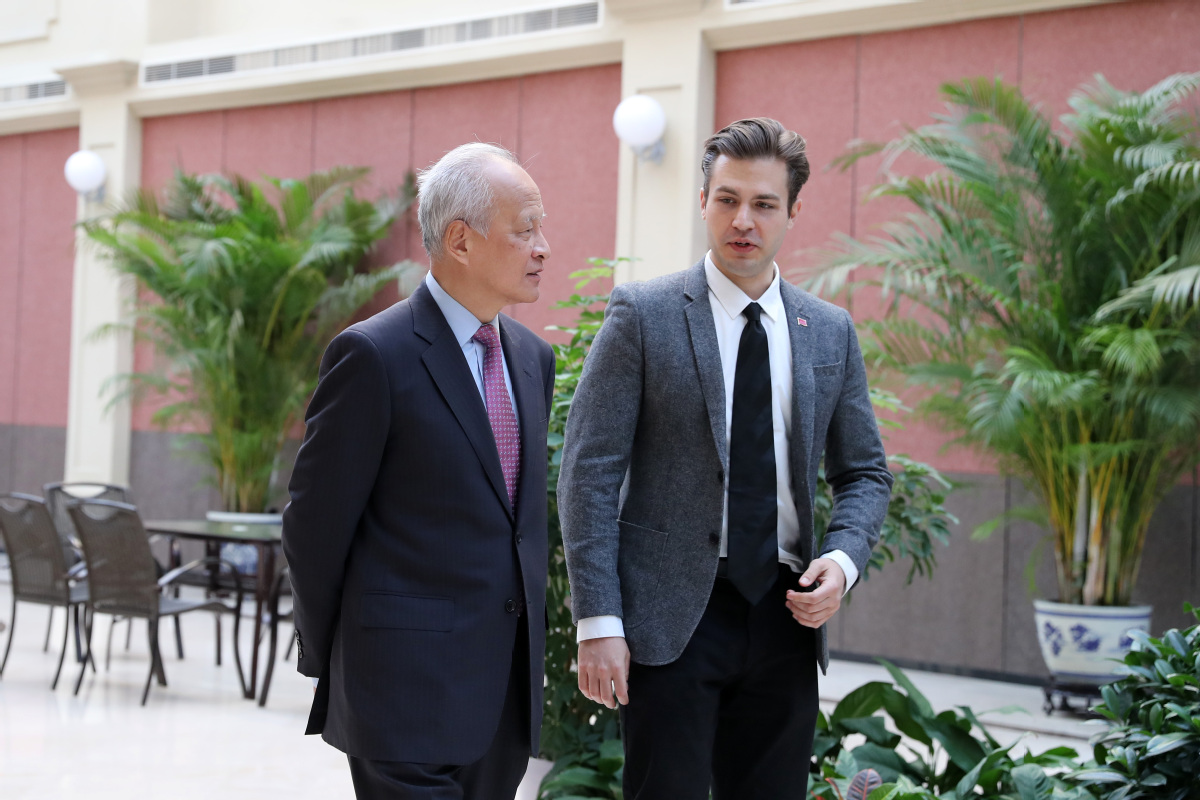
Q: So you mentioned the 40th anniversary of the third communique. So there's also the anniversary, I believe, the 50th anniversary of the Shanghai Communique. And this took place during Richard Nixon's visit. What lessons can we take from this moment in time?
Cui: I think the most important agreement in the Shanghai Communique is that the US agreed not to challenge this one-China principle. The US was ready to recognize there's only one China in the world.
Q: There are these accusations being thrown about of "assertiveness" or "aggressiveness". Where does this come from? How do we clarify this better for people?
Cui: I think sometimes American politicians or maybe even some people in the media, they are very good at putting the label on others for all the things they themselves are doing.
For instance, on the question of Taiwan, what we are doing is very simple. We are defending our territorial integrity and national unity. We are not being aggressive to other countries.
But at the same time, if people are trying to sell arms to support these attempts at so-called independence in Taiwan, if people are selling arms and giving political support to such attempts, this is real action of aggression. Because they are intervening and trying to undermine the unity and territorial integrity of other countries.
Q: We also hear allegations of "assertiveness" as it relates to the South China Sea. Can you talk about the present situation?
Cui: You see in the South China Sea, we have countries putting forward different claims. We have our own claims, and we certainly believe we have sufficient historical and legal foundation for these claims.
There's ongoing effort for the claimant countries to communicate with each other, to work out an agreement. For instance, there are discussions between China and some other countries on the code of conduct.
Actually, we already have the Declaration of Conduct for many years, which is basically a political document. Now we are working on a more binding document, a code of conduct. I think we are making good progress. We want to solve the issue through negotiation.
But now the problem is that the US is trying to intervene, although they have no territorial claims in the region. They are trying to intervene by force. They are sending more and more warships, military planes into the region. Trying to escalate the tension, to stir up conflict.
Q: How do you manage this relationship in a way you can ensure that there's not a risk of this kind of catastrophic event? Because you have to balance the need to protect territorial integrity and to protect sovereignty, but also the need to avoid war between nuclear powers.
Cui: I think for the situation in the South China Sea, if there is no outside interference, I have full confidence the regional countries will be able to solve the disputes by themselves. So hopefully, the US and others will refrain from intruding, intervening into the situation, making things more complicated, even harder to resolve.
As for the possibility of direct conflict between nuclear powers, it's going to be disastrous.
A few days ago, the five nuclear weapons states issued a joint statement to say there should be no attempt to fight such a war and nobody can afford such a war. This is a right statement to make and it has to be implemented.
Q: You mentioned the challenges that face the entire world that can only be solved through joint action. What is the right path for China to take and the US to take?
Cui: I think fundamentally it's a question of world outlook. We have a shared future. That's why we believe that despite all the differences among countries, we should focus on the common challenges, on the real global challenges, and a shared interest for the long run.
But sometimes there's too much obsession in America about global dominance, or as they say leadership. They believe everything is a zero-sum game.
We are all living on a small planet, the global village. And there are things that will affect us all, whatever our political beliefs, whatever our cultural values. We have to work together to address these real issues for the benefit of everybody.
We have different cultures, different political systems. This is a kind of diversity in the world. We should try our best to turn these differences into opportunities of mutual understanding and cooperation. So if people could have such a world outlook, we could really make a much better world.
Q: I wonder, you as a diplomat, having served as long as you have, how do you navigate these realities? How does a diplomat work in an environment such as this?
Cui: As diplomats, we should have an open mind, we should always be ready to learn more about others and to learn more from others. We have to have a good understanding of our own culture, our own system.
But we are also ready to understand others. We are also ready to recognize that other people, other nations have a different historical background. They may have a different path for their development. We believe people should have the right to determine their own destiny. But as part of the human being, as part of the international community, we share so many things.
I think these are the basic things a diplomat has to believe in. And because we are diplomats, we should help others. I mean people in our own country, people in other countries to have better communication and better mutual understanding to avoid misunderstanding, misperception, miscalculation, and to certainly avoid conflicts and confrontation.
Q: Do you consider yourself an optimist for the future?
Cui: We should have confidence in ourselves, especially both China and the US, we are great countries.
And maybe what we can do as individuals is very little. But if all of us can do our own bit, then we put all the efforts together and we'll make a difference.










