Have disposable income, will buy imported goods









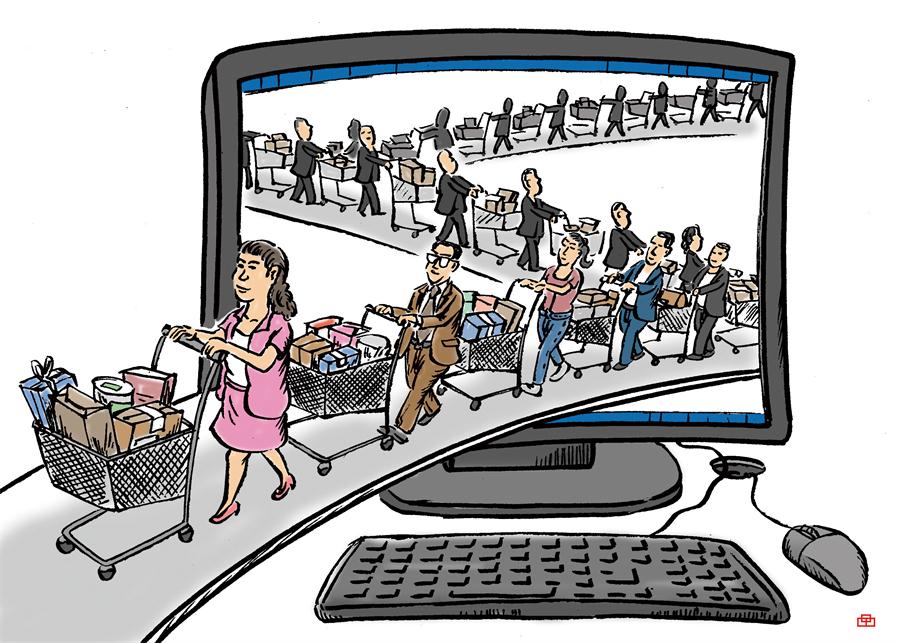
Crave imported products? If you are in China, you don't even have to visit exclusive stores to buy them anymore. Online shopping will suffice.
A growing number of Chinese consumers did just that this Spring Festival. They trawled websites and apps and filled their e-shopping carts with fresh produce, alcoholic beverages, cosmetics, jewelry, gifts, and what have you.
Shopping in the run-up to big festivals and family celebrations has long been a tradition in China-not only for personal consumption but also to gift prized goodies to relatives and friends.
True to that tradition, I shopped at some cross-border e-commerce platforms such as JD Worldwide and Tmall Global to welcome Spring Festival this year. To ring in the Chinese New Year (of the tiger), and to lift my spirits from the long shadow of the COVID-19 pandemic, I used apps to buy Chilean cherries, Norwegian salmon, New Zealand milk and French red wine. I'm not a shopaholic, I swear.
It took no more than a few days for all that goods to arrive in fine shape at my door, and they all looked (and tasted) authentic, and seemed worth the prices I paid for them.
In hindsight, I now understand the effect that cross-border e-commerce players have had on me and, presumably, on other Chinese consumers who sought to add an exotic twist to their Spring Festival shopping. Promotions of a wide range of authentic and high-quality overseas products and quick delivery services were irresistible indeed.
Chinese consumers have been displaying an increasing demand for premium brands and high-quality imported products like toothpaste, mattresses, clothes and handbags, said Zeng Bibo, founder and CEO of Ymatou, a Shanghai-based cross-border e-commerce platform, in the run-up to Spring Festival.
Zeng also said the post-90s generation favor niche and designer brands and are also big fans of e-commerce via livestreaming.
China's cross-border e-commerce sector has witnessed rapid growth. The import and export value of China's cross-border e-commerce was 1.98 trillion yuan ($312 billion) in 2021, up 15 percent, said the General Administration of Customs.
According to a report released by JD, the top three best-selling categories of imported products are beauty and makeup, healthcare, and maternal and baby products. Consumers prefer to buy products from the United States, Japan, France, Germany and Switzerland on JD.
Female consumers who buy imported merchandise outnumber male shoppers. The young generation aged below 30 is the fastest-growing consumer group for imported products, said the report.
Nowadays, imported goods are no longer exclusive to residents in first- and second-tier cities, as disposable incomes of people in third- to fifth-tier cities are up, spurring demand from such places, part of which is being met by convenient and efficient e-commerce channels, experts said.
Chen Tao, an analyst with the Beijing-based internet consultancy Analysys, said e-commerce platforms hope to seize the opportunities emerging from the consumption upgrade of Chinese consumers and the Lunar New Year shopping.
Chen said Chinese consumers have a rising demand for diversified, personalized and niche products made overseas.
"People in smaller cities and towns tend to celebrate Spring Festival by purchasing imported goods and have greater access to various kinds of special purchases due to the rising e-commerce penetration rate in these lower-tier areas," he said.
Last year, the per capita disposable income of urban residents came in at 47,412 yuan, up 8.2 percent in nominal terms and 7.1 percent in real terms, while that for rural residents was at 18,931 yuan, up 10.5 percent in nominal terms and 9.7 percent in real terms, data from the National Bureau of Statistics showed.
Consumers in third-tier cities and below, counties and rural areas account for about 70 percent of China's population, indicating huge untapped consumption potential, said Pan Helin, executive dean of the Digital Economy Research Institute at the Zhongnan University of Economics and Law.