How Xi's thought navigates China's high-quality development









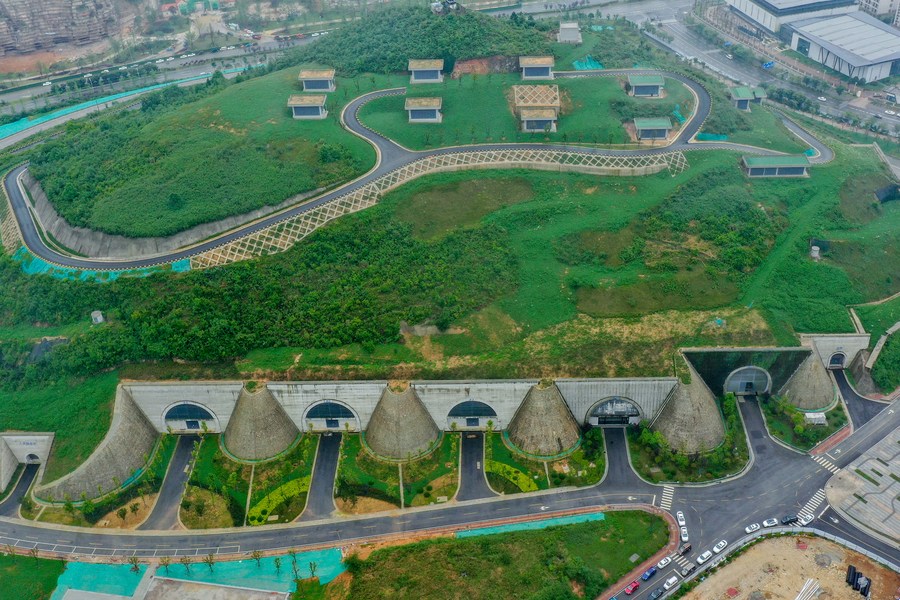
BEIJING -- Guizhou, the southwestern Chinese region once with the biggest poverty-stricken population at the provincial level, is now at the forefront of the world's latest technology revolution.
Thanks to the mild weather, clean air, and conducive geographical conditions, the province is now among the regions with the most mega-data centers globally. In 2021, the digital economy contributed about 34 percent of the region's gross domestic product (GDP).
The sea change took place in the past ten years. The locals refer to the period as the "golden decade." Since the convening of the 18th Communist Party of China (CPC) National Congress in 2012, Guizhou has been one of the fastest-growing provincial regions in China in terms of the economy and lifted 9.23 million people out of poverty.
Today, forests cover more than 61 percent of the region's land. It is also home to the Five-hundred-meter Aperture Spherical Radio Telescope (FAST), the world's largest single-dish radio telescope.
This "golden decade" of Guizhou typifies what has happened to China under the guidance of Chinese President Xi Jinping's economic thought. It steered the world's largest developing economy on a path of higher-quality growth that is more efficient, equitable, sustainable, and secure.
A look into Xi's economic thought on high-quality development and how far the country has come in achieving it may provide some insights into China's development experiences and clues for its future development trajectory.
A NEW DEVELOPMENT PHILOSOPHY
Back in 2012, when Xi was elected the general secretary of the CPC Central Committee, the Chinese economy was facing a growth slowdown after decades of skyrocketing expansion.
The lingering impact of the global financial crisis, an extensive growth model, pollution, as well as a stack-up of institutional and structural problems were challenging the traditional development pattern of this galloping economy.
Xi defined this phase of China's economic development as "the new normal," which called for new solutions to growth, structure, and a new driving force for the economy.
He has repeatedly emphasized GDP growth rate could not serve as the sole yardstick of success for development.
In search of solutions, the president visited cities, villages, and enterprises, and held meetings and symposiums with scholars, entrepreneurs, scientists, and public representatives to devise major plans and strategies for the country's next-stage development.
In 2015, Xi put forward a new development philosophy featuring innovative, coordinated, green, open, and shared growth. It set a fundamental guideline for China's economic development as the core of Xi's economic thought.
"These development concepts did not emerge from the ether; they came from the domestic and foreign experience of development, and from analysis of both domestic and foreign trends in development," Xi explained.
"They epitomize our Party's growing understanding of laws governing economic and social development based on our country's most prominent problems," he said.
Two years later, at the 19th CPC National Congress, Xi made a significant judgment that the country's economy had been transitioning from a phase of rapid growth to a stage of high-quality development.
Since then, high-quality development has become the fundamental requirement for authorities to make economic policies and exercise macroeconomic control.
In a landmark resolution released last autumn, the CPC reiterated the need to achieve high-quality development. It is a development blueprint in which "innovation is the primary driver, coordination is an endogenous trait, eco-friendly growth prevails, openness to the world is the only way, and shared growth is the ultimate goal."
HIGHER-QUALITY DEVELOPMENT
Guided by the new development philosophy, China has carried out strategies featuring a supply-side structural reform, poverty alleviation, innovation, pollution control, rural vitalization, coordinated regional development, the socialist market economy, and greater opening-up.
Under Xi's leadership, tremendous changes have occurred in the past decade. In 2021, which marks the centenary of the CPC, China realized the goal of building a moderately prosperous society in all respects, with absolute poverty eliminated.
China is now the world's second-largest economy and an upper-middle-income country with a per capita GDP of over $12,500. Over 400 million Chinese have entered the middle-income group.
Marked improvement has taken place in China's economic structure. In 2020, the tertiary industry, mainly the service sector, accounted for 54.5 percent of the country's GDP, while the country's ratio of foreign trade to GDP dropped from 67 percent in 2006 to less than 32 percent in 2019.
From 2011 to 2020, China's energy consumption per unit of GDP decreased 28.7 percent, one of the fastest reductions in the world. Clean energy consumption accounted for 25.3 percent of total energy consumption in 2021, up from 14.5 percent in 2012.
On the innovation front, China rose to 12th on the Global Innovation Index 2021 released by the World Intellectual Property Organization, the only middle-income economy to rank in the top 30. China's spending on R&D hit a new high of 2.44 percent of its GDP in 2021, up from 1.98 percent in 2012.
China has pursued synchronized development across regions, optimizing resource allocation and closing economic disparities to seek harmony and coordination. The country has rolled out regional development plans nationwide, including the Beijing-Tianjin-Hebei region, the Yangtze River Delta, and the Guangdong-Hong Kong-Macao Greater Bay Area.
Despite protectionism and unilateralism arising amid the COVID-19 pandemic, China has stayed committed to wider opening-up to seek room for growth and share development momentum with the world.
Following constant efforts to open up more sectors, improve the business environment and reduce tariffs, China has become one of the top destinations for foreign investment. The foreign direct investment into the Chinese mainland, in actual use, hit a record high last year after expanding 14.9 percent year on year.
The country started holding expos such as the China International Import Expo and the China International Consumer Products Expo to share its vast market with the rest of the world.
Upon a complete victory over absolute poverty in 2021, the country embarked on a new mission of mutual prosperity, which is "the essential requirement of socialism and an important feature of Chinese modernization," according to Xi.
Rather than "robbing the rich to help the poor" or pursuing egalitarianism, China has vowed to deal with the relationship between efficiency and fairness and make basic institutional arrangements for income distribution.
"The ultimate purpose of social and economic development is to fulfill the desire of the people for a better life," Xi once told the country's lawmakers.
"High-quality development will remain the theme for China's economic and social development in the 14th Five-Year Plan (2021-2025) period and beyond, and it concerns the overall situation of the country's socialist modernization drive," he has said.


- Tsinghua math talent rivals top US peers, Yau says
- China's sacred revolutionary sites Zunyi, Yan'an to be connected by high-speed rail
- Power of education shines in Xizang
- Ancient pressure cooker making a stir
- Ten photos from across China: Jan 16 – 22
- China moves to set national standards for pre-made dishes