



Deputy seeks improvements in river basin protection mechanism









A national legislator has suggested improvements in the top-level design of a mechanism that protects river basins by compensating upstream areas for their environmental conservation efforts.
Aside from making it compulsory for benefiting areas to compensate, Wang Tao, a deputy to the National People's Congress, suggested the introduction of a system to appraise local governments' performance in implementing the mechanism.
Guided by central government guidelines, Gansu has rolled out pilot programs in the river basins within its jurisdiction, while making efforts to sign agreements with other regions in the Yellow River basin to introduce the mechanism, he said. Wang was former head of the Northwest Institute of Eco-Environment and Resources, Chinese Academy of Sciences.
While an agreement has already been reached with Sichuan province, Gansu is still in negotiations with Ningxia Hui autonomous region and the Qinghai province, he said. Gansu is, however, facing some difficulties in implementing the mechanism, Wang noted in his suggestion to the National People's Congress. With no unified compensation standard, he said the different areas can hardly reach consensus on the compensation amount. He also noted that in the absence of relevant laws and regulations, it is not legally binding on downstream areas to make the compensation. Therefore, there was a "low willingness to compensate".
Wang called for efforts at the national level to improve the policy, law and regulation system that supports the mechanism. "Law and regulation should be drafted to specify the obligation and responsibility of the benefited downstream areas to make compensations," he said.
He also suggested introduction of a performance appraisal system with rules for reward and punishment to help promote the mechanism's implementation.
He was also concerned about ensuring that the mechanism is sufficiently funded. Aside from establishing a national special fund to support pilot programs, he called for efforts to motivate private investment to participate.
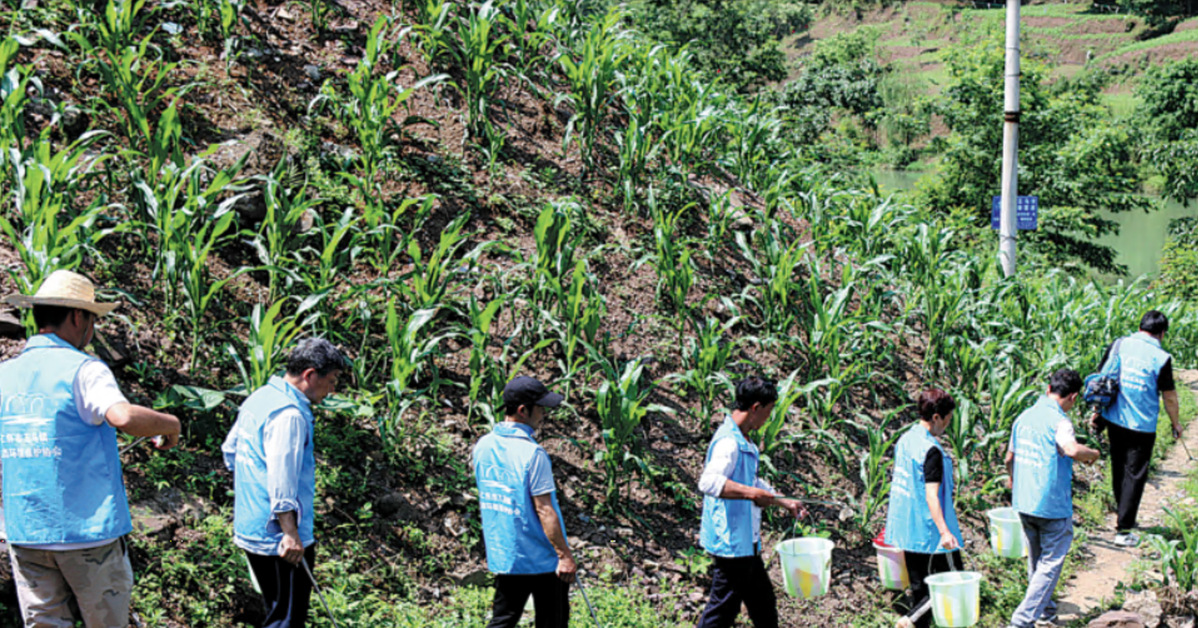
In recent years, China has made great efforts to promote the mechanism, which has been introduced in the basin of the Chishui River, which runs across Yunnan, Guizhou and Sichuan provinces in Southwest China.
In 2018, governments of the three provinces signed an agreement to introduce the mechanism on the Chishui and committed to contributing 200 million yuan ($31 million) a year to a fund dedicated to the river's conservation.
As a region that will gain the least economic benefit from the joint environmental protection efforts, Yunnan will only contribute 10 percent of the fund. However, it will get 30 percent of the proceeds.
Guizhou and Sichuan, each with an alcohol industry heavily dependent on water from the river, will contribute 50 percent and 40 percent, respectively. When it comes to distribution, Guizhou will be allocated 40 percent and Sichuan 30 percent.
The mechanism has solved the financial problems faced by governments in Chishui's upper reaches in rolling out environmental protection measures.
Thanks to compensation from the mechanism, a series of projects for environmental conservation have been launched, further lifting the water quality in the river and improving local residents' living environment.


- China's carbon dioxide emissions per 10,000 yuan of GDP down 5% in 2025
- Tangible gains during China's 14th Five-Year Plan period
- Foreigners entering China visa-free up 49.5% in 2025
- Various forms of job fairs held across China
- Snowscapes, vineyards, and beyond: the rural vitalization in China's villages
- Xinjiang Story: Powering up Xinjiang's winter boom








