



Findings refine knowledge of galaxy









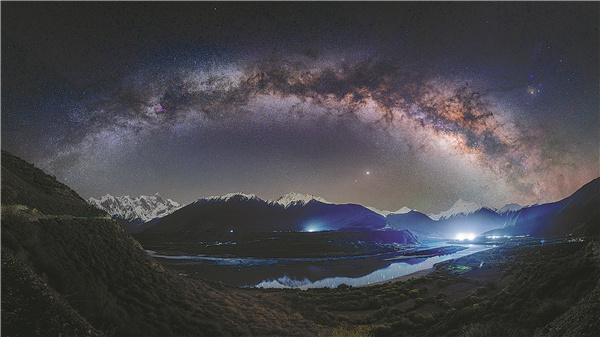
A Chinese astronomer has helped uncover the exuberant "teenage years" of the Milky Way when it merged with a satellite galaxy, consumed plenty of hydrogen gas and formed many stars, according to a study published in the journal Nature on Thursday.
Xiang Maosheng and Hans-Walter Rix, two astronomers working at the Max Planck Institute for Astronomy in Germany, made the discoveries using data from the Large Sky Area Multi-Object Fiber Spectroscopic Telescope in Hebei province and the European Space Agency's Gaia Telescope.
They examined the ages, chemical compositions and orbits of nearly 250,000 stars in our galaxy, and used them like a "stellar clock" to piece together the most precise estimate of the Milky Way's evolution to date.
The findings have refined our understanding of the Milky Way's evolution, suggesting that parts of it were taking shape much earlier than previously thought. They also suggest the Milky Way may have collided and merged with a satellite galaxy called Gaia-Sausage-Enceladus about 11 billion years ago.
From about 13 to 8 billion years ago, the Milky Way was essentially in its adolescent phase, characterized by creating a massive number of stars. Its productivity peaked around 11.2 billion years ago, the study said.
The high formation of stars might be due to the two merging galaxies colliding and mixing huge amounts of interstellar material and gases together, leading to favorable conditions for new stars to be born.
Broadly speaking, our home galaxy's structure is made of two components: the halo and the disk. Traditional theory held that the halo, the spherical region surrounding the disk, is the oldest component of the galaxy.
However, the study found that the thicker region of the disk of stars that make up the core of our galaxy, also known as the "thick disk", began forming around 13 billion years ago, 800 million years after the Big Bang.
This meant parts of our Milky Way galaxy were forming 2 billion years earlier than the assembly of the halo, during the period known as the cosmic Dark Ages about 370,000 to 1 billion years after the Big Bang.
From the subsequent 8 billion years to the present, our galaxy entered its long and relatively "tamed" adulthood as the thick disk had exhausted much of its initial supply of hydrogen gas, the material needed to sustain nuclear fusion at a star's core.
Rix told Nature that their methodology is comparable to studying the evolution of a metropolis by finding out who lived where, when houses were built, and how and when people moved around.
Xiang, who was a postdoctoral fellow at the National Astronomical Observatories of the Chinese Academy of Sciences, said stars are like fossils, which help scientists probe the galaxy's past.
Given how the study only sampled a tiny fraction of the estimated 100 to 400 billion stars in the Milky Way, Xiang said he hopes to examine a much greater number of stars across considerably larger distances in the future to get a more precise chronology of our galaxy.


- Hainan's 1st batch of daily consumer goods duty-free shops for island residents opens
- Cross-Strait affairs should be settled 'like family', official says
- Whale injured in collision with fishing boat near Weizhou Island
- Lizard found on high-speed train brought by passenger, rail authorities say
- Zeiss top exec: Learn from China speed
- Ancient tomb cluster in Changsha offers a glimpse into millennia of history











