US increases presence in S. China Sea










Drills expand in scale and frequency, focus on preparing for real combat, report says
From massive military drills to record spy plane activities, the United States military drastically intensified its presence in the South China Sea last year, which serves to undermine China's security interests and increase the risk of friction in the region, according to Chinese experts.
A report published on Sunday by the South China Sea Strategic Situation Probing Initiative, a Beijing-based think tank tracking US military operations with open source data, said the US carried out at least 95 military exercises in the South China Sea last year, 10 more than in 2019.
In August 2021, the US, along with Australia, the United Kingdom and Japan, carried out "Large Scale Exercise 21", its largest naval exercise in 40 years, involving around 25,000 military personnel operating across 17 time zones from Europe to Asia.
Hu Bo, director of the think tank, said the US military has maintained a fairly strong presence near China since 1949, but in recent years it has considerably ramped up its operations in the region and made them more public.
These US military drills not only saw expanding scale and frequency, but also focused on preparing for real combat, with China being the clear target, according to the report.
Around 1,200 sorties of maritime patrol and reconnaissance aircraft conducted close-in intelligence gathering over the South China Sea last year, the report said.
The US set multiple records in November, including 94 sorties, the greatest number in a single month, and 10 flights, which was the highest number in a single day.
In addition, November also saw the US reach its closest surveillance distance to China's territorial water baseline at 15.9 nautical miles, or around 29 kilometers, said the report. Twelve nautical miles outward from this baseline is China's territorial sea, while water inside the baseline is considered inland waters.
"The US is continuously setting records in terms of the distance between its reconnaissance aircraft and China's territorial sea baseline, which poses increasingly high military risks," the report said.
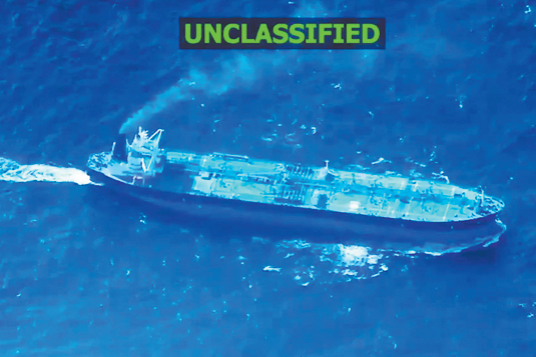
Meanwhile, US ocean surveillance ships and maritime survey vessels carried out operations for a total of 419 sea days. A sea day is a day spent in transit between port calls.
This meant that there was always at least one of these vessels operating in the South China Sea throughout the entire year, according to the report.
Regarding activities by strategic military forces, the US sent amphibious landing and carrier strike groups to the South China Sea on 12 occasions in 2021, nearly double the previous year's total. Nuclear submarines also made at least 11 transits through the waters, along with 22 sorties by B-1B and B-52H strategic bombers.
Hu said the US' "Indo-Pacific strategy" is deeply related to geopolitics and its desire to maintain maritime dominance in the region. As a result, the US will most likely continue to intensify its military activities near China, such as in the South China Sea, the East China Sea and the Taiwan Straits, he added.
Meanwhile, the US is also encouraging and coordinating its allies, including Japan and Australia, to bolster their military capabilities and continue to stir up trouble in the South China Sea, he said.
This trend is already in motion given the fact that Japan took part last year in 61 joint military drills with the US, while Australia announced it would acquire eight nuclear submarines with help from the US and the UK.
"Japan has become the vanguard of the US' 'Indo-Pacific strategy', which will further support US military operations in the South China Sea," the report said. Australia's acquisition of a nuclear submarine capability will "very likely induce a new round of arms race in the region or even across the globe, and cast a shadow over peace and stability in the South China Sea".
Hu said one of the ramifications of Washington's drastically increased military activities is that its military hardware and personnel would be severely stretched, leading to a greater risk of accidents and friction in the South China Sea.
Recent examples include the USS Connecticut nuclear submarine colliding with an uncharted seamount in the South China Sea last year, and an F-35C fighter jet crashing on an aircraft carrier operating in the region in January.
"In an era of peace, if one country maintains such a powerful military presence close to another country, it is hard for the former to convince people that it is doing it for peaceful purposes," Hu said.
Washington's increased military operations pose a serious threat to China's sovereignty and national security, he said, China will therefore be forced to take necessary measures in response.
Xia Liping, dean of the Institute of International and Public Affairs at Tongji University in Shanghai, said that even as the Ukraine crisis unfolds, the US military has not scaled down its activities in the South China Sea, highlighted by frequent transits of its carrier strike groups and drills in January and February.
"The US views China as a long-term competitor, therefore it is willing to focus its maritime forces in the Asia-Pacific region," Xia said, adding that the increased military activities and the subsequent reporting and hype by US officials and media are also aimed at painting China as a regional threat.