



Green finance turns thin air into money









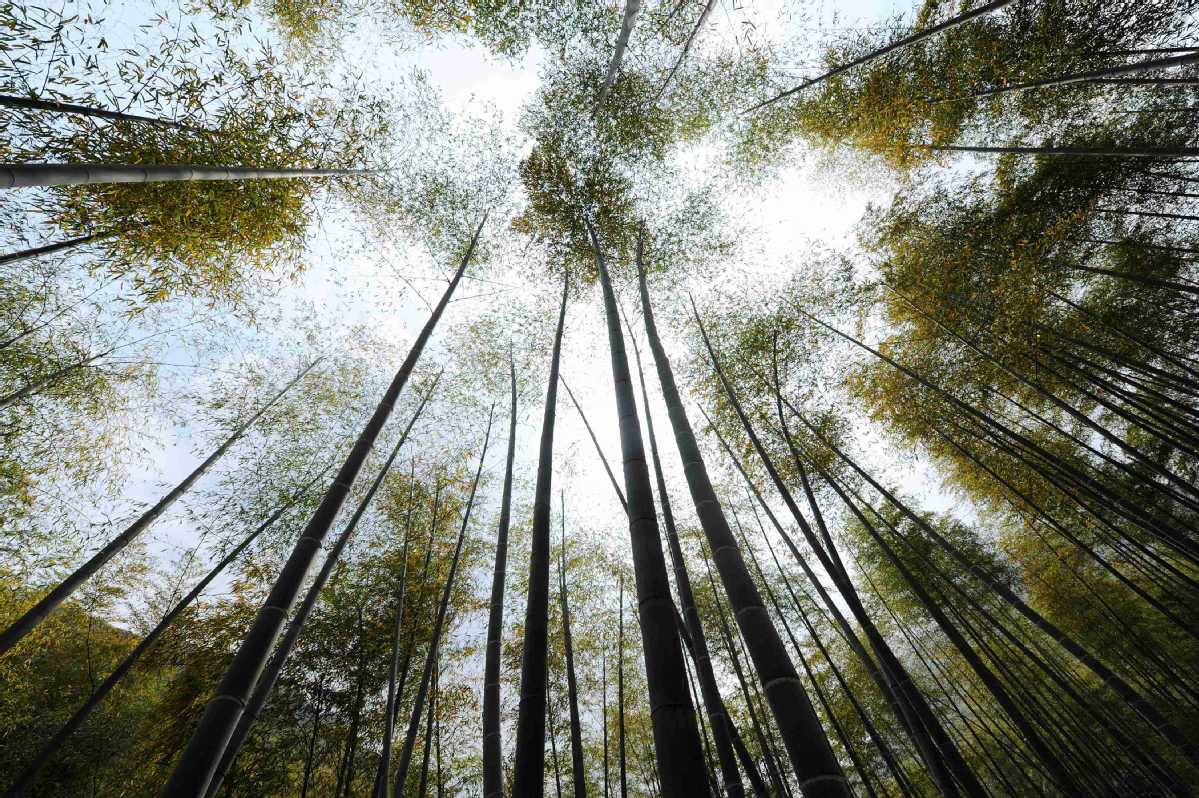
Zhejiang's bamboo groves create clean atmosphere, boost tourism and promote common prosperity
What amazes farmer Ying Zhongdong in East China's Zhejiang province most these days is a sort of miracle that turns local thin air into money. The fresh air in the bamboo forest area near his native village not only attracts tourists from around the country, but helps strengthen the local economy.
"I never expected fresh air produced by bamboo forests could earn us so much money," said Ying with a broad smile. As head of Dali village in Anji county, Huzhou city, Ying recently received nearly 300,000 yuan ($47,100) on behalf of the village.
The revenue has been generated not through cutting down bamboo or from products made from the plants. Instead, it has come from one of the unique properties of bamboo-to absorb carbon.
The area of over 5,000 mu (334 hectares) of bamboo in Dali is only a fraction of the 870,000 mu of moso bamboo groves in the county, which is known as one of the nation's top 10"bamboo hometowns".
According to estimates, the carbon storage capacity of these bamboo groves can reach as much as 1.34 million metric tons, and with effective management, they can sequester 340,000 tons of carbon annually.
Plenty of research shows that bamboo is a top plant to help cut greenhouse gases, as it rapidly captures large quantities of carbon and stores them as a powerful carbon sink. As a very fast-growing plant that can thrive on degraded soils, bamboo is often considered an ideal choice to fight climate change.
First observation tower
As far back as 2010, Anji teamed up with Zhejiang A&F University, which has a strong research team in agricultural and forestry sciences, and built the world's first moso bamboo carbon flux observation tower to track and calculate the carbon sequestration capacity of the local bamboo stands.
These days, residents can both enjoy the environmental value and reap the economic benefits, thanks to a program called "Liangshan Bank", an initiative that, unlike traditional banks, seeks to integrate fragmented ecological resources and transform them into assets with monetary value by leveraging green finance-financial activities and investments that help ensure sustainable development.
Liangshan Bank, literally "the bank of Two Mountains", derives its name from Chinese President Xi Jinping's idea that "lucid waters and lush mountains are invaluable assets", which he put forward during a visit to Anji in 2005 when he was Party secretary of the province.
In June 2020, Anji piloted the first Liangshan Bank branch in Zhejiang province. Last year, the bank attracted investment of about 3 billion yuan for 22 projects, raising revenue for the county's villages by over 20 million yuan and providing jobs for 2,160 villagers. Currently, many places in Zhejiang and across China have followed suit and set up their own Liangshan Bank branches.
Indeed, with the support of Liangshan Bank, a carbon trading platform was established in Anji in December, the first county-level platform of its kind in China. Dali is among the first five entities to benefit from the platform.
Ecological innovation
"Our goal is to build a circular carbon trading market to promote green innovation of the bamboo industry and realize the high-quality development value of ecological products," said Chen Wei, chairman of Anji Construction Investment Group, which manages Anji's Liangshan Bank.
During the process, a series of innovative tools of green finance were used.
For example, villages can borrow from a low-interest loan specially allotted to develop bamboo groves and grow carbon sinks, before selling them to the carbon trading platform, which, relying on financing from Liangshan Bank, trades them to companies that need carbon offsets. The companies buying carbon offsets enjoy a special discounts on loans for such purposes, thereby creating a self-reinforcing loop.
Green insurance products are also provided to deal with such risks as price fluctuations and natural disasters that may diminish the value or cause damage to bamboo groves.
"Ultimately, what we hope to achieve is to find a path to common prosperity," Chen said.
"Common prosperity" has gained much prominence since 2021 as China is determined to further improve the quality of life of more people, and Zhejiang has been designated as a demonstration zone for common prosperity.
"The essence of common prosperity is to make the economic 'cake' bigger and better, and distribute it more fairly," said a financial scholar from Zhejiang University in an exclusive interview with China Daily, who preferred not to be named. "The introduction of Liangshan Bank is definitely an innovative and important step in the right direction."
Now, Anji's drive toward high-quality development and common prosperity through the Liangshan Bank initiative is getting another boost from a raft of financial measures unveiled in a guideline recently.
The guideline, jointly released by the People's Bank of China-the country's central bank-the China Banking and Insurance Regulatory Commission, the China Securities Regulatory Commission, the State Administration of Foreign Exchange and the Zhejiang Provincial People's Government in March, spelled out dozens of measures to ensure adequate financial policy support for Zhejiang's pursuit of common prosperity.
The guideline seeks to provide more financial resources from the supply side, said the Zhejiang University scholar. "The aim is to establish a financial system and mechanism that can allocate financial resources in a more efficient and fairer manner."
"The guideline is a major innovation," said Chen Jia, a researcher with the International Monetary Institute at the Renmin University of China. Financial scholars have long argued for leveraging financial means to achieve common prosperity, and its implementation in China will point a way for other countries to pursue common prosperity in a similar manner.
Over the past decade, a lot of research has been done on issues like income disparity caused by financial inequality in the West, and topics including how to ensure financial inclusion, improve people's livelihoods and reduce income gaps are now high on the public agenda, said Chen.
Among the myriad messages conveyed through the guideline, a key thrust is to channel financial resources to causes of social good, and a couple of measures undertaken "to build Zhejiang into a model of green finance" and "strengthen financial support for the realization of carbon neutrality and carbon peaking".
In line with the 2015 Paris climate conference, China pledged in 2020 to peak carbon emissions by 2030 and achieve carbon neutrality by 2060, commonly referred to as the "dual carbon goals".
"With the money from 'fresh air' produced by the bamboo, we will invest more in mechanized development of the bamboo growth, which will help villagers continue to increase their income," said Ying, head of Dali. And with rising incomes, villages like Dali can grow more green resources like bamboo, further helping reduce carbon emissions and move toward realizing the "dual carbon goals".




















