Turning back toxic flows of misinformation










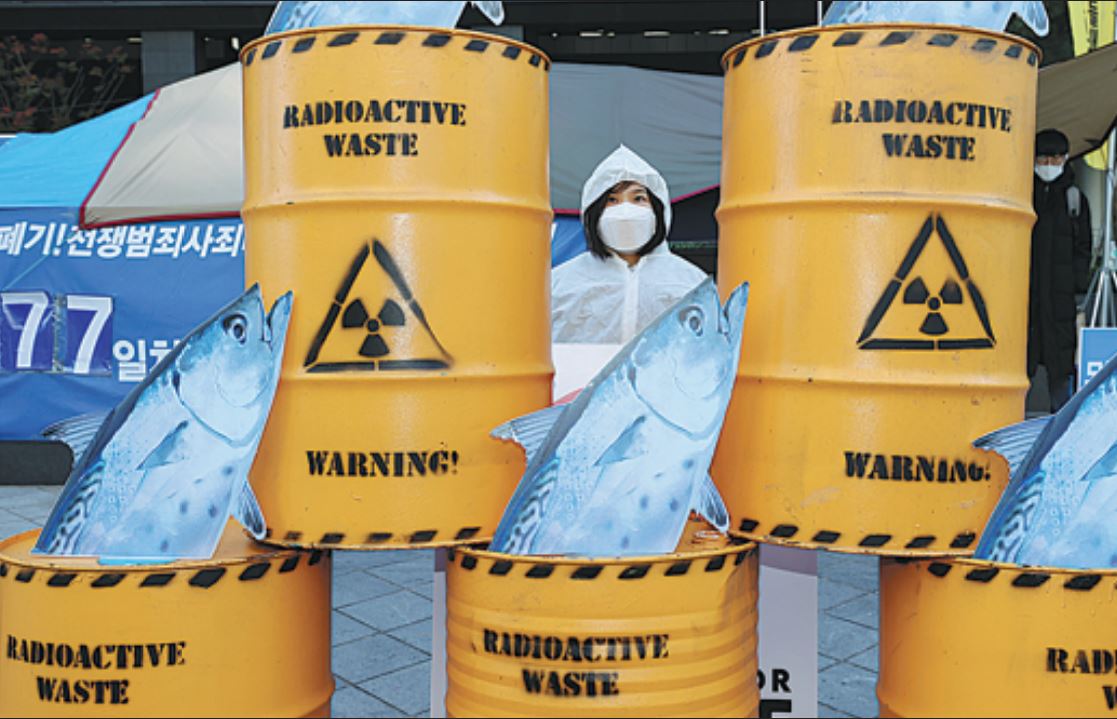
Dangers ignored
The decommissioning of a nuclear reactor involves removing the used nuclear fuel from the reactor, placing it into the used fuel pool, and eventually into dry storage containers. The decommissioning process for the three reactors that remained undamaged in the 1986 explosion at the Chernobyl nuclear power plant started in 2015. The first stage, the so-called final shutdown and preservation stage, could take a decade to complete.
As for Carbon-14, which can reach into communities in Japan and abroad for many generations due to its long half-life, the Greenpeace report says the dangers of it are being ignored by the Japanese government and that it has the potential to damage the structure of human DNA.
Taking a similar view are three United Nations human rights experts, Marcos Orellana, Michael Fakhri and David Boyd, who say in a joint statement that the water may contain quantities of Carbon-14 and other radioactive isotopes. Discharging the tainted water into the Pacific Ocean will threaten the health of people and the planet.
"Japan has noted that the levels of tritium are very low and do not pose a threat to human health. However, scientists warn that the tritium in the water organically binds to other molecules, moving up the food chain affecting plants and fish and humans," the experts say in their report. They say the radioactive hazards of tritium have been underestimated and could pose risks to humans and the environment for over 100 years.
"We remind Japan of its international obligations to prevent exposure to hazardous substances, to conduct environmental impact assessments of the risks that the discharge of water may have, to prevent trans-boundary environmental harms, and to protect the marine environment," the experts say.
Lack of sincerity
In a country well versed in public relations and branding, the Japanese government was quick to employ inventive ways in a bid to gather support for the ocean disposal.
Days after it announced the discharge plan, Japan's Reconstruction Agency released a video depicting tritium as a "cute character" in an effort to dispel concerns about the radioactive substance and sweeten the government's message.
Within a day, the tadpolelike character was scrapped and an apology issued after a wave of criticism on social media as well as in Japan's parliament.
"If the government thinks it can get the general public to understand just by creating a cute character, it is making a mockery of risk communication," Riken Komatsu, a writer involved in reconstruction activities in Iwaki, Fukushima, said on Twitter.
Sticking to the message, the national government busied itself organizing expert panels to explain the policy to communities. The efforts fell flat and only made the situation worse.
"They use all those big words and difficult phrases to talk with us. They only repeat their side of the story but never give solutions to our problems," said Katsuo Watanabe, an 82-year-old fisherman in Fukushima. "We just can't understand."
A China Daily investigation found that 41 of Fukushima prefecture's 59 municipal councils oppose the disposal plan, with 25 of them strongly opposing it.
The report ordered by Japan's parliament into the Fukushima nuclear disaster says that TEPCO's corporate culture was to blame for the accident, citing misplaced deference and reluctance to question authority within the company as the root causes, in addition to many other factors.
Yet, a sequence of events that occurred after the accident has raised fears about whether the company has truly changed. Many question why the government still relies on TEPCO to deal with the consequences of the disaster given the repeated accusations of cover-ups and delayed disclosure leveled at the utility.
In September 2021, TEPCO officials first acknowledged that 24 of the 25 filters attached to the water treatment equipment had been found in August to be damaged, and they admitted that they had detected similar damage in all the filters two years ago. But the officials never investigated the cause of the problem and did not take any preventive steps after replacing the filters.
The filters are designed to prevent particles from escaping into the air from the ALPS.
"At the core of this problem is TEPCO's attitude," Japan's Nuclear Regulation Authority commissioner, Nobuhiko Ban, said after the problems surfaced.
In January 2021, at the Kashiwazaki-Kariwa nuclear power station, another plant owned by TEPCO, it was proved that the company had lied about having completed safety work on one of the plant's reactors.
And the list could go further.
"It is safe to say that credibility is the key issue," says Liu Qingbin, a professor at the Institute of Advanced Sciences at Yokohama National University.
According to Liu, even if the disposal plan was deemed perfect in theory, there is no guarantee that TEPCO and the Japanese government could deliver 100 percent safe treatment because all the events put together had "demolished Japan's reputation for craftsmanship".
Japan's dumping plan clearly flies in the face of credibility. In a response to concerns from the Fukushima prefectural federation of fisheries cooperatives in 2020, Naomi Hirose, then president of TEPCO, said in a statement: "We will not proceed with any kind of disposal of treated radioactive water without gaining the understanding from the concerned parties. We will store the water in tanks on the premises of the plant."
Given the fact that the Japanese government owns the majority share in TEPCO through the Nuclear Damage Compensation and Decommissioning Facilitation Corporation, the company's integrity matters to the Japanese government and its financial performance matters to Japan's public purse.
Japan's unilateral decision a year ago provoked an immediate outcry from neighboring countries and Pacific Island communities. The foreign ministries of China and South Korea vocally expressed the opposition and the Pacific Islands Forum, an intergovernmental organization for the region, said that "Japan has not taken sufficient steps to address the potential harm to the Pacific".
At the time, China's foreign ministry condemned Japan for making the decision without proper consultation with the affected countries, calling Tokyo highly irresponsible and stressing that the Pacific Ocean is not Japan's "trash can".
In a recent news conference, Chinese Foreign Ministry spokesman Wang Wenbin said: "We hope the Japanese side will not turn a deaf ear to all parties' concerns and the public opinion at home.
"We urge Japan to revoke the erroneous decision of ocean discharge, conduct thorough consultation with stakeholders and relevant international organizations, and carefully assess the benefits and drawbacks of all disposal plans before making any decision, so as to ensure the safe disposal of nuclear-contaminated water."
In response to the sustained pressure, the Japanese government invited two task forces from the International Atomic Energy Agency to conduct missions in Japan to review its dumping proposal in February and March. The findings won't come anytime soon, though the IAEA says a comprehensive report containing the overall conclusions of its task forces "will be published before any treated water is released".