



More solutions, funding needed to reach China's carbon emission goals









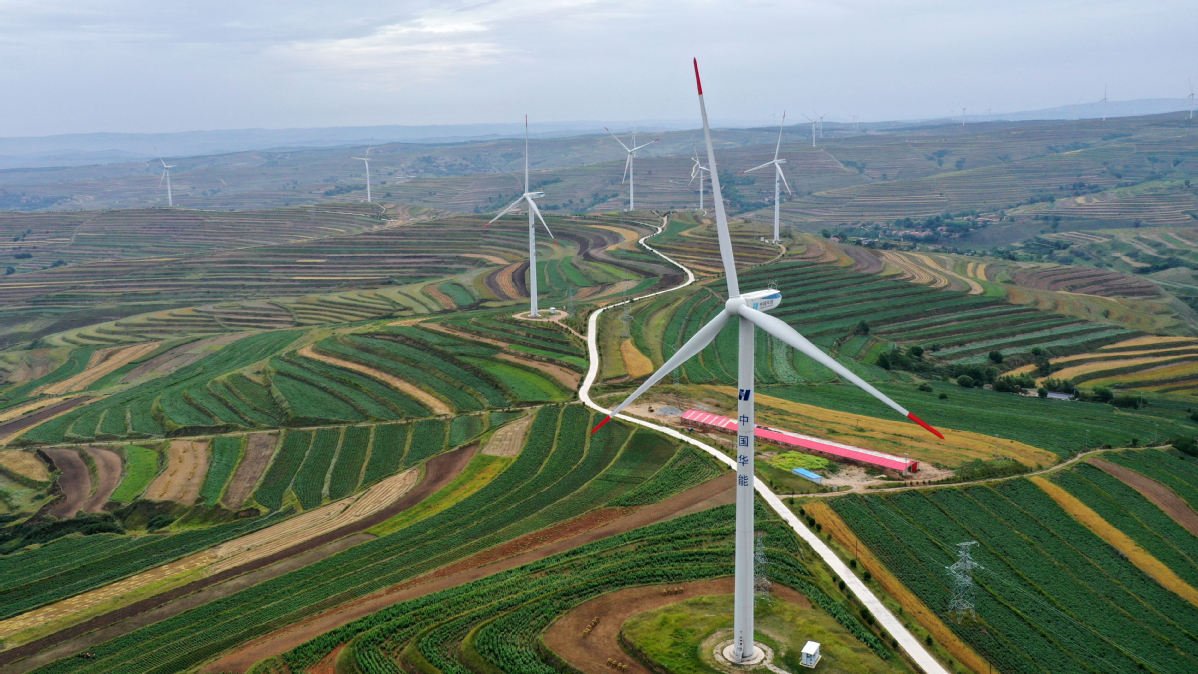
More practical and scalable carbon reduction solutions, better funding and regulatory mechanisms, and greater international cooperation are key for China to achieve its carbon dioxide emission peak and carbon neutrality goals, experts have said.
By the end of last year, 136 countries had issued carbon emission goals.
International investment for energy transition hit a record high of $755 billion last year, but the world also has a $700 billion annual financing gap in global biodiversity conservation by 2030, said Jerry Yu, chief representative of the Paulson Institute's Beijing office. The institute is a think tank that focuses on the China-US relationship.
"This urgently requires the private sector and other market forces to keep promoting innovation and change," he said.
With China being the world's second largest economy and a nation with rich biodiversity, its innovative solutions for going green will serve as an important facilitator and reference for the world to fulfill its sustainable development goals, Yu said.
The remarks were made during the launch ceremony of the Paulson Prize for Sustainability 2022 on Friday. Since 2017, the institute and Tsinghua University have cooperated to offer this annual award to projects in China that provide innovative, scalable and market-based solutions to sustainability challenges such as climate change and biodiversity loss. The award is open for submissions until June 30.
Tracy Wolstencroft, co-chairman of the prize's jury committee and former president of the National Geographic Society, said that climate change is both a challenge and an opportunity for the current generation as humanity embarks on the largest socioeconomic transformation in history to achieve a more sustainable future.
This process will drastically change how society makes products, grows food, travels and adapts to a warmer world, he said. "We are at a pivotal time during the transition to a low carbon economy, where capital, technology and policy all must align to enable growth in green initiatives and industries at a significant pace and scale."
Zhuang Weimin, president and chief architect of the Architectural Design and Research Institute of Tsinghua University, said China has only 30 years to go from a carbon peak to carbon neutrality, which is a very tight time frame considering developed countries generally have over half a century to do so.
In the field of construction, which is a major carbon emitter for China, it is important to learn green technologies from other countries, but it is also imperative to adopt these technologies and designs in accordance with China's situations and needs, he said.
For instance, the average age of Chinese buildings is less than 40 years old, which is far lower than that of developed countries, many of which have buildings that have lasted over a century, he said.
Therefore, China should avoid the mass demolition and reconstruction of its buildings, which may increase carbon emissions, he said. Instead, local governments should issue administrative regulations about building demolition while encouraging research and innovation to retrofit existing structures to be more environmentally friendly.
Ma Keping, deputy director-general of the Biodiversity Committee of the Chinese Academy of Sciences, said China's vision of building an ecological civilization, which stresses the harmonious coexistence of humanity and nature, is in line with the shared aspiration of the United Nation's Biodiversity Conference.
But implementing these ambitious goals will require a great effort, he said. Moreover, it will be necessary to effectively finance these projects, to create mechanisms to regulate and evaluate these undertakings, and to encourage the public and private sectors to work together toward these goals.
Jiang Li, chairman of Nanjing TICA Climate Solutions, a company that utilizes thermal energy, said sustainability can be part of a company's competitive advantage.
To meet the two carbon goals, it is important to create a third-party credibility system that can track how much energy a company conserves so that experts can intuitively see the cost of energy usage and optimize it, he added.


- Xizang aims to better preserve ethnic culture
- China steps up diplomatic push for peace in Mideast
- Advisers align wisdom and strength
- Lawmakers call for action on 'invisible overtime'
- F1 Chinese Grand Prix returns with major upgrades
- Taiwan's 'goodwill mission' criticized as futile bid for 'independence' support





