Improving mental health amid pandemic









The resurgence of the novel coronavirus has prompted authorities to restrict people's movement in many places. Many people in some provinces and cities, for instance, have been staying at home for some time now. The more than two years of the pandemic prevention and control measures have also had some psychological effects on the people, increasing the need for better mental health services.
Compared with the fear in the early days of the outbreak, people today see the virus more rationally thanks to the progress in research and vaccination. But the uncertainties around the virus and its impact on normal life have triggered widespread anxiety in society. That calls for ramping up mental health services, in order to help people develop a positive mindset.
In China, the fight to contain the pandemic has become a new normal. This fight is characterized by China's dynamic clearing policy, which adheres to the principle of "people first and life first". Contrary to the misconception of some, the objective of the dynamic clearing policy is not to pursue zero infections in the country. Instead, it requires a swift official response wherever infections are reported so that the outbreak can be controlled within a limited area as soon as possible. Only with this approach can China minimize the human cost of the pandemic.
Since the cause and speed of infections may vary from place to place, mental health service providers should be prepared to deal with all the problems. The strict health and safety protocols, including wearing face masks and maintaining social distancing, and working from home, which people have had to follow have, to a certain extent, changed people's thought process and behavior.
So, counseling and other mental health services have to change accordingly in order to deal with these new problems. And as the fight against the virus is expected to continue, mental health services should be available to as many people as possible.
The recent outbreak in Shanghai has aroused widespread concern. As Shanghai is one of China's biggest cosmopolitan cities, its residents are used to a certain lifestyle, which makes it a bit difficult for them to adjust to changes in face of emergencies. For instance, the daily routine of buying vegetables online and stockpiling food is costing people precious time and energy, especially for those who are used to buying fresh vegetables whenever they want.
Human attention is a very limited resource. People have to use a lot of willpower to change their habits in a short time, which anti-pandemic protocols demand. When a city's orderly life is disrupted, it triggers intense anxiety among individuals and causes tension in society. That partly explains why some Beijing residents rushed to stockpile vegetables and other essentials after the authorities announced to tighten measures from Monday, despite supplies being restored very soon.
Other cities, especially those highly urbanized, can find some inspiration from Shanghai. A modern, sophisticated city life surely signifies social progress but it can also make it hard for people to adjust to changes in case of emergencies. So increasing cities' resilience against variables is necessary, which can be done by educating the public about mental health and providing proper mental health services.
Given the challenges the pandemic poses to mental health, it's necessary for individuals to develop self-regulation. Self-regulation is the ability to control inner states or responses with respect to thoughts, emotions, attention and performance, and is therefore a critical aspect of development and fundamental to personality and behavioral adjustment. In fact, research shows that self-regulation is necessary for emotional well-being.
As for cognitive self-regulation, it is about having the ability to focus attention, ignore distractions and switch one's focus of attention as needed, use memory, especially to keep several pieces of information in mind at the same time, having necessary logic skills including an understanding of cause and effect and the ability to plan a sequence of steps to accomplish a task or solve a problem, and understanding individual learning strengths and weaknesses, and knowing how to use the strengths to compensate for or improve on weaknesses.
The online world is a mix of truth and rumors. People staying at home who have almost nothing to do can fall easy prey to online rumors, leading to cognitive bias and depression. It is therefore necessary that people improve their digital literacy by using cognitive self-regulation, so they can see things from different perspectives and focus on the positives in real life.
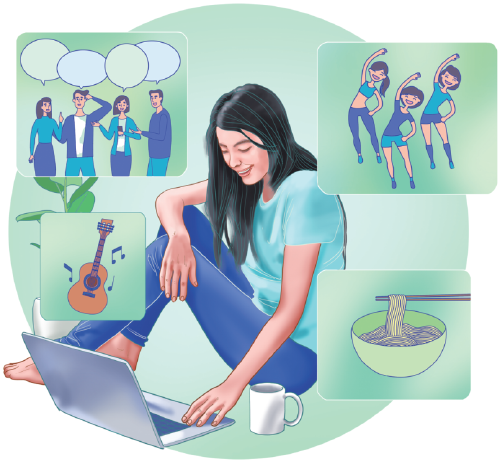
Social life is important for human beings. Self-isolation at home has prevented many people from interacting face-to-face with others and thus affected their mental health. Such people should make good use of communication tools to enhance interpersonal interaction and work out a usual bedtime routine, so as to control their emotions and have peace of mind.
Long-time quarantine can create a series of problems that people have never encountered before. And it is necessary to identify a problem before addressing it. For example, the parents-children conflict over students taking online classes at home is about family education and cooperation on home-schooling. Therefore, meticulous planning, including setting goals and making best use of time, is needed to make online classes effective.
The pandemic prevention and control measures can be seen as a test for mental endurance. By taking advantage of the challenge, we can turn a crisis into an opportunity which will enable both cities and individuals to better deal with their problems in the future.
The views don't necessarily represent those of China Daily.
The author is a researcher at the Institute of Psychology, Chinese Academy of Sciences.
If you have a specific expertise, or would like to share your thought about our stories, then send us your writings at opinion@chinadaily.com.cn, and comment@chinadaily.com.cn.