


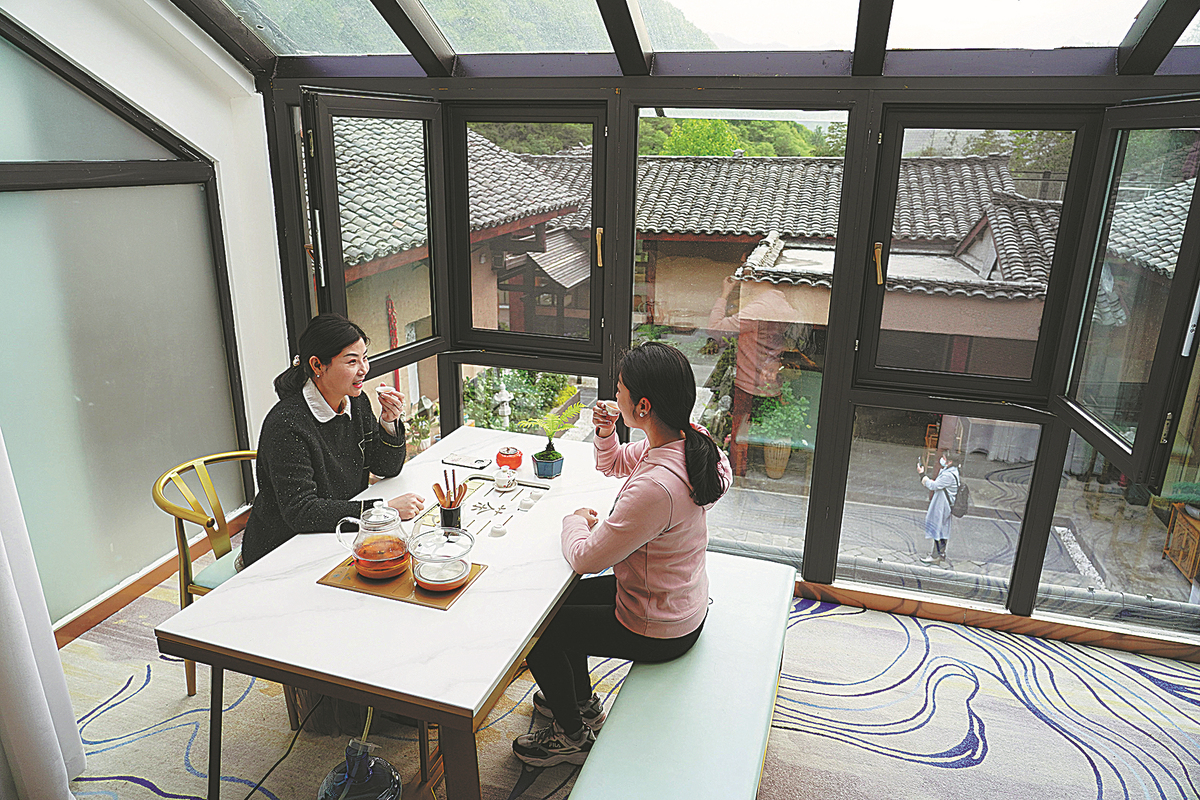
Rural homestays have become the fastest-growing segment in the bed-and-breakfast market since the COVID-19 pandemic, fueled by travelers who seek a more relaxed, pleasant and experiential lifestyle that is close to nature, a recent report found.
Tujia, a domestic online homestay service provider, said there are nearly 800,000 domestic rural homestays available online nationwide. Most people who took rural trips are urbanites, and most of them come from Beijing, Shanghai, Guangzhou of Guangdong province, Chengdu of Sichuan province and Chongqing. These urbanites have driven the rapid growth of rural homestays.
Among those who booked rural homestays, more than 60 percent of the total were born in the 1980s and 1990s. Fruit and vegetable picking, agricultural research and learning, making handicrafts and tasting delicious foods are among the most popular activities for rural homestay tourists, according to Tujia, a Chinese short-term lodging rental platform.
In 2021, the booking volume of rural homestays in Beijing increased by 10 percent year-on-year, and revenue jumped 38 percent year-on-year. Now, the booking volume of rural homestays accounts for about 40 percent of the total short-term rentals compared with 30 percent before the pandemic, according to Tujia.
"Cross-provincial tours are often limited for pandemic prevention and control reasons, and consumers' frequent short trips to suburban areas have driven the growth of rural homestays," said Hu Yang, senior vice-president of Tujia.
Zhou Cheng, a 33-year-old rural homestay operator, has been involved in the business for more than a decade, and he witnessed the fast growth of the domestic bed-and-breakfast sector.
In 2010, he started operating a rural homestay in Lijiang, Yunnan province in Southwest China, and annual income was about 200,000 yuan ($30,500), which is less than one-tenth of his current annual income. Now, he has transferred his business to Urumqi in Xinjiang Uygur autonomous region.
"Earlier, rural homestays were a niche business in China, but it has been widely accepted by more people now. Once people started to like such lifestyles, our returning customer will keep growing. Some of our customers come to stay a couple of days each month," Zhou said.
Besides accommodations, Zhou also provides catering services to customers and that revenue accounts for 60 percent to 70 percent of the total revenue. Most travelers stay for two days and one night, and their total spending on catering and accommodation together is around 2,000 yuan per person. At his homestay business, there are 13 employees in total. All of them are local villagers and their monthly income is around 4,000 yuan per person, Zhou said.
"Domestic consumers are increasingly pursuing tailored and personalized trips, and the COVID-19 pandemic has further fostered their habit of choosing bed-and-breakfast options. Unlike the early stages, rural homestays now provide better facilities and services, and more operators are willing to spend years to build their brand and reputation," Hu of Tujia said.
"Still, the proportion of homestays in the accommodation market in China is far less than the ratios in Europe and the United States, and the sector's growth potential is higher than hotels," Hu said.
In the long term, the potential room for future growth of rural tourism and rural homestays is remarkable, with the backing of favorable policies related to the revitalization of rural areas.
The development of rural homestays has changed the trend of previous one-day tours to suburbs into more in-depth trips, and tourists can have more immersive trip experiences and improve the quality of their trips, said Yang Hu, director of the Guangdong Province B&B Industry Association.
"An effective way to increase consumption scenarios is to convince travelers to stay overnight. Rural homestays can also promote the comprehensive upgrading of rural tourism products and the industrial clusters," Yang said.








