



Growing guarantee
China must motivate millions of smallholders toward the sustainable use of arable land









China must motivate millions of smallholders toward the sustainable use of arable land
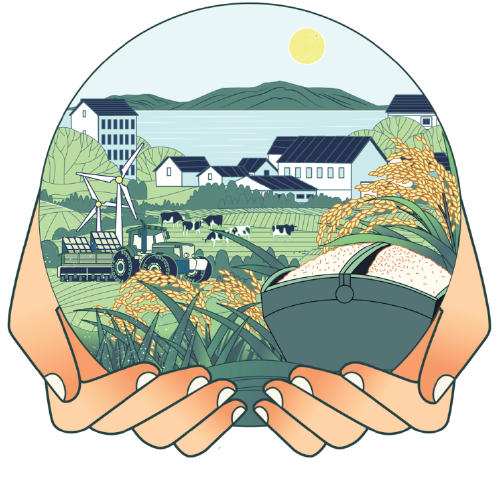
Global food security faces challenges from the shrinking of arable land and freshwater, extreme climate disasters and the COVID-19 pandemic. It calls for that strong leadership should take actions at the UN Food Systems Summit 2021 to bring our fragile and vulnerable food system back on track. However, smallholder farmers' efforts on driving the sustainable transformation of the food system are being overlooked.
In China, new trends have been identified based on the results of China's third Nation-Wide Land Survey released at the end of August in 2021. The first trend is that China's arable land area has dipped dramatically by 5.92 percent, from 135 million hectares in 2010 to 127 million hectares in 2020, and is inching closer to the redline of 120 million hectares of arable land.
The second is the net loss of arable land because of its conversion to forests and orchards. During the aforementioned decade, 74 million, 42 million, and 41 million hectares of arable land were converted to forest land, orchards, and built-up land, respectively.
The survey also showed that more than 2.20 million hectares of high-quality arable land in the south have disappeared, while 1.80 million hectares of former cropland have become marginal land in the north. The expansion of these low-yield and ecologically vulnerable areas is seriously undermining local environmental sustainability.
Rising abandonment of arable land has become another important issue. In particular, the land abandonment of mountainous areas in southern China is ubiquitous with the rapid decrease and aging of farming labor if effective measures are not taken to prevent it.
The last trend, one that most researchers have been focusing on, is that the arable land-use system is already out of environmental boundaries because of excessive use of fertilizers, pesticides, agricultural plastic film and irrigation.
The government is making extraordinary efforts to apply strict arable land preservation policies such as the redline of Arable Land Policy and Requisition, Compensation Balance of Arable Land Policy and the Permanent Prime Arable Land Policy to control the loss of arable land and guarantee enough arable land for growing grain to feed China.
In November 2020, the China's State Council issued a new guideline restricting the planting of non-grain crops to ensure food security based on the result of the land survey.
Nevertheless, the behavior of around 1 million farmers does not entirely match the goal set by the government. It is far from enough to only rely on the government to control the loss of arable land.
China needs to align its goals and actions with those of farmers on arable land use, and to increase smallholders' planting income and mobilize their motivation for sustainable use of arable land, thereby ensuring a sustainable transformation of food systems. More planting areas and yield are fundamental ways to increase farming income. The application of new technology and skills is also critical. For example, ratoon rice technology can increase yields by 60 percent with a 50 percent reduction in resources and labor. Growing organic food with fewer fertilizers and pesticides can also provide a diversified source of income.
Ecological compensation is being implemented to encourage sustainable agriculture and reduce farmers' losses. Moreover, transboundary watershed ecological compensation should be established, especially for upstream farmers who lose yield to reduce fertilizer use so as to reduce water pollution, while downstream people who benefit can compensate for the losses.
Boosting nature-positive production is advocated by the Food System Summit 2021. This can be achieved by training smallholders to identify the importance of sustainable production patterns. Innovations are needed to improve production patterns, climate-smart farming and digital agriculture.
China needs to establish various systems for the transfer of land operation rights and a withdrawal mechanism for the land contract right, especially for farmers who have settled in cities. Implementing both can help break the boundaries of the field, promote the concentration of scattered farmland, reconstruct the land production unit, and solve the problem of farmland fragmentation.
It is also necessary to strengthen consultation and information exchange platforms for farming stakeholders, including smallholders, agricultural enterprises, research institutes, and the government. For example, the Science and Technology Backyard platform, established by scientists from China Agricultural University, enables smallholders to sustainably achieve yield and economic gains by involving agricultural scientists living in villages among farmers, advancing participatory innovation and technology transfer, and garnering public and private support.
Kong Xiangbin is a professor of the College of Land Science and Technology at China Agricultural University. Lei Ming is a post-doc in the Academy of Global Food Economics and Policy at China Agricultural University. The authors contributed this article to China Watch, a think tank powered by China Daily. The views do not necessarily reflect those of China Daily.
Contact the editor at editor@chinawatch.cn





