



Green hydrogen to rise in China









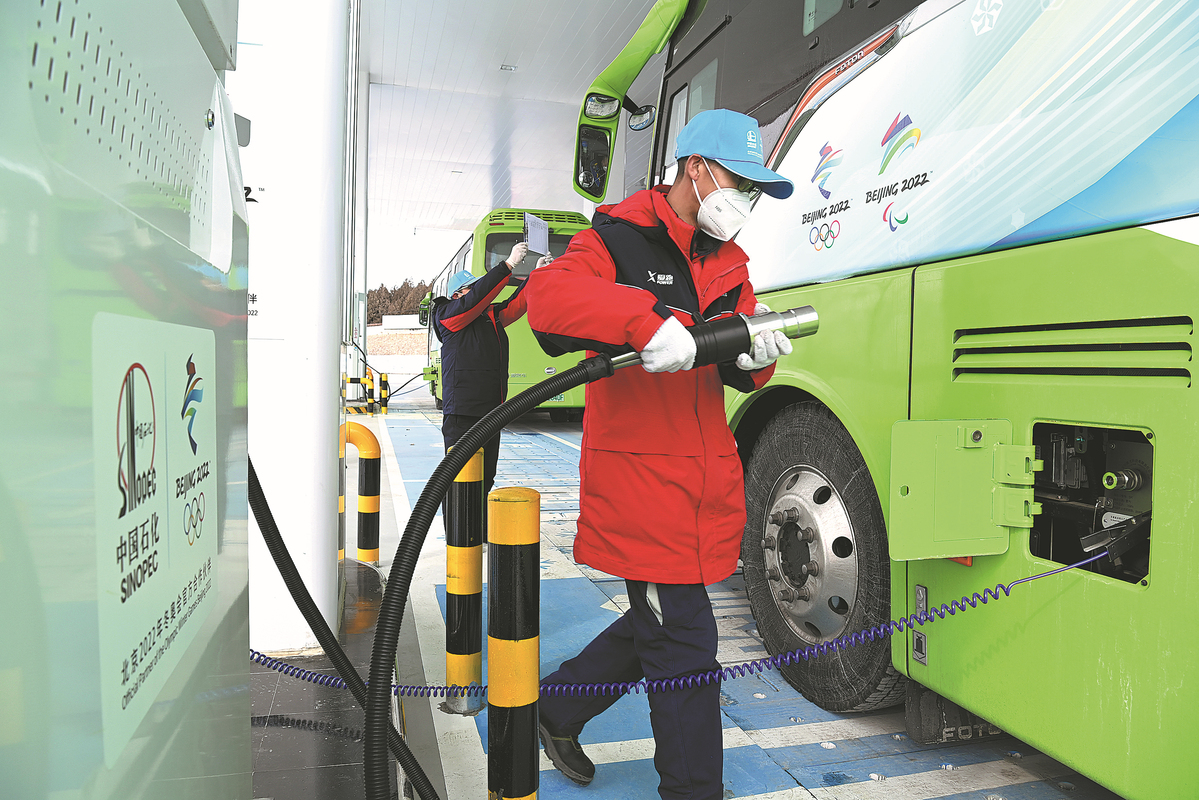
New energy generated from renewables gains more ground as private firms, SOEs up efforts
Expanding the use of "green hydrogen "will be crucial for China to reach its dual carbon goals as the future growth of power supply will mostly come from non-fossil sectors, analysts said.
The National Development and Reform Commission and the National Energy Administration jointly issued a 15-year plan to develop the hydrogen energy industry and boost the proportion of such energy generated from renewables.
The country produced some 33 million metric tons of hydrogen last year, making it the world's largest producer, and the production scale is expected to reach 43 million tons by 2030. The China Hydrogen Alliance estimated that green hydrogen will take up more in the energy mix, from 1 percent in 2019 to 10 percent by 2030, and the market scale will have increased nearly 30 times by then.
The hydrogen, mainly produced from natural gas-the current mainstream-generates massive carbon emissions and is known as "gray hydrogen". "Blue hydrogen "has its carbon emissions captured and stored, or reused, while green hydrogen is generated by renewable energy sources without producing carbon emissions.
Companies nationwide, private and State-owned, have all laid out plans for a slice of the green hydrogen market in China, either leveraging their location condition or coming up with new industrial parks to develop solar or wind power to produce green hydrogen.
China Petroleum and Chemical Corp, also known as Sinopec, the world's largest refiner by volume, has already come up with four green hydrogen projects, including the 20,000 tons per year solar-based project in Kuqa, Xinjiang Uygur autonomous region, 10,000 t/y wind and solar-based project in Ordos, Inner Mongolia autonomous region, 100,000 t/y renewables-based project in Ulaanqab, Inner Mongolia, and 10,000 t/y offshore wind-based project in Zhangzhou, Fujian province.
These are part of its investment plan of $4.6 billion in the hydrogen sector through 2025, aiming to boost its annual hydrogen production capacity to 500,000 tons by 2025.
State Power Investment Corp Ltd has also proposed ambitious hydrogen strategies, including its demonstration project in the Tibet autonomous region focused on using hydrogen to overcome the issue of the intermittence of renewable-based power.
Private companies are also making moves. Chinese green technology company Envision Group announced earlier that it would partner with Australian iron ore giant Fortescue Metals Group to jointly develop 10 million tons of green hydrogen by 2030.
Compared with the current rising price of natural gas, green hydrogen already has cost advantages, and Envision Group is confident it can lower the hydrogen manufacturing costs to 10 yuan ($1.52) per kilogram with the abundant green power from Inner Mongolia, said Zhang Lei, the company's CEO.
The company has built the world's first zero-carbon industrial park in the city of Ordos in Inner Mongolia to further take advantage of the abundant renewable resources and grid system there to achieve low-cost and efficient production and use of renewable energy.
Zhang said the company plans to build 100 zero-carbon industrial parks in the next 10 years with partners worldwide.
It is believed that with progress toward global carbon neutrality, the zero-carbon industrial park in Ordos will promote the development of electric vehicles and new energy industries. The cooperation with Envision would effectively lift the cost competitiveness of green hydrogen, taking advantage of its global zero-carbon industrial park layout, said Andrew Forrest, chairman of FMG.
While fossil fuels account for nearly 80 percent of hydrogen produced in China so far and that produced from renewables is still small, experts said the hydrogen energy industry will be key to China's dual carbon goals.
One main reason for the low proportion of green hydrogen applications is the high cost of hydrogen production, said Chai Maorong, chief technology officer of Hydrogen Energy Co Ltd under the State Power Investment Corp.
The cost of producing green hydrogen is three to four times that of production from fossil fuels and as much as 70 percent of the cost of hydrogen production by electrolysis of water comes from high electricity costs, Chai said.
Continuous efforts should be made in technological innovation to solve cost problems and boost the conversion efficiency of renewable resources, including wind, light and water, throughout the transition process, Chai said.
According to Ivy Yin, energy transition analyst at S&P Global Platts, China may further maximize its efforts to facilitate the production and supply of hydrogen, such as leveraging renewables in North China and Northwest China for massive wind and solar power projects, among which the first batches in the areas comprising 100 gigawatts of wind and solar energy have already launched operations.
Yin said heavy transportation, including trucking and public transit buses, is a potential market for fuel cell EVs, while hydrogen can also be transported across long distances flexibly, which is difficult for renewable energy due to the great challenges associated with inter-regional power transmission.
The development plan for such vehicles drafted by the Ministry of Industry and Information Technology said China aims to have 1 million hydrogen fuel cell EVs on the road by 2030, with at least 1,000 hydrogen refueling stations.
Yin said for green hydrogen to further grow its share in China's power mix to replace coal and gas, it's necessary to step up investment in infrastructure, including hydrogen transportation, storage and delivery, as well as renewable electricity generation, for it to better penetrate the market.
Some first-tier cities in China have already taken action. Beijing, for example, aims to have over 10,000 fuel cell EVs on the road and 37 hydrogen filling stations by 2025. Meanwhile, Shanghai aims to have 10,000 hydrogen cars and more than 30 hydrogen stations by 2023.
- Expert says China's dynamic zero-COVID policy can defeat the epidemic
- Beijing's makeshift hospital put into use
- China to keep dynamic zero-COVID policy to curb virus' spread
- Students and teachers stand together during Shanghai university lockdown
- A Russian poet shares her quarantine life in Shanghai




















