



New development mode of realty calls for innovative solutions









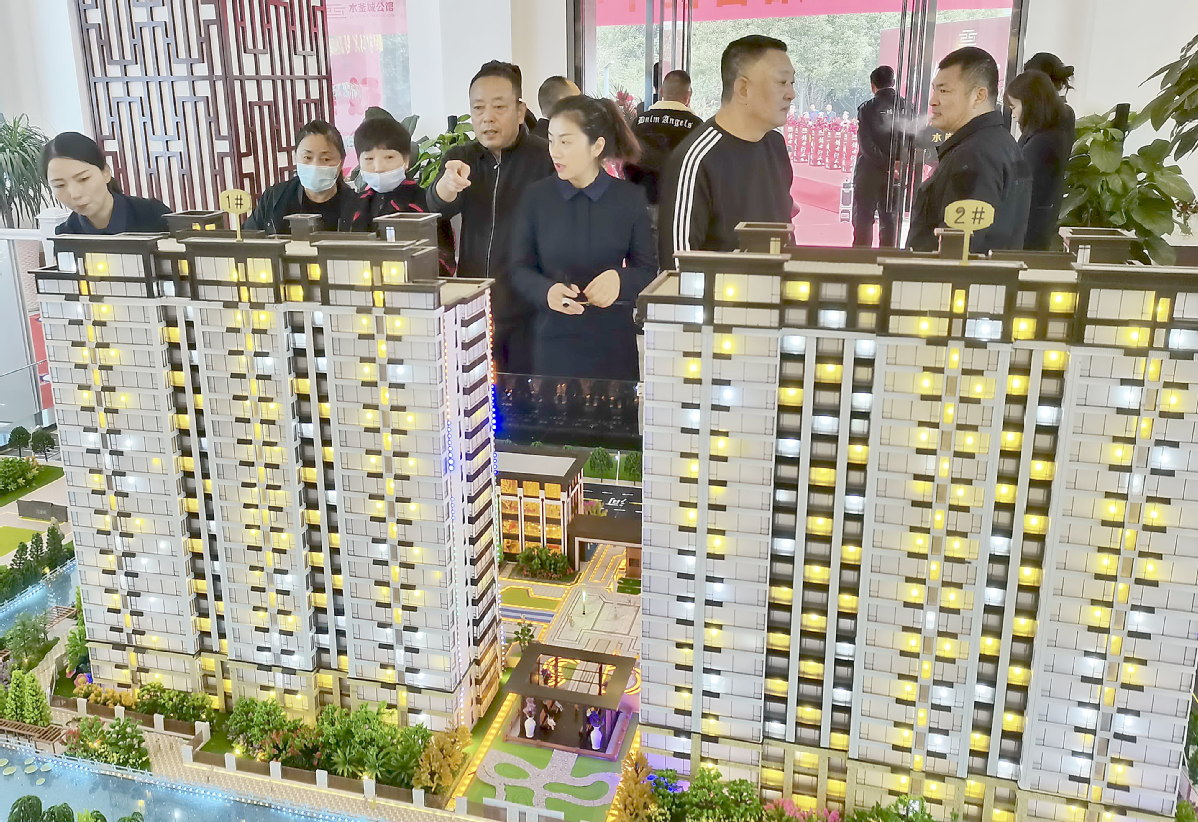
With China's property market now seemingly heading for an era of weaker demand, housing market speculation and an excessive inflow of funds naturally no longer represent the sector's top issues to be remedied.
Instead, the most prominent problems facing the sector lie in two other aspects, based on our research results.
First, excessively high housing prices outside the center of metropolitan areas have hindered a large number of low and middle-income individuals from settling down in the cities where they work.
Second, debt risks and shrinking balance sheets among property plays could hurt macroeconomic and financial stability.
As China has stepped up efforts to explore a new development mode for the real estate sector, measures to properly resolve these two issues should be incorporated into the new mode.
Therefore, we propose two solutions to the above issues: A housing construction program in big cities oriented toward newcomers and a plan to reduce debt risks in the property sector.
In the past few decades, urbanization, urban renewal and demographic structure have combined to propel rapid development of China's property market.
Accelerated urbanization has led to buoyant housing demand from new arrivals, urban renewal has generated a great deal of real estate investment and a relatively young population has provided steady demand for home purchases.
However, all three factors have seen marked changes, and new demand for homes in China is expected to significantly decrease over the next five to 10 years.
The pace of urbanization will slow down as the rate of urbanization has reached a relatively high level, while most cities have almost completed their urban renewal processes. The aging of China's population also points to shrinking new demand for housing.
Against such a backdrop, a universal increase in housing prices will no longer be the top issue facing the property sector. Though several megacities could continue to see tight housing supply and rising property prices, the pressure of rising residential real estate prices will be significantly mitigated in most cities, with even downside risks for cities facing net population outflows.
With cooling housing prices and new property market regulations such as down payment requirements, the principle that "houses are for living and not for speculation" has increasingly become a reality. In other words, housing market speculation will no longer be the most vexing problem.
In addition, an excessive inflow of money into the property sector draining resources that could be used in other sectors will not be a real concern either. In an economic climate lacking credit demand, credit expansion driven by the property sector will help boost the growth in purchasing power of the whole society and therefore prop up the revenue growth of other sectors.
In fact, one big problem facing the property sector is overly high housing prices in the outskirts of big cities.
High home prices in the center of metropolitan areas are not unique in China. The real issue here is that home prices are still comparatively high, even in suburbs of megacities.
For instance, the ratio between housing prices and per capita income stands at more than 30 in core areas of China's first-tier cities, such as Beijing and Shanghai, and more than 15 in suburban districts of such cities. But in New York, for example, the ratio is close to 30 in the center of Manhattan but drops below 5 in some areas of Staten Island, a borough of the city.
High housing prices even on the periphery of big cities have prevented some low and middle-income newcomers from settling down in the suburbs, thus impeding the expansion of megacities and reducing newcomers' willingness to consume.
To address this problem, efforts should be made to boost the housing supply for new residents in megacities and provide financial support for their dreams of owning a home.
Possible measures include allowing new arrivals to convert their quota of collective construction land in rural areas into land quotas to build new housing units in suburbs, and also establish specialized financial institutions to offer low-interest loans for newcomers.
Apart from boosting the housing supply itself, it is also important to mobilize enterprises to increase the supply of supportive services, especially education and medical care, for newcomers.
Another major problem facing China's property sector is debt risk pressure and balance sheet stress.
As it has become hard for highly leveraged real estate enterprises to sustain robust sales and high profits, their heavy interest payment burdens exposed many of them; and cash flow strains put some at risk of bankruptcy.
It should be noted that the difficulties facing property plays could affect credit expansion of the entire society, induce contraction in aggregate demand and cause macroeconomic instability.
As real estate developers reduce land purchases, local government land revenues will decrease. This could in turn affect the operation of local governments' financing vehicles and restrict credit growth of public sector entities.
Also, stagnant real estate activity could dampen the revenue growth and credit expansion of the industrial sector overall, given that real estate development is closely linked to numerous sectors such as building materials and furniture.
Therefore, implementing a series of measures to promote debt restructuring of the real estate sector will not only stabilize the housing market, but help safeguard systemic stability of macroeconomic and financial conditions.
Specifically, it is advisable to promote market-oriented reform of mortgage rates, which will reduce repayment burdens of households and stabilize demand for the purchase of new homes. This will in turn help prevent a sharp decline in developers' property sales, stabilize their cash flow and sustain their debt repayment ability.
Also, it would be wise to establish a securitization mechanism to make better use of real estate developers' assets that barely generate returns but carry debt burdens.
Under such a mechanism, developers are allowed to change the usage of such assets into quasi-public housing projects. Financial institutions purchase these housing projects and securitize them into real estate investment trusts, or REITs, whose interest rates are subsidized by fiscal funds to make the products appealing to investors.
Such a mechanism has the potential to both ease debt pressures facing real estate developers and boost the public housing supply to better accommodate low and middle-income groups.
The views don't necessarily reflect those of China Daily.
The writer is a nonresident senior fellow of the China Finance 40 Forum, a Chinese think tank, and deputy director of the Chinese Academy of Social Sciences' Institute of World Economics and Politics.



















