On timeless rivers, life finds a peak









Editor's note: China is home to 56 UNESCO World Heritage sites. To find out how these natural and cultural gems still shine and continue to inspire the nation in this new era of development, China Daily is running a series of reports covering 10 groups of selected sites from across the country. In this installment, we explore an oasis of biodiversity nestled amid the mountains of Yunnan province.
Three mighty waterways provide the lifeblood for a natural wonder, report Yang Yang in Beijing and Li Yingqing in Kunming.
It is a story transcending time, a witness of sea changes, a land with "mystery rivers", an ark of life, a symphony of natural wonders, a museum sheltering the eternal and the transitional, a piece of evidence showing that life can be both tough and frail, and a history that records people's changing perceptions of nature.
It is the Three Parallel Rivers of Yunnan Protected Areas in the northwest part of Yunnan province, which is located in Southwest China.
The story began about 40 million years ago, when the Indian Plate collided with the Eurasian Plate, raising the Qinghai-Tibet Plateau and creating the rumpled peaks of the Hengduan Mountains.
The roof of the world, the Qinghai-Tibet Plateau, cradles the sources of the longest rivers in Asia. In between the precipitous north-south ranges of the rippling Hengduan Mountains runs a mighty trio of waterways-the Nujiang in the west, the Lancang in the middle and the Jinsha in the east.
Respectively they are the upper streams of the Salween River, which runs through Myanmar, the vast Mekong River and the Yangtze River, the world's third-longest watercourse.
One singular thing about the three rivers is that they run abreast for 170 kilometers through Yunnan, before the Jinsha River turns drastically northeastward and finally meets the East China Sea.
Another is that they run unusually close to each other. The shortest distance between Lancang and Jinsha measures 66 km, and between Lancang and Nujiang, the distance is less than 19 km.
That was how, in 1985, this geographical wonder, highlighted on a satellite map, drew the attention of an expert from UNESCO, which marked the commencement of a long journey to apply for inclusion on the World Heritage List.
UNESCO selects world heritage sites according to four criteria: aesthetic importance, outstanding examples representing major stages of Earth's history, exceptional examples of significant ongoing ecological and biological processes, and the most significant natural habitats for in situ conservation of biological diversity. Meeting one of them is usually adequate.
The Three Parallel Rivers of Yunnan Protected Areas went on the list in 2003. Liang Yongning, a professor of geology from Kunming University of Science and Technology in Yunnan, says it is the only world heritage site in China that meets all four criteria.
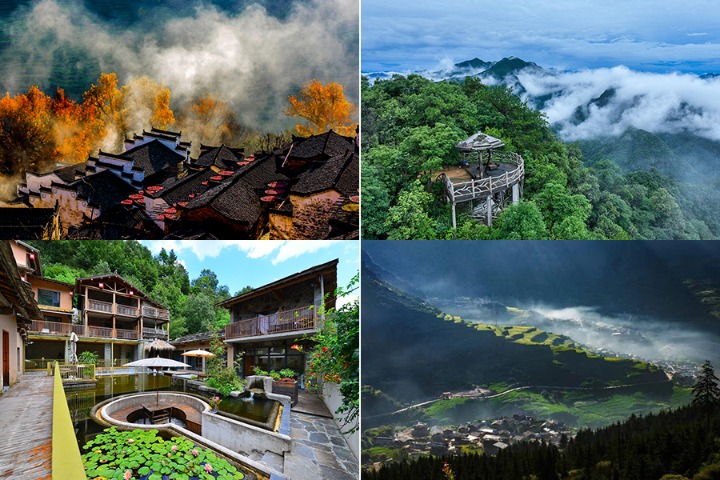
Covering 1.7 million hectares, the site consists of 15 different protected areas that have been divided into eight clusters, each providing a representative sample of the full range of the biological and geological diversity of the Hengduan Mountains, Shangri-La included.
Back in the autumn of 2002, Liang, an expert on the team preparing the area's application for inclusion on the list, received two experts from UNESCO who were sent to investigate the region.
Two decades ago, the area was one of the most impoverished in China. It was blocked by unscalable mountains and rushing rivers. Roads were carved into escarpments and some bridges were merely cables which people used to get across roaring torrents together with their animals.