Kazakhs feel warmth of bilateral ties
Xi's trips to Central Asian nation have produced solid economic, social results









Editor's note: China Daily is publishing a series of stories reviewing President Xi Jinping's visits at home and abroad in the past decade, to showcase his vision for development in China and the world.
A legendary Chinese composer has different names in different places. As one of the greatest composers in China, he is known as Xian Xinghai whose Yellow River Cantata has inspired millions. In Kazakhstan, he is known as Huang Xun and was regarded as a refugee with remarkable talent.
Wherever he went, whatever people called him, his music gave people courage and strength to fight against fascist invaders. President Xi Jinping recounted the composer's story during his first state visit to Kazakhstan in 2013.
When war broke out between Nazi Germany and the Soviet Union in 1941, the composer was working on a documentary for the Communist Party of China under the alias Huang Xun in Moscow. Forced to abort his mission and evacuate, he tried to return home through a southern area of the Soviet Union that is now Kazakhstan, only to find the borders closed. He was left alone in the Kazakh city of Almaty, where he knew no one and had nowhere to stay.
Xian hid his true identity and contributed to the Kazakh cultural cause anonymously. He incorporated Kazakh traditional music and folklore in his works. They served as a rallying call to fight fascism and were immensely popular with locals.
In Almaty today, a boulevard is named after him, and a monument was erected to commemorate him in the city center.
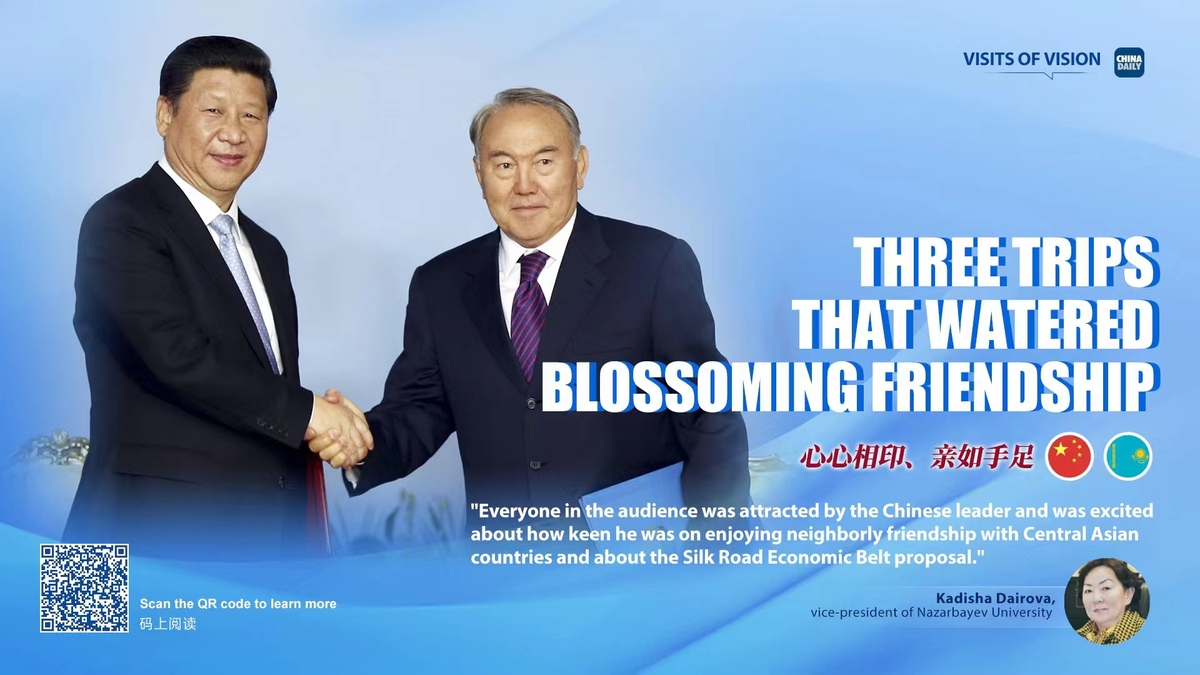
This year marks the 30th anniversary of the establishment of diplomatic relations between China and Kazakhstan, and three visits by Xi to the country, in 2013, 2015 and 2017, carried on the Silk Road spirit and exemplified the warm relationship between the two neighbors.
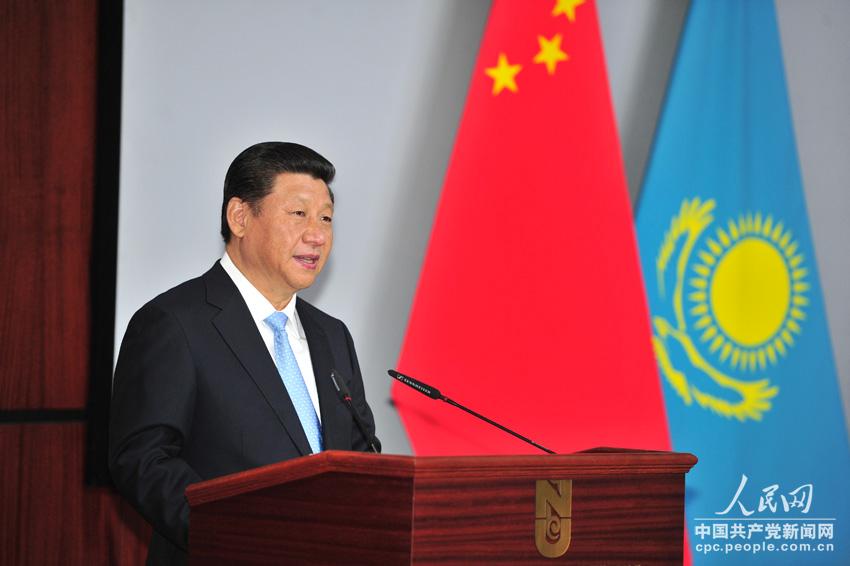
Kadisha Dairova, vice-president of Nazarbayev University in the Kazakh capital, Nur-Sultan, formerly Astana, brims with excitement when she recalls a speech Xi delivered during his first visit to the country on Sept 7, 2013.
It was this speech that formally launched an ambitious initiative to jointly build an "economic belt along the Silk Road" to boost China-Kazakh relations and regional collaboration.
"Kazakhstan, sitting on the ancient Silk Road, has made an important contribution to the exchanges between Eastern and Western civilizations and the interactions and cooperation between various nations and cultures," Xi said.
Over the previous 20 years and more, relations between China and Eurasian countries had developed rapidly, he said, and the ancient Silk Road had gained fresh vitality. In a new way it was taking collaboration between China and Eurasian countries to new heights.
To forge closer economic ties, deepen collaboration and expand development space in Eurasia, an innovative approach was needed, Xi said, and an "economic belt along the Silk Road" should be jointly built that would be a great undertaking benefiting the people of all countries along the route.
"There were no empty seats in the university's semicircular auditorium," Dairova said.
"Everyone in the audience was attracted by the Chinese leader and was excited about how keen he was on enjoying neighborly friendship with Central Asian countries and about the Silk Road Economic Belt proposal."
Xi's address was followed by prolonged applause, and the students seemed to sense that bilateral collaboration in the framework of the Belt and Road Initiative offered them good job prospects once they graduated, she said.
Zhang Xiao, China's ambassador to Kazakhstan, said Xi's Silk Road Economic Belt proposal in 2013 was immediately supported by Nursultan Nazarbayev, the president of Kazakhstan at the time, and was received positively by various segments of Kazakh society.
"As a result, Kazakhstan became one of the first states to engage in international collaboration as part of the Belt and Road Initiative. China and Kazakhstan are at the forefront in building the Belt and Road."
Since the 2013 visit, China and Kazakhstan have firmly adhered to the principles of "joint discussion, joint construction and joint use", ensuring that the Belt and Road Initiative aligns closely with Kazakhstan's new economic policy Nurly Zhol, meaning bright path, comprehensively promoting collaboration, Zhang added.
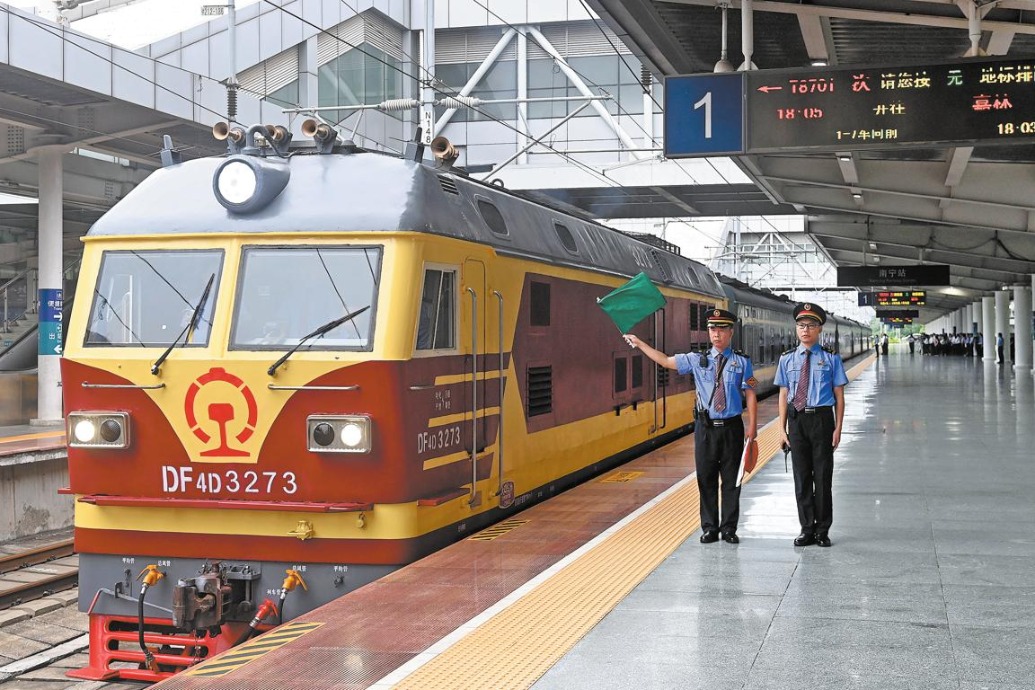
Askar Mamin, a former Kazakh prime minister and former president of the national railway company Kazakhstan Temir Zholy, said he felt the energy of China-Kazakh cross-border trade after Xi's visit.
The Kazakh city of Khorgos on the border with China used to play an important role on the ancient Silk Road, and it now enjoys increasing trade between the two countries with the new Silk Road, he said.
In December 2013, Nazarbayev initiated the Khorgos-East Gate Free Economic Zone on the border. The zone is a part of the Khorgos International Border Cooperation Center, a China-Kazakhstan joint venture, Mamin said, and Xi's visit convinced him that the project could became a key bridge between China and Europe.
Trade between China and Kazakhstan has grown rapidly under the Belt and Road Initiative, said Jiang Wei, China's consul general in Almaty. In the first 10 months of 2021, trade between the two countries was worth $20.8 billion. China continued to be Kazakhstan's second-biggest trading partner, and for the first time became its largest export destination country.
"We are proud that this initiative was first announced in Kazakhstan during President Xi Jinping's visit," said Ruslan Bultrikov, Kazakhstan's deputy permanent representative to the United Nations.
Xi's speech was "very symbolic because this concept was first announced during his meeting with students, who represent the young generation and for whom the great project will be carried out", he said.
For Dairova, the Belt and Road Initiative is good for mutual understanding and cultural exchanges. She has overseen the establishment at Nazarbayev University of a China Culture Center.
"It is my greatest wish to help more students have opportunities to study in China, to boost China-Kazakh cultural exchanges, and to cultivate more talent for Kazakhstan's development."
Following the example of the composer Xian, another "musical ambassador" has also brought the peoples of the two countries together.
Dimash Kudaibergen, a young Kazakh singer, has become phenomenally popular in China, giving Chinese audiences a great insight into the landlocked country.
The singer, known as Dimash, sang for Xi during his state visit to Kazakhstan in 2015.
In 2017, he performed in Singer, a talent show made by Hunan TV, and he soon had millions of Chinese fans.
Mira Nazbekova, a Kazakh who works for an energy company, said more Chinese TV shows were broadcast in Kazakhstan after Xi's visits, and these helped young Kazakhs to learn more about China.
"More Kazakhs, especially young people, are choosing to learn Chinese as a foreign language in school and university," Nazbekova said.
On Xi's third visit to Kazakhstan, in 2017, both countries agreed to further align Nurly Zhol with the Belt and Road Initiative, with industrialization at the core.
Xi took part in the opening ceremony of Expo 2017 in Nur-Sultan and visited the China pavilion accompanied by Nazarbayev.
Dairova said that during the 2017 visit, she was glad to hear Xi had promised to increase the number of government scholarships by 200 for Kazakh students in the following five years.
Deng Ying, director of the Confucius Institute at Xi'an International Studies University, said there were only dozens of students at the institute when it opened in 2007, but the number rose rapidly after Xi's visit to Kazakhstan in 2013.
There are five of the institutes in Kazakhstan, and nearly 20,000 Kazakh students now study in China.
- Black Americans facing a harder financial time during pandemic
- Meeting helps awaken US to China's strategic determination on Taiwan question: Experts
- Pop star Kris Wu stands trial
- China leaves no doubt it will fight to crush 'Taiwan independence': China Daily editorial
- China's new yuan loans at 1.89 trln yuan in May

- Memorial ceremony remembers victims of Nanjing Massacre
- Louvre's largest showcase in China goes on display at Museum of Art Pudong in Shanghai
- Indonesian foundation to fund students, school administrators to exchange and study in Tianjin
- Archives detailing crimes of Japanese unit released
- 'Reservoirs of primordial water' may be buried deep within Earth
- China remembers victims of Nanjing Massacre, 88 years on