



All sectors must play bigger role in protection, analysts say









China still faces a host of challenges in its transition to a greener future, and the nation must enable greater social participation to bring all sectors of society on board in efforts to protect ecology and the environment, according to analysts.
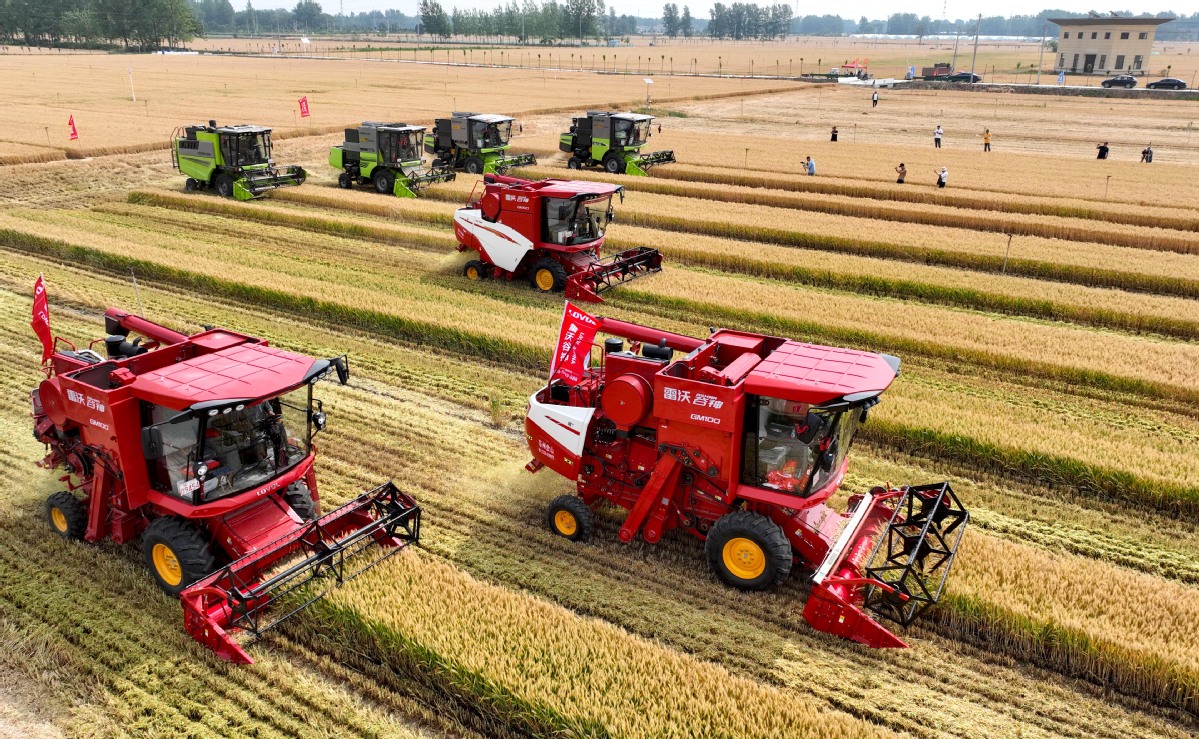
Wan Jun, chief engineer at the Chinese Academy of Environmental Planning, said that to ensure its food security, China uses a substantial amount of pesticides and fertilizers to maintain its annual grain output, posing one of the main environmental threats in the coming decade.
"The pesticides and fertilizers China uses each year have exceeded the amount used by the United States and India combined, but there are no other options, as this is a 'must' to ensure China's food security," he said.
The nation has produced more than 650 million metric tons of grain annually since 2015, an amount viewed by many experts as a bottom line for it to ensure self-sufficiency in stable food supplies.
China also continues to rely mainly on coal for energy, and on exports for about 70 percent of its crude oil and 50 percent of its natural gas supplies.
Wan said the conflict between Russia and Ukraine, which has resulted in higher global energy prices, could slow China's efforts to replace the use of coal.
"Many developed countries have completed their industrialization process and have thus peaked their carbon emissions, but China has not," he said. Wan added that he believes it could take three to five years for the nation to complete its urbanization and peak its consumption of energy and other resources.
China has pledged to use a 10-year period to peak its carbon emissions before 2030, compared to the 50 to 70 years for many developed countries.
Wan said the proposal made by Xi Jinping, general secretary of the Communist Party of China Central Committee, in 2017 in his report to the 19th National Congress of the CPC to build a Beautiful China was a landmark move in the nation's efforts to protect ecology and the environment.
In the report, Xi said the goal of building a Beautiful China would basically be reached by 2035.
Wan said this vision will continue to underpin the nation's environmental governance in the coming decade, enabling the public to enjoy an improved environment in the future.
Greater public participation is needed to reduce the amount of pesticides, fertilizers and coal being used, he said.
Dimitri De Boer, chief representative of the environmental law organization ClientEarth in China and team leader of the EU-China Environment Project, said the nation must seek more public awareness and participation in its commitment to peak carbon emissions before 2030 and attain carbon neutrality before 2060.
This would require a strong commitment from Xi and the top leadership, along with the understanding and cooperation of local communities to honor climate commitments, he said.
De Boer stressed the need for China to bolster action against chemical pollution, including stronger measures to treat pollution from plastics.
Wan said the nation must encourage stronger participation from the public and different sectors of society in environmental protection and climate actions.
He added that environmental protection campaigns over the past decade have been driven largely by official policies conducted in a way similar to a battle being fought.
"With the majority of environmental problems being solved, policy priority should shift to building a Beautiful China. Such an endeavor will require more enthusiasm, initiative and creativity from the public," he said.
"The ultimate goal is to enable everyone to have a sense of participation and a sense of gain."


- Ten photos from across China: March 6 - 12
- Consumer rights protection disputes in new business models surge in Guangzhou
- French vloggers explore highland scenery and Tibetan culture in Yunnan
- Village in Jiangxi gives 100,000 yuan bonus to residents turning 100
- World's leading lab service provider opens China headquarters in Wuxi
- 'Ride to spring' becomes a major tourist attraction in Chongqing





