New occupations could ease pressure on job market









Emerging business trends, together with Internet Plus and information and communications technology, are reshaping the way people work, communicate, and create and distribute values. They have helped create new occupations which will trigger revolutionary reform in the labor ecosystem.
The Ministry of Human Resources and Social Security recently released a list of 18 new occupations, including robotics technician, data security technician and digital solution designer-all related to the digital economy. These new professions will be included in the new edition of the occupational classification dictionary if necessary after soliciting public opinions.
This is the fourth time the ministry has released a list of new occupations since the dictionary was first revised in 2015, reflecting the market demand for emerging professions.
Some occupations have emerged to meet the needs of the digital era. Some others are aimed at accelerating the pace of reducing carbon emissions and thus help the country peak emissions before 2030 and achieve carbon neutrality before 2060, while some can help improve people's livelihoods.
The emergence of new occupations reflects the qualitative and quantitative changes in the Chinese economy, and not only offers new, promising career choices but also will restructure the employment market.
China attaches great importance to the review of the occupational classification dictionary. First, the establishment of a mechanism to study and list new professions means the country supports new forms of employment. And the official recognition and regulations for the new occupations can help generate more new jobs and develop new careers.
Second, the revision of the dictionary will encourage vocational education and training centers to update their curriculums in order to meet the changing needs of society and enterprises, and help strike a balance between supply and demand in the labor market.
Third, the dictionary will help optimize the classification and standardization of new occupations, which in turn will facilitate human resource development and evaluation of vocational education. It will also provide scientific evidence for the country to study the employment situation and formulate development plans for related industries.
And fourth, the release of the list of new occupations will help regulate the hiring and training process, and guide employees to choose the career path best suited to them and improve their professional skills.
The employment situation this year is more challenging given the economic downturn, external uncertainties and uneven global economic recovery due to the long-term effects of the COVID-19 pandemic. So the government should especially focus on ensuring that vulnerable groups get employment and help new forms of business to solve their problems.
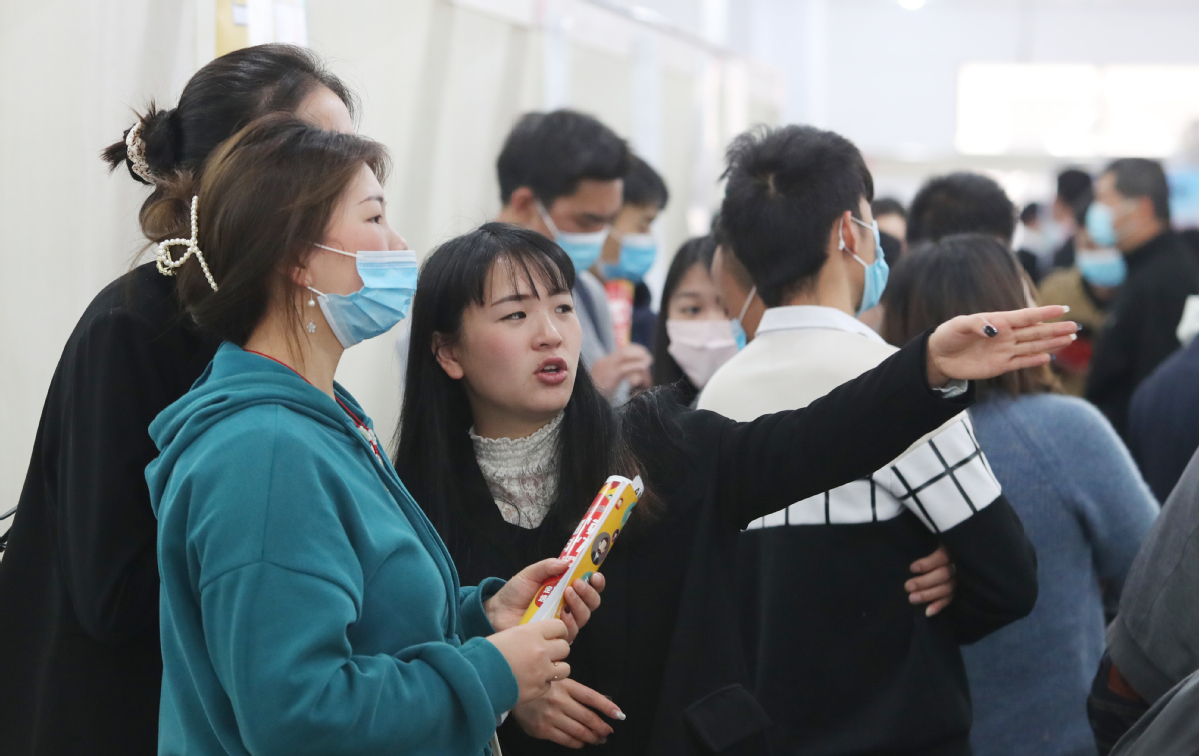
Fresh college graduates in China face an increasingly competitive job market, because about 10.76 million students, 1.67 million more than last year, are expected to graduate from college this year. Add to that the high number of overseas students expected to return home this year and those who graduated last year or before but could not find a job and you'll get an idea of the huge pressure the labor market faces.
According to a recent report by Zhaopin, an online recruitment platform, the China Institute for Employment Research's index, which measures the supply-demand tension in the labor market, hit rock bottom for the first time since the pandemic-touching 0.71 for new graduates in the first three months of this year. This means for every job seeker there is 0.71 vacancy. The figure is significantly lower than the national level of 1.56 during the same period last year.
This has increased the pressure on job seekers, mostly college graduates. The latest figures, according to the National Bureau of Statistics, show the surveyed unemployment rate of people aged 16 to 24 was 18.4 percent in May, up 0.2 percentage points from April, the highest since 2018.
Fortunately, the new forms of businesses and the emergence of new occupations can provide diversified career choices for youths and alleviate the employment pressure. Hence, government departments should cooperate with each other, and introduce policies to encourage new forms of employment, in a bid to ensure stable employment.
In addition, they should also guide the healthy development of new forms of employment and protect the rights of the new types of professionals. The new forms of occupations have not only created new jobs but also lowered the threshold for employees and provided opportunities for more people to boost their incomes.
Apart from paying special attention to the emergence of new forms of businesses and implementing policies to protect the legitimate rights of their practitioners, government departments have also strengthened supervision of algorithm-based technology, which many of the new forms of businesses use. Which means measures will be taken soon to regulate the new forms of occupations and protect the rights of their practitioners.
However, the authorities should also take measures to minimize potential risks and overcome the future challenges given the rapid development of the digital economy.
The author is an associate researcher at the Chinese Academy of Labor and Social Security.
If you have a specific expertise, or would like to share your thought about our stories, then send us your writings at opinion@chinadaily.com.cn, and comment@chinadaily.com.cn.