Better eating habits









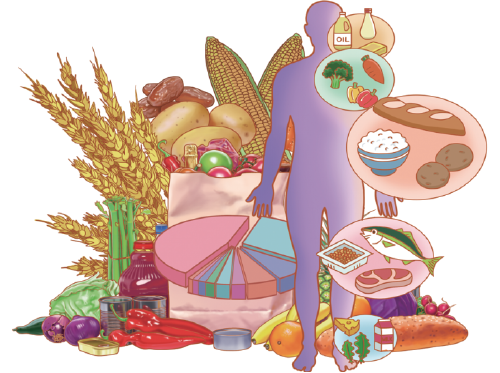
Now the Chinese diet has moved beyond filling the belly, healthy nutrition standards should be recommended
China's policies with regard to agricultural products have for a long time focused more on ensuring supply. However, as the basic needs of Chinese residents have been met and the agricultural product consumption is tending toward stability, we should focus on the consumption side problems and value guidance and management improvement, so as to achieve a benign balance between supply and demand.
Since the 1980s, Chinese residents' annual per capita consumption of major agricultural products has been gradually stabilized. Chinese residents' grain consumption is comparable to that in the developed countries, and the meat consumption exceeds the average of the developing countries.
Compared with 1985, Chinese residents' consumption of meat, vegetables, eggs, milk and aquatic products increased significantly in 2020, but grain consumption dropped. The average annual grain consumption for urban and rural residents in China decreased by 10.6 percent and 34.5 percent respectively. In the same year, Chinese urban residents' annual per capita consumption of meat, edible vegetable oil, fresh eggs and aquatic products was 1.6 to 2.3 times that of 1985 respectively, and rural residents' annual per capita consumption of the above-mentioned agricultural products was 1.8 to 6.4 times that of 1985 respectively. In terms of milk consumption, the annual per capita of urban residents in 2020 was 1.2 times that of 2010, and the annual per capita of rural residents was 2.6 times that of 2009. This is inevitable, since people's incomes and living standards have improved greatly.
Since 2015, the urban residents' egg consumption and the rural residents' consumption of egg, milk and aquatic products have maintained an average annual growth rate of 5.2 percent, 7.3 percent, 3.3 percent and 7.4 percent respectively. The average annual variation of other food is within 3 percent, basically tending to stabilize. This means that in recent years, Chinese people's constructional demand for agricultural products consumption has been mostly met, but with the continuous increase of income, the demand for a few agricultural, animal husbandry and fishery products such as milk and aquatic products will rise in the future.
The Chinese per capita grain consumption in 2020 was 128.1 kilograms, 7.5 kg higher than that of the three major grain staples in the developed countries. The Chinese per capita meat consumption was close to the global average, higher than the average of the developing countries. In 2020, the per capita meat consumption in China was 34.4 kg, slightly higher than the global average of 33.8 kg, 24.2 percent higher than the average of the developing countries.
However, the Chinese per capita meat consumption was less than half of the average of the developed countries, which was 83.7 percent of that in Japan and 56.5 percent of that in the Republic of Korea and only 33.9 percent of that in the United States. And the per capita aquatic products consumption was only 68.5 percent of the average of the developing countries, 30.2 percent of that in Japan and 24.1 percent of that in the ROK.
There are three main problems in China's consumption of agricultural products. First, the proportion of grain, meat and other major agricultural products in the total global consumption is significantly higher than the proportion of the Chinese population to global population. According to the China National Grain and Oils Information Center, the total consumption of wheat, rice and corn in China in 2020 was 147.27 million tons, 194.8 million tons and 294.04 million tons respectively, accounting for 18.8 percent, 31 percent and 25.8 percent of the total global consumption, which was significantly higher than China's population proportion of 18.1 percent in the same year. In addition, figures from the US Department of Agriculture show that China also consumed about 86 million tons of meat in 2020, accounting for 23.6 percent of the world's total, of which pork consumption was about 45.41 million tons, accounting for 42.7 percent.
Second, both the grain and edible oil consumption of rural residents and the meat consumption of urban and rural residents have exceeded the recommended standard of a healthy diet. In 2020, the annual per capita consumption of these three products was 168.4 kg, 11 kg and 34.4 kg respectively, equal to or exceeding the recommended upper limit for Chinese residents.
Third, the accuracy, flexibility and pertinence of China's diet and nutrition recommendations need to be improved compared with international standards. For example, Japan clearly proposes the intake of major nutrients such as carbohydrates and proteins. For Australians, two or three cups of spaghetti can meet the daily intake of carbohydrates. The US, the United Kingdom and Switzerland recommend the intake of aquatic products on a weekly basis, taking into account both scientificity and flexibility. Sweden, Turkey and other countries recommend food intake for different genders.
Efforts should be made to guide and manage the consumption side of agricultural products. First, it should be included in the regulation and control of agricultural products. The balance between supply and demand of agricultural products requires both supply side and consumption side management. China should ensure its grain security by giving equal attention to both sides. China's agricultural products have achieved a primary and tight balance between supply and demand rather than a short supply. In this context, we should take the economical consumption of agricultural products, reasonable household reserves and personal healthy diets under the guidance and management of the consumption side, bring them into regulation, carry out food security education, start to ease the pressure on the supply of agricultural products, and seek loose balance between supply and demand on the consumption side.
Second, families should be encouraged to store agricultural products moderately. In recent years, due to lack of awareness of agri-food, daily grain, oil and meat reserves, the micro-foundation of food security and agricultural products supply in households is unstable, which exerts certain pressure on the nation's overall food security and agricultural products supply. Household reserves can help ease the stress on the national reserve and supply, enhance the stability of agricultural product supply, and also play an important role in handling major emergencies such as epidemics and disasters. Therefore, it is necessary to store some grain and reserve agricultural products in households.
Third, we should popularize general knowledge of a healthy diet, and make the dietary nutrition recommendation standards more specific, scientific and suitable for the Chinese citizens. Nowadays, people's physical labor has been greatly reduced in general, and excessive nutritional intake is likely to pose a risk to people's health. Some developed countries have shown that the higher the level of an economy and nutritional intake, the higher the proportion of the population with obesity and the "three hypers" (hypertension, hyperglycemia and hyperlipidemia) chronic conditions. There is a similar situation in China. Therefore, it is necessary to carry out common-sense education on a low-carbon, scientific and healthy diet, and guide residents to reasonably arrange the proportion of carbohydrate, oil, protein and other food intakes. People should follow the basic law of filling the stomach first, then eating heartily, and having a healthy diet.
Efforts should be made to deepen, refine and scientifically recommend dietary nutrition standards suitable for the Chinese people. We should take precise measures and advocate appropriate consumption of agricultural products and nutrient intakes according to the differences in nutritional intake needed by different groups, gender and age, as well as the supply and demand characteristics of agricultural products and eating habits in different regions so as to continuously make China's diet and nutrition recommendations more targeted, applicable and operable.
Zhang Yunhua is a research fellow and deputy director-general of the Rural Economy Research Department at the Development Research Center of the State Council. Zhao Junchao is a research fellow and director of the Research Office of the Rural Economy Research Department at the DRC. Zhang Xu is a PhD at the Rural Economy Research Department at the DRC. The authors contributed this article to China Watch, a think tank powered by China Daily.
The views do not necessarily reflect those of China Daily.
Contact the editor at editor@chinawatch.cn