Chinese students excel at math, so why aren't there more mathematicians?









Recently, the Fields Medal which is known as the Nobel Prize in mathematics issued every four years was announced. Four "Generation Y", young mathematicians from France, America, Britain and Ukraine won the prizes. There into, June Huh has an especially legendary experience, who is a Korean-American mathematician had a bad math performance and even was repelled by math in his early years, finally becomes another Asian who won the medal after Shing-Tung Yau, Terence Chi-Shen Tao and Bao Chau Ngo.
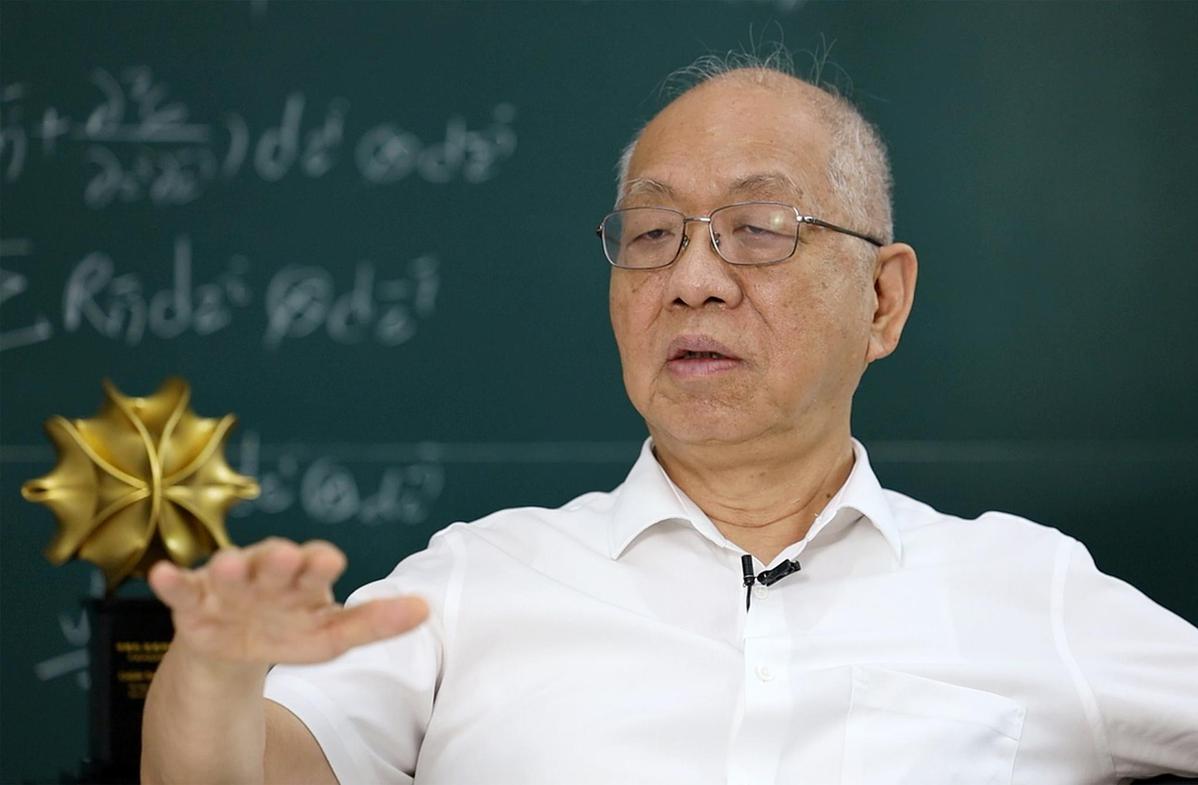
Which characteristics does a mathematician have? How can China cultivate more native and world-class mathematicians? What can China do if it wants to rise from a "mathematic giant" to a "mathematic power"? Famous Chinese mathematician Shing-Tung Yau who is also the first Chinese Fields Medal winner, had an exclusive interview with the "W.E. Talk" of China News Service recently. He said, "To learn math well, you should have fundamentals and talents, interests and be hardworking. The true essence of math is not solving math problems, especially not those made by others, but requiring us to develop good research direction and good problems and to make our way through."
Here are excerpts from the interview:
CNS:Once you said that you had a home either in China or in the U.S.. And a third home inhabited for over half a century – Mathematic State. How do you become interested in math?
Shing-Tung Yau:I have been interested in math from early time. My father was a philosopher, but he showed special preference to math. Though he did not explore math, he thought it was an important subject. Under the guidance of my father, I had interests in math since then.
When I was 14, my father passed away. I had great interest in math, but I did not get to know real math until my study in UC Berkeley.
Frankly speaking, research areas were one-sided which Chinese mathematician realized and there was not a huge panorama. I saw it till I was in Berkeley.
CNS:You have dual experiences of learning and teaching in the East and the West and lived in the U.S. for nearly 50 years. How to solve the phenomena that Chinese students like to solve Olympic mathematics rather than ask questions?
Shing-Tung Yau:Many people are curious about why Chinese students are good at math but there are few great mathematicians in China. Actually, there are lots of mistakes among them. Among euromericans, people with best math performance are not only taught mathematical primary contents by their teachers but also lay emphasis on stimulating them to have true interests in mathematics, which makes them have enormous original motivation to find the beauties of mathematics.
Many Chinese children do not understand the most essential part of mathematics. They seem happy to solve the problems and to get good test results. However, the true essence of math is not solving math problems, especially not those made by others, but requiring us to develop good research direction and good problems and to make our way through.
To break this difficult situation, utilitarian mind should be abstained. Don't think about getting a promotion or fortune by doing mathematics, compete for the so-called "title of talent" and strive for becoming academicians. When I was in the U.S., I found a lot of young people considering that their research were interesting. They are satisfied, and they do not think about whether they can be academicians or get high salaries. As for people who aspired to engage in scholarship, the real reward is knowledge itself. The most important thing is to solve difficult problems. We should learn from Tang Monk's Journey to the West, during which he overcomes 81 tribulations.
Therefore, to learn mathematics well, they should be talented, interested and hardworking. It takes such a long time. Without interests, people can barely persist. Besides, do not rely on inspiration. It is impossible to solve unanswered problems by just relying on inspiration.
CNS:You are fond of classical Chinese poetry, and you used to write poems. Once you said, Chinese classical literature deeply influences your temperament and self-cultivation in terms of engaging in scholarship. What nourishment and enlightment did Chinese traditional culture bring to you as for doing mathematics?
Shing-Tung Yau:It requires cultural foundation, when pursuing one's studies. Not only do we read classical Chinese poetry, but read Shakespeare, Goethe's Faust and listen to Beethoven's music. Poetry is an important part of Chinese culture. No matter poetry or mathematics, they both explore nature, but the ways of describing are different.
I like ancient style, The Book of Songs (Shijing, also translated as Classic of Poetry), The Songs of Chu (Chuci, also translated as Poetry of the South) and Poetry of Wei, Jin, Northern and Southern Dynasties, such as The Nineteen Ancient Poems. Overall, my favorite is Han-Fu (also translated as The Rythme Prose of Han Dynasty).
Thanks to reading Bold and Unconstrained School of Ci lyrics, such as SuDongpo's works, my vision of doing mathematic research is different from other's. I usually encourage students to read more Bold and Unconstrained School of Ci lyrics and the Historical Records by Sima Qian, which benefits them a lot in doing research, help them open minds and pay attention to more big issues. This is also where the main idea of Qiuzhen College of Tsinghua University – "Explore happiness of the Heaven and Human, open your mind eternally."
CNS:What function indeed does mathematics have? What problems can it help solve for human beings?
Shing-Tung Yau:From the past to the present, mathematics is the foundation of the whole science. To interpret the structure of nature, the only language is mathematics. The basic rules of nature can only be induced by mathematics.
When doing experiment during the early time, nothing can be presented without mathematics. To present the results of such experiments, it needs logical derivations through which it can be applied to mainframe computers or even the Two Bombs, One Satellite project . Actually, all of the scientific projects cannot be completed without mathematics. Especially the internet, which has been developing during the recent decades, is closely related to mathematics, such as finding how to research internet structure and how to send information in the fastest way. There is nearly nothing that can exist without mathematics.
Recently, a lot of mathematicians talked about the epidemic. The number of infected persons in the future can be predicted by mathematical modelling. AlphaGo that defeated human in Go games is closely related to mathematics, in terms of deep learning, AI, etc.
CNS:What are the development approaches of mathematics in the East and the West? What is the current level of Chinese mathematics in the world?
Shing-Tung Yau:Mathematics in ancient China developed quite well for a period of time, but since the significant development of mathematics took place in Greece, there was no country in the world could be compared with it. The mathematical achievements of Greece were unparalleled for over seven hundred years from 500 BC to 200 AD. During that time, ancient civilizations including Babylon, India, and China studied mathematics as well, but they did not find a perfect logical method to deal with mathematics. Only Greek mathematicians made it.
China did not start the research of modern mathematics in the true sense until the early 20th century. Chinese mathematics has been developing quite well, but it is still far from the most advanced mathematics in the world. There are a few Chinese mathematicians who have done well, but there is a strong team of mathematicians in the West, between which there is still a gap.
At present, China is more focused on applied mathematics, while the development of theoretical mathematics needs to be strengthened, which requires a painful and even isolated experience of independent thinking.
CNS:In your autobiography, you say that mathematics has the magical power to break down the barriers of distance, language and culture, and to bring people together instantly and share common knowledge with each other. How do you think mathematics can promote communication between the East and the West?
Shing-Tung Yau:It is a basic concept that mathematics follows the rules of logic, which applies everywhere. For instance, my Russian friend and I both use the same mathematical language and we communicate with each other without any barriers. Different nationalities have their own characteristics, and each era has different environment, which influences the development of mathematics, while mathematicians are all strict to the rules of logic. Although our steps and methods of solving problems are different, it does not prevent us from appreciating and integrating with each other.
A good institute of mathematics should be open for many mathematicians from different countries and nationalities. I probably know all the great mathematicians after the 1950s, and I have learned a lot from them and their attitude towards learning. I also learn a lot from physicists, thanks to which plenty of my research is related to physics.
CNS:The 9th International Congress of China Mathematicians (ICCM) is about to be held. What was your original intention in initiating this conference? What unique role can Chinese mathematicians play in promoting communication between the East and the West?
Shing-Tung Yau:The ICCM was first launched in 1998. At that time, China's mathematics was relatively backward, so I hoped to gather the strength of Chinese mathematicians from all over the world to improve China's mathematics level and facilitate their communication with each other. I think I made it. Many outstanding Chinese mathematicians who had lived overseas came to China, and many Chinese mathematicians got opportunities to visit and exchange abroad. This congress plays a very good role as a bridge.
We have also launched many important awards, such as the "Mornin gside Medal of Mathematics" known as the "Chinese Fields Medal". Almost all of the most important mathematicians in China have won this award. In 1998, the level of mathematics in China was behind that of overseas countries, and mathematicians in China did not know much about the progress of overseas mathematics research. Through the speeches of those Chinese mathematicians, local Chinese mathematicians had the opportunity to learn about the most cutting-edge mathematics research. After more than 20 years of development, China's mathematics level has been significantly improved. At present, the direction in which we lead Chinese students to do research is much clearer than before, and we can grasp the key points.
CNS:You once predicted, "The 19th century was the century of mathematics in Europe, and the 20th century was the century of mathematics in the United States, and the 21st century should be in China." What else do you think China needs to do to become a strong country in mathematics?
Shing-Tung Yau:I sincerely expect that the world's first-class mathematical achievements can be made in China within ten years. China will absolutely play a vital role on the "international stage", since it has a larger population than almost any other country, and its people respect knowledge very much. China has over 10 million college graduates this year. If 0.01% of them have the potential to become world-class mathematicians, China will have 10,000 excellent mathematicians in 10 years.
Specifically, the talent selection system should be appropriately innovated, and not all talents need to be selected through the College Entrance Examination (CEE). Qiuzhen College, Tsinghua University independently admits 100 students each year, which is only a small proportion compared to the 10 million students competing for the CEE. Nevertheless, these students are expected to become leading mathematical talents in China in the future. To change the academic direction of mathematics in China, it may depend on this small number of people.
Scholar Biography:
Shing-Tung Yau, Member of the American Academy of Sciences, Fellow of the American Academy of Arts and Sciences, Foreign academician of the Chinese Academy of Sciences, Foreign academician of the Russian Academy of Sciences. Tenured professor in the Department of Mathematics and Physics at Harvard University, Chair Professor of Tsinghua University, Director of Yau Mathematical Sciences Center of Tsinghua University, Dean of Qiuzhen College.
Yau graduated from the Department of Mathematics of the Chinese University of Hong Kong, and received a Ph.D. from the University of California, Berkeley. He studied under Shiing-Shen Chern, a famous differential geometer. Yau has proved the Calabi conjecture that has plagued the mathematics community for many years and the positive mass conjecture in general relativity. He is the first Chinese winner of the Fields Medal, the "Nobel Prize in mathematics".