Asian Elephants embrace baby boom in China amid enhanced conservation efforts









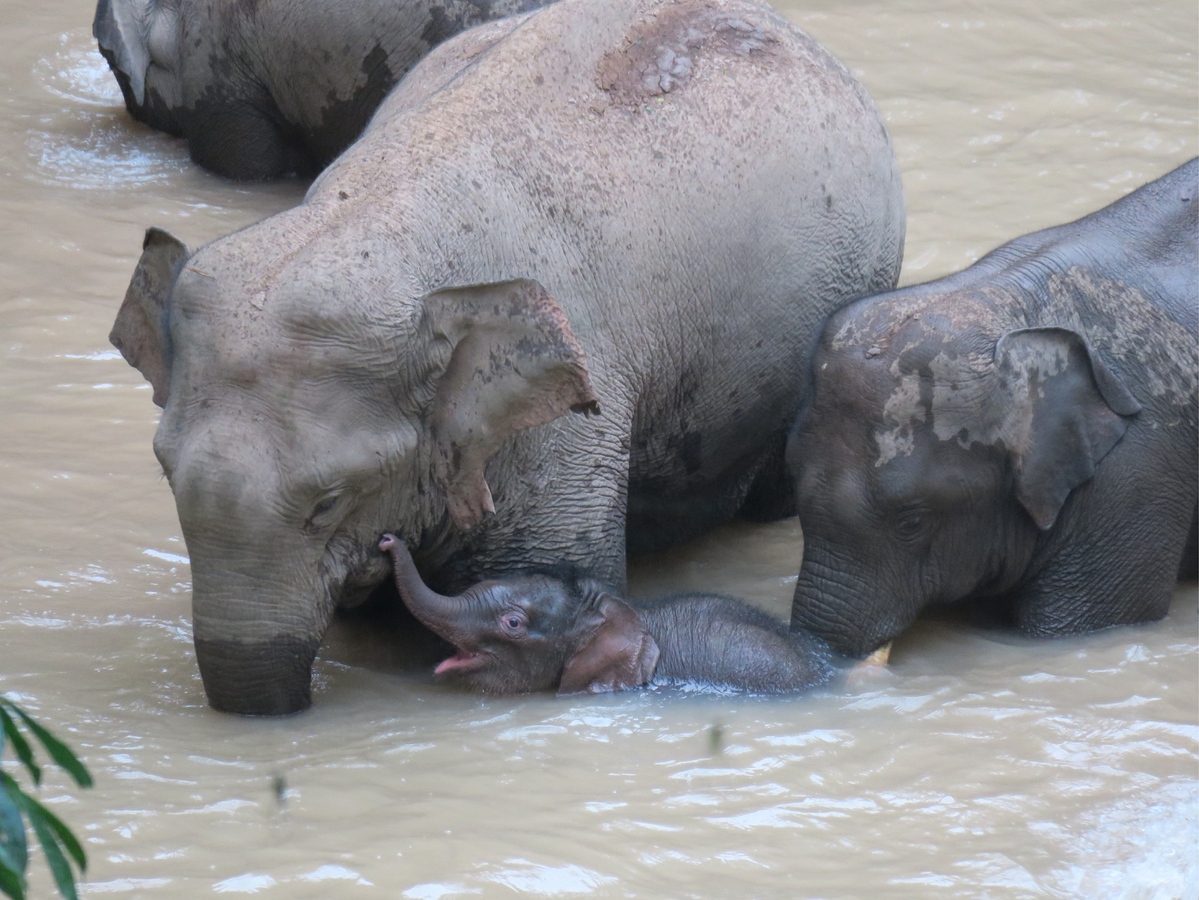
KUNMING -- It usually takes Asian elephants, one of the animals with the longest pregnancy duration, 20 to 22 months to produce a calf. However, in Yunnan province in Southwest China, nearly every elephant herd has welcomed newborns in recent years.
Asian elephants, the continent's largest land animal, are under top-level protection in China and constitute an important part of Yunnan's rainforest ecosystem.
According to the Yunnan provincial forestry and grassland bureau, the number of Asian elephants in the province increased from 293 in 2018 to about 360 by 2021.
The "baby boom" of the giant mammal demonstrates the success of China's arduous protection efforts and the country's progress in conserving ecological biodiversity, especially when the population of this species is showing a declining trend globally.
HUMAN-ELEPHANT HARMONY
"Strengthened protection and fewer human impacts are important reasons behind the high fertility rate," said Chen Mingyong, professor at the School of Ecology and Environmental Science of Yunnan University.
During these years, the province has explored multiple ways to reduce the encounters between humans and elephants and to keep the animals away from farmers' crops.
Food stores, dubbed "elephant canteens," have been established in many locations across Yunnan, providing the animals with attractive and nutritious meals. In 2022, the province's Pu'er city has set up around 467 hectares of food stores in areas where Asian elephants are found.
"The food stores have both lowered human-elephant encounters and enriched elephants' food resources," said Guo Xianming, director of the scientific research institute with the Xishuangbanna National Nature Reserve in Yunnan.
According to the investigation results provided by Chen, the Asian elephant's "food menu" has expanded from nearly 100 to 240 types, and most of them are crops such as corn, rice, and sugar cane, which are planted on a large scale and within easy reach of the elephants.
Ever since 2021, the provincial government of Yunnan has invested a total of 100 million yuan (about $14.83 million) in strengthening monitoring and early warning systems, habitat restoration, and safety precautions to improve the harmonious co-existence of humans and elephants.
In 2010, Yunnan became the first provincial-level region in China to introduce commercial insurance for damage caused by wildlife, which covered the whole province by 2014.
Wang Chuan, a villager in Pu'er, witnessed growth in elephant numbers and indicated that they are now more frequently spotted in his village than before.
"Of course it's annoying to see our crops destroyed by the elephants, but villagers always put up with those naughty animals instead of dispersing them by force," said Wang.
Over the years, the compensation level for elephant-caused damages has been rising. During the 13th Five-Year Plan period (2016-2020), some 297 million yuan was paid in the province to cover the losses caused by wildlife, mainly Asian elephants.
Major infrastructure development in the region also intentionally heeded the activities of the Asian elephant.
In the construction of the China-Laos Railway, routes were redesigned to avoid the habitats of elephants and some parts of the railway were built into bridges and tunnels to provide passage for the migratory giants.
CONSERVATION EFFORTS
Elephant inspectors play an important role in the detection of the baby boom. Diao Faxing, 47, has been working as one of the ten local inspectors for six years in Jiangcheng Hani and Yi autonomous county of Pu'er.
"The number of elephants multiplied in recent years," said Diao. "There are a total of 43 wild elephants in Jiangcheng, and four calves were born this year."
During an inspection tour at the end of July, Diao noticed a female elephant left behind by the herd and stopped eating.
Diao and his colleagues reported the incident immediately and were relieved when seeing the elephant recover and catch up with the rest of the herd.
"It may be stressful to have more elephants to care for, but every newborn is a sign of achievement of our protection," said Diao. "They are like new family members and I named all of them."
As the frequent visit of elephants in the county requires inspectors to synchronize their daily schedule with elephant movements, they have to get up at five in the morning and work till midnight.
Apart from the efforts of inspectors, scientific researchers also carry out various studies, including the analysis of the suitability of elephant habitats and conservation of biological diversity, to enhance the knowledge and protection of Asian elephants.
Bao Mingwei, an elephant doctor at the Asian Elephant Breeding and Rescue Center in Xishuangbanna, and his research team, have successfully bred nine calves by studying the method of human-assisted breeding, which has aided the population increase of Asian elephants in China.
"The elephant rescue and protection efforts helped population increase and the baby boom happened as there are more female elephants at childbearing age," said Guo.
Also on the agenda is the establishment of a national park for Asian elephants. National and local authorities will coordinate efforts in the integration and optimization of the existing habitat range and build a unified protection and management system.
"Based on the established mechanism of Asian elephant conservation, the national park will be critical for conserving tropical rainforests and long-term conservation of nature and ecology," said Chen Fei, director of the Asian elephant research center under the National Forestry and Grassland Administration.
"We will work to guarantee the balance among the expansion of elephant population, human safety, and property in the park," he added.




- Yangtze finless porpoise population increases in China
- Trains undergo inspections ahead of Spring Festival travel rush
- China to foster new quality productive forces in water conservancy sector
- China sees 66.86 billion cross-regional trips in 2025
- China braces for four cold waves in February
- Scientists design flexible patch for precision drug delivery to complex organs