Losers to different degrees









Protectionism is no defense against the global volatility stoked by the pandemic and national insecurities
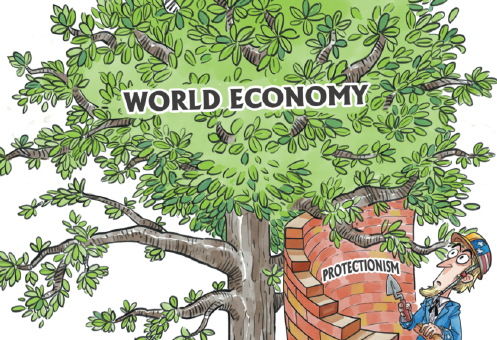
Over the past 70-plus years since the end of World War II, the pole-positioning in global wealth creation has become the chief decider of global domination rather than mere growth. The rising cases of conflicts and subversion of trade practices only mark a new phase in the global lurch toward protectionism. There seems to be a blind urge to repeat the mistakes of the 1930s when protectionism led to economic disaster.
The damage being inflicted by protectionism on the global trading system must be measured not against the cases and instances but cumulatively. This has caused enough drag to slow the growth of the global economies and adversely impacted the prospects of developing economies, hitting the poorest countries the hardest.
Protectionism can take many forms, not all of them evidently so. Exclusion from market competition does not fit the usual definition of protectionism, but that seems to be the rising fact. At the same time, the conventional protectionism of the tariffs and quotas has re-emerged in recent years. Such practices have also crept back in other guises beyond the usual definitions of protectionism to avoid violating World Trade Organization rules.
The WTO concentrates on measures designed to keep out imports. Global Trade Alert defines protectionism more broadly as anything that hurts another country's commercial interests, but data make it clear that countries have found ways other than traditional protectionism to help their domestic industries, keep out imports and boost exports, often under the guise of industrial policy. And a few countries have perfected the art of covert protectionism.
The unilateral policies pursued by a few countries have turned out to be a factor contributing to the conditions of inflation and recession, coupled with labor redundancies and reduced market access. The protectionist measures often appear contradictory as they are being administered while promoting open and free trade principles. In other words, the apparent protectionism is a symptom of prevailing political beliefs rather than a cure to the problem. A failure to appreciate the proper lines of causation has led to pressure for a new protectionist measure to eliminate imports from certain countries. While developing countries are often the target of these protectionist measures, particularly those countries exporting semi-processed and processed products, there is little evidence concerning the actual market disruption due to their exports. This lack of empirical evidence is surprising in view of the potential importance of trade expansion given the overall industrialization programs pursued by developing countries. Specifically, many economists have strongly advocated development policies geared to export expansion rather than import substitution. As such, it seems incongruous to find that export markets are being artificially closed now that developing countries have begun to reap the benefits of these outward-oriented growth strategies.
One must not forget that trade barriers cause productivity and potential output to decline. The GTA database provides revealing details. The growing tide of protectionism in recent years has pushed many developing economies to the brink of collapse. It is not a secret that the two major rising economies of Asia, namely India and China, face the most significant number of protectionist interventions. The unprecedented global imbalances have the strongest correlations with the increasing trend of protectionism in Asia. For example, India has been undergoing an economic transformation over the past few decades. Since 2014 with the exception of 2017, India's economy has been one of the world's fastest-growing major economies. The rising global protectionist tendencies have caused a sharp decline in India's manufacturing export share and a steep rise in imports. The hollowing out of manufacturing and agricultural exports suggests how some of these industries lose their position in the global chains of production, supplies and values. This is antithetical to the idea of globalization.
In a time of global crisis stoked by pandemics and rising insecurities among nations across the world, what is most important is an orderly rebalancing to be achieved without severely disrupting international trade and finance or global growth. In the post-pandemic scenario, trade and commerce must overcome stagnation. Protectionism is not the correct answer to these challenges. Not only on the global scale but within Asia, countries need to rely on access to a stable global market.
Shorter cycles of production and chains of supplies must be comprehended without a thumb rule of denials and exclusions. Lean supply chains and efficient lines of production facilities will bring stability and rescue from global volatilities. Protectionism will not solve the distributional consequences of globalization while it is sure to reduce aggregate global living standards. There are no winners in trade wars, just different degrees of losers.
The author is a senior fellow of HSBC Business School at Peking University. The author contributed this article to China Watch, a think tank powered by China Daily. The views do not necessarily reflect those of China Daily.
Contact the editor at editor@chinawatch.cn.